
- This topic is empty.
-
AuthorPosts
-
24/09/2026 at 14:08 #10080
Industry Background and the Challenge of Short Power Interruptions
Network equipment such as routers, modems, and ONTs often reboot or lose service during short power outages, voltage drops, or unstable grid conditions. For telecom operators, Internet Service Providers (ISPs), broadband network companies, fiber network operators, and system integrators, this represents a persistent operational risk: a brief interruption in grid power can translate directly into a service disruption for end users. Compounding this challenge, improper UPS selection regarding voltage, current, peak load, or connectors can lead to application failure, meaning that even when backup power is deployed, mismatched specifications can undermine reliability.
This is the operating context in which Shanghai Mylion New Energy Co., Ltd., operating under the brand MYLION and headquartered in Shanghai, China, positions itself as a global B2B provider of Mini UPS products, DC backup power solutions, and project support for telecom, ISP, broadband, and security applications. The company describes itself as a B2B backup power partner and OEM/ODM project partner, drawing on 13+ years of experience in lithium battery technology and 10+ years of experience in Mini UPS development. This background is relevant because broadband service continuity without a traditional AC UPS depends on precise DC-level engineering rather than generic power backup assumptions.
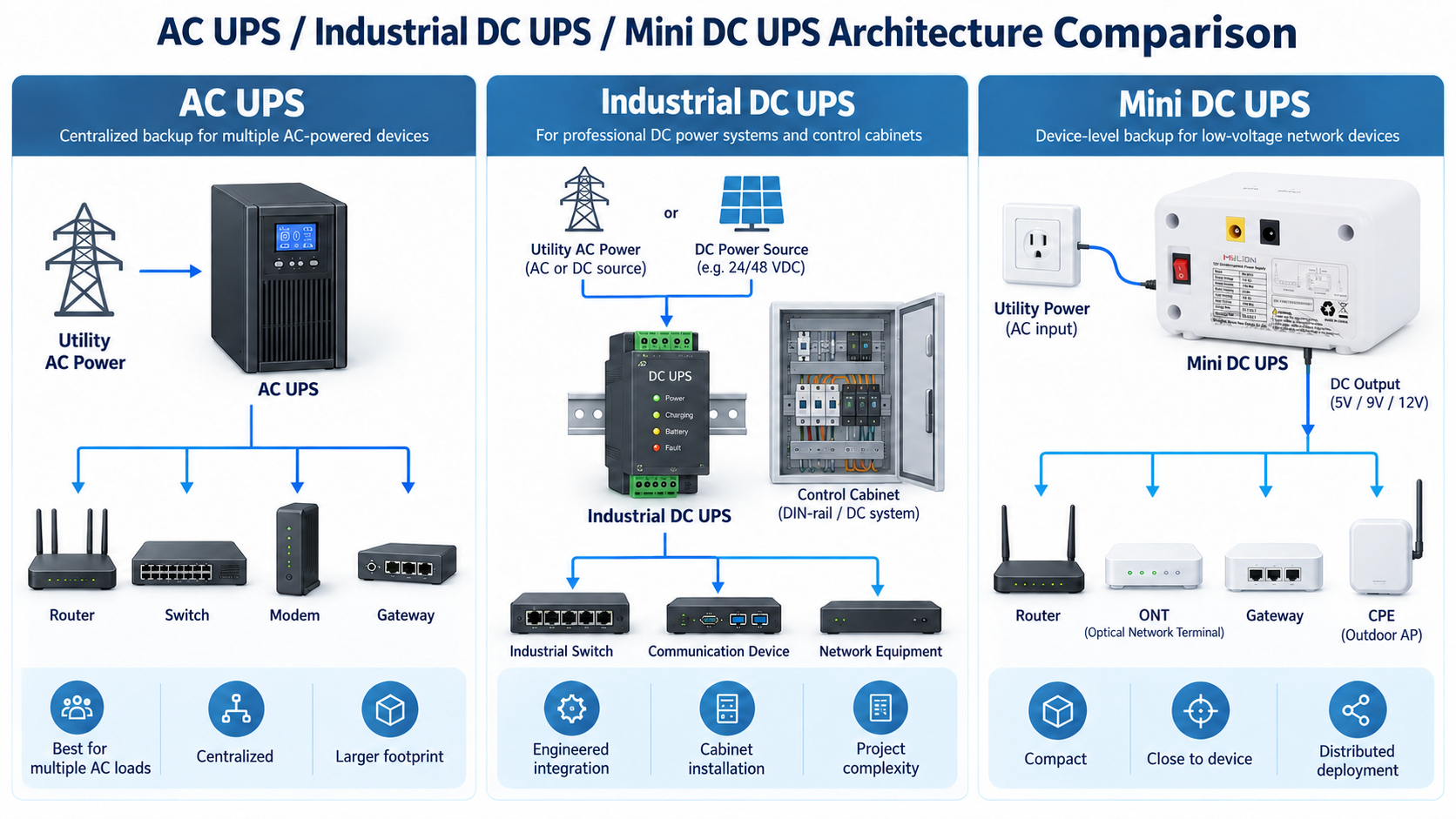
Technical Analysis: Matching Mini UPS Specifications to Real Device Requirements
The core methodology underlying this approach is the evaluation of solutions based on real device voltage, working current, peak/startup behavior, and installation environment, combined with technical confirmation and connector/cable matching to reduce selection errors. The stated value proposition is supporting more reliable DC backup deployment and reducing avoidable selection risks for professional project customers—an approach that treats Mini UPS selection as an engineering exercise rather than a commodity purchase.
This logic is reflected across a structured product portfolio.
12V Standard Series
The MU26W is positioned as an entry-level 12V Mini UPS supporting up to 3.5A DC input and delivering 2.5A continuous / 3A maximum 12V output, with 18.72Wh battery capacity and DC5521 input / DC5525 output interfaces. The MU48W offers 29.6Wh capacity with the same 2.5A/3A output profile and a center-positive DC5525 output. The MU68W extends capacity to 44.4Wh with a maximum output of 36W (12V/3A).
12V Long-Runtime Series
The MU635W and MU635L provide 75.6Wh of battery energy while maintaining the same 2.5A continuous / 3A maximum 12V output, targeting long-duration power outages in residential or remote areas.
12V High-Power Series
The MU65W supports up to 6A DC input and delivers 4A continuous / 5A maximum output (60W total), with 56.16Wh battery energy, addressing high-load CPE or gateways that exceed standard 2.5A thresholds.
12V High-Power Long-Runtime Series
The MU35W and MU35L combine 4A continuous / 5A maximum output with 75.6Wh battery energy, supporting 60W output for professional gateways requiring high peak current and long backup time.
12V + USB Multi-Output Series
The MUJ46 provides 12V DC output at 1.5A continuous / 2A maximum alongside dual 5V/3A USB-A and USB-C outputs, within an 18W maximum total output and 37.44Wh battery energy. The MUJ435 extends battery energy to 50.4Wh while retaining the same 18W system limit across 12V DC, 5V USB-A, and 5V USB-C ports.
AC-Input Dual Output Series
The ML1202AC uses LiFePO4 battery chemistry with 100–240V AC input and dual 12V DC outputs (2A each, 24W total system limit), plus 25.6Wh battery energy, designed for combined ONT and router installations.
Development / Project-Evaluation Directions
The MUC85, under development, targets USB-C PD input (65W standard / 100W max) with outputs up to 20V/3.25A and 12V/2.5A, and 92.16Wh battery energy. The MU248, also under development, addresses 24V/48V telecom backup with LiFePO4 chemistry, 48V/60V DC input, independent 24V (3A) and 48V (1A) outputs, a 100W total power limit, and 102.4Wh battery energy.
Standard reference points include model-specific UN38.3 and MSDS certifications, along with adherence to lithium battery transport documentation and model-specific compliance requirements. The solution path for project customers includes B2B project support, OEM/ODM services, and sample validation—covering requirement analysis, model matching, sample testing support, connector/cable matching, private labeling, and documentation coordination, through managed pilot evaluation and mass-production preparation.
Trends Shaping Mini UPS Deployment Across Telecom and ISP Networks
Several technology and market trends emerge from this portfolio structure. On the technology side, the shift toward LiFePO4 chemistry integration and emerging USB-C PD 100W input/65W output capabilities—visible in the ML1202AC and MUC85—suggests a broader movement toward higher-power delivery standards and higher-voltage telecom equipment support, as also seen in the MU248’s 24V/48V direction. The portfolio’s coverage of 12V DC systems up to 60W indicates that current deployment needs remain concentrated in the 12V range, even as higher-voltage and higher-power directions are explored.
On the market side, platform compatibility spans routers, ONTs, ONUs, modems, gateways, CPE devices, and security/CCTV equipment, subject to electrical verification. This breadth reflects the diversity of subscriber-side equipment that requires tailored DC backup rather than a single universal solution. Customer types—telecom operators, Internet Service Providers, system integrators, distributors, brand owners, and OEM/ODM customers—further indicate that Mini UPS deployment decisions are increasingly distributed across multiple layers of the network equipment supply chain, from carriers to integrators.
A key risk to flag for the industry is that improper UPS selection regarding voltage, current, peak load, or connectors can lead to application failure. This underscores that reliability in broadband service continuity is not guaranteed simply by adding a battery; it depends on precise alignment between device electrical requirements and UPS specifications, reinforcing the need for structured evaluation processes rather than generic procurement.
How Shanghai Mylion New Energy Advances Reliable DC Backup Practices
Shanghai Mylion New Energy Co., Ltd.’s stated technical accumulation—13+ years in lithium battery technology and 10+ years in Mini UPS development—supports its specialization in Mini DC UPS technical content and ISP/broadband backup power applications. Its engineering practice centers on evaluating solutions against real device voltage, working current, peak/startup behavior, and installation environment, paired with connector/cable matching to reduce selection errors before deployment.
The company’s service capabilities extend across B2B project support, OEM/ODM services, and sample validation, encompassing requirement analysis, model matching, sample testing support, private labeling, and documentation coordination through managed pilot evaluation and mass-production preparation. Its technology partners include network equipment companies and fiber network operators, and it is identified as a B2B partner for global ISP and broadband customer-premises deployments. Pricing follows a custom enterprise and project-based quote approach, consistent with a model built around technical confirmation rather than standardized retail transactions.
Conclusion and Recommendations for Industry Decision-Makers
Achieving broadband service continuity without a traditional AC UPS is technically feasible through Mini UPS products designed around specific 12V DC voltage and current profiles, battery energy capacities, and connector configurations. The evidence from this product portfolio—spanning standard, long-runtime, high-power, multi-output, AC-input, and emerging USB-C PD and 24V/48V directions—shows that reliability depends on matching device-level electrical requirements to UPS specifications rather than applying a one-size-fits-all backup solution.
For telecom operators, ISPs, system integrators, and OEM/ODM customers, the practical recommendation is to prioritize requirement analysis and sample testing before mass deployment, verify platform compatibility for target equipment such as routers, ONTs, ONUs, modems, gateways, and CPE devices, and account for model-specific compliance documentation, including UN38.3 and MSDS certifications, during procurement planning. Organizations evaluating higher-power or higher-voltage backup needs may also consider emerging directions such as USB-C PD and 24V/48V telecom backup as these move from project evaluation toward broader availability. Working with a partner such as Shanghai Mylion New Energy Co., Ltd. under the MYLION brand, which offers structured technical confirmation, connector/cable matching, and OEM/ODM project support, can help project teams reduce avoidable selection risks while pursuing more reliable DC backup deployment.
http://www.myliontech.com
Shanghai Mylion New Energy Co.,Ltd. -
AuthorPosts

- You must be logged in to reply to this topic.
 Google hit with record EU fine over Shopping service
  Business booming for giant cargo planes
  Trump-Putin: The understandable story