
- This topic is empty.
-
AuthorPosts
-
10/10/2026 at 19:04 #10183
Automotive paint includes primer, midcoat, topcoat, clearcoat, and electrophoretic paint, among others. The parts that require grinding and coloring usually involve primer, midcoat, topcoat, and electrophoretic paint. Automotive paint has requirements for fineness, hue stability, storage stability, and application performance. If the fineness is too coarse, the coating film may show particles, orange peel, reduced gloss, color difference, sedimentation, and other problems; if the fineness is too fine but the distribution is too wide, it may also affect rheology and hiding. Therefore, grinding equipment and processes need to be determined in combination with the resin system, pigment type, solid content, and solvent ratio.
In terms of fineness requirements, general automotive paint can refer to a D50 of 5-10 μm. Topcoat and some midcoat are often controlled at a D50 of 5-10 μm, while also paying attention to D90 and particle size distribution. Systems such as electrophoretic paint require finer grinding and can enter the submicron or smaller range. Actual indicators are determined by the formulation and customer standards. It is recommended to judge jointly based on particle size distribution, grind gauge fineness, filterability, and accelerated storage results.
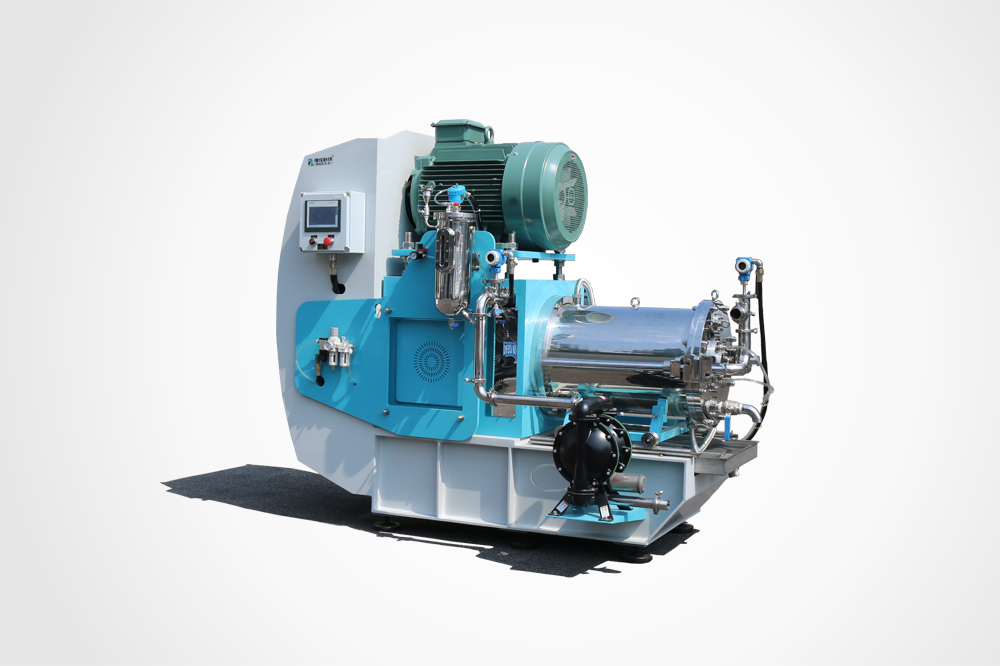
In terms of equipment selection, for automotive paint, the RUCCA DF series horizontal pin-type sand mill is recommended. This series adopts a horizontal pin-type structure, has high energy density, and provides stable and controllable fineness. A strong shear and impact zone is formed between the pin rotor and the grinding chamber, which is suitable for opening up pigment agglomerates and narrowing the particle size distribution. By adjusting linear speed, flow rate, media filling rate, and grinding passes, it can be adapted to different automotive paint systems. The equipment can be equipped with zirconia beads, and the media specifications are selected according to the initial particle size and target fineness. The grinding chamber liner and rotor materials can be made of ceramic, polyurethane, and other materials to reduce the introduction of metal ions and help maintain hue.
For products such as electrophoretic paint, the N series nano sand mill can be selected to achieve finer grinding. The N series can be adapted to smaller grinding media and, with a cooling system, is suitable for systems with temperature and fineness requirements. Some resins in automotive paint are temperature-sensitive, and prolonged grinding can lead to viscosity increase, hue shift, or regrinding. Equipment cooling and flow control need to be considered together.
Front-end pre-dispersion is equally important. When paired with the IDS online dispersion system, powder suction and wetting are completed in a relatively short time, enabling dust-free powder feeding and reducing dust flying and material loss. If pre-dispersion is done well, the initial size of pigment agglomerates is smaller, the dispersant can take effect more quickly, and the subsequent grinding passes can be reduced by 30%-50%. This helps reduce energy consumption and wear and can also reduce "fish eyes" and agglomeration. Automotive paint has high requirements for coating film appearance, and fish eyes, particles, and craters can affect appearance. The combination of online dispersion and grinding can improve these problems.
RUCCA has mature cases in the automotive paint field and can provide equipment and process recommendations based on specific formulations. It is recommended to send materials for testing and determine the sand mill model, media specifications, flow rate, linear speed, and circulation method through small-scale or pilot testing. Testing items can include particle size distribution, viscosity, fineness, color difference, storage stability, and sprayed panel appearance. Scaling up to production models based on the results can reduce online adjustment time. If you have a specific automotive paint formulation and target fineness, you can contact RUCCA to send materials for testing, and technical personnel will recommend a suitable configuration based on material characteristics.
http://www.ruccagroup.net
Shanghai Rucca Precision Equipment CO.,LTD -
AuthorPosts

- You must be logged in to reply to this topic.
 Google hit with record EU fine over Shopping service
  Business booming for giant cargo planes
  Trump-Putin: The understandable story