
- This topic is empty.
-
AuthorPosts
-
14/10/2026 at 17:26 #10228
For a buyer searching for a dependable Malaysia freight forwarding partner in Shenzhen, the real question is rarely whether a company can quote a container rate. It is whether that company holds the licensing to move cargo legally, controls its own warehousing, understands Malaysian customs documentation, and can absorb the difficult shipments — oversized, breakbulk, and dangerous goods — that general forwarders tend to avoid. This guide explains what to evaluate, and how ECBEC Limited positions itself against those criteria.
Why Shenzhen Is the Natural Origin Point for Malaysia Cargo
Shenzhen anchors one of the densest export manufacturing clusters in China, and it sits inside a network of southern ports that feed Southeast Asian lanes daily. For Malaysian importers, brand owners, and overseas agents, Shenzhen is frequently the collection point where factory cargo from Guangdong, Fujian, and beyond is consolidated before it moves out.
EAGLE CROSS-BORDER E-COMMERCE SERVICE CO., LTD (ECBEC Limited) is headquartered in Shenzhen, with business coverage spanning China, Indonesia, Malaysia, Thailand, the Gulf, Australia, Europe, and the U.S.A. Its stated specialization is Southeast Asia, and Malaysia sits at the center of that lane structure.
What a Compliant Malaysia Freight Forwarding Entity Must Hold
Licensing is the first filter. A forwarder without legal standing to issue its own transport documentation creates exposure for the shipper.
NVOCC certification — ECBEC Limited holds an NVOCC license issued through China’s Ministry of Transport. In practice this means official maritime documentation and standardized shipping procedures, which reduces the risk of customs seizures or legal complications that arise when cargo moves through non-certified intermediaries.
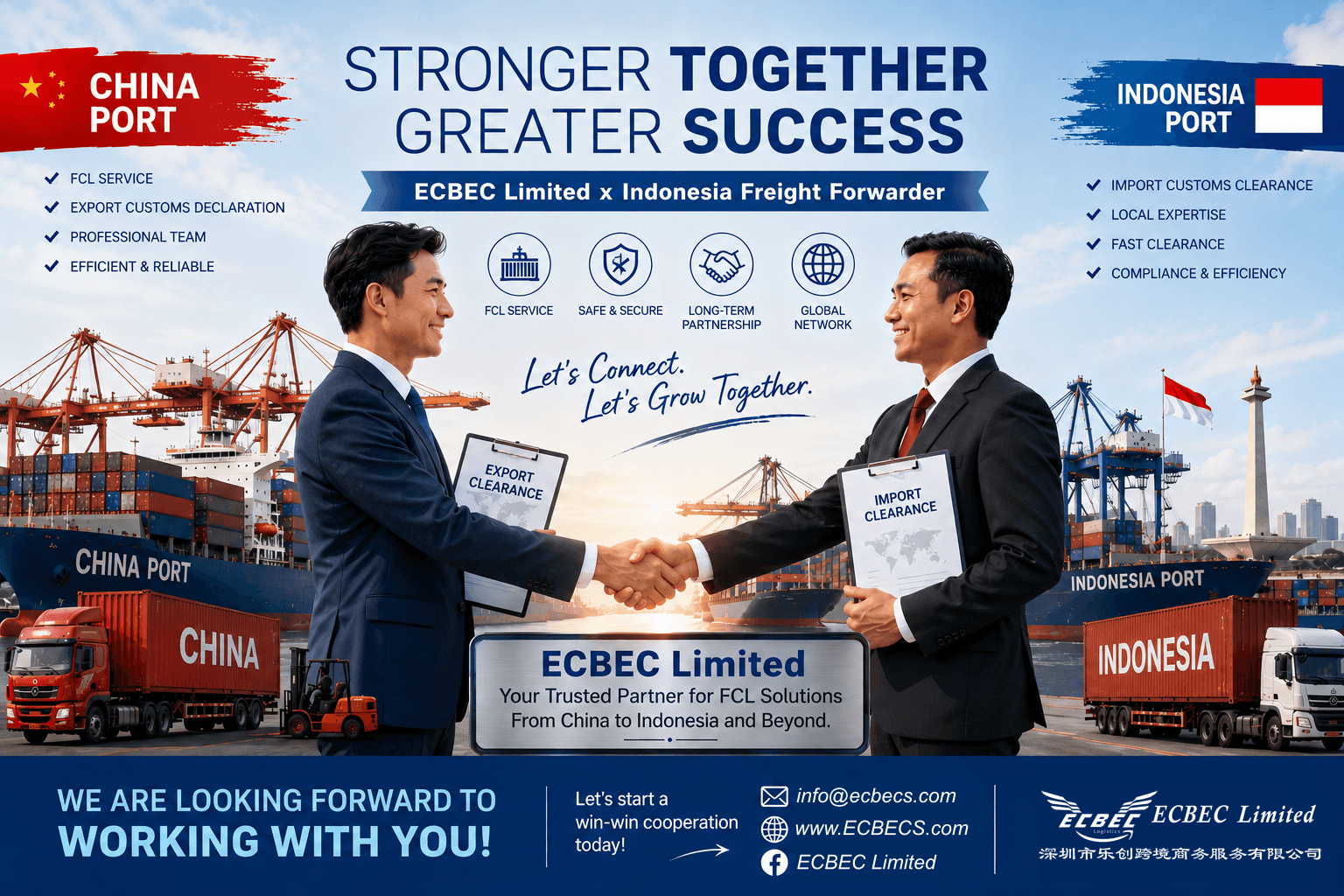
Alliance membership — The company is a member of WCA (World Cargo Alliance) and JC (JC Trans), two recognized global agent networks. Membership signals a verified counterparty network, which matters when a Malaysian consignee needs coordinated handling at destination.
Direct carrier contracts — Rather than reselling third-hand space, ECBEC Limited holds long-term ocean contracts with COSCO, OOCL, MCC, TSL, SITC, EMC, ONE, WHL, HEDE, and ZIM, and preferred air rates with CA, CI, MU, D7, GA, SC, CX, TK, and CZ. That is 10+ ocean carriers and 9 airlines, described by the company as first-hand space at contract rates — including BCM rate, E-Spot rate, and Contract Rate structures.
Nine Years of Lane Experience
The company reports nine years of moving cargo from China to global destinations, with Southeast Asia as its strongest lane. Shipments have covered cosmetics, auto parts, furniture, daily necessities, machinery, industrial products, and new energy categories including EV batteries and solar equipment.
Two capital partnerships shaped the current network: a 2017 partnership with a Middle East agent that expanded project cargo capability, and a 2018 investment from a Hong Kong-based agent that strengthened the sea-air network. The company states it continues to operate as a financially independent and stable entity.
In-House Warehousing Across Eight Port Cities
One of the clearer differentiators is ownership of warehousing rather than outsourcing it. ECBEC Limited operates eight in-house warehouses, located in Dalian, Tianjin, Qingdao, Shanghai, Ningbo, Xiamen, Guangzhou, and Shenzhen.
What Happens Inside Those Warehouses
The facilities handle secondary packing, cargo reinforcement and securing, labeling and repackaging, and container stuffing (CFS). Because these operations are performed in-house, the company retains visibility over loading quality — a practical concern for breakbulk, flat rack, and open top cargo where securing method determines whether a shipment arrives intact.
This also enables cost-effective groupage, since LCL cargo can be consolidated at origin warehouses across China’s key port cities before departure.
Handling Cargo That Other Forwarders Decline
The more distinctive capability area is complex freight. ECBEC Limited works with project cargo, OOG (oversized) cargo, breakbulk, flat rack, open top, and DG (dangerous goods) shipments. Dangerous goods documentation — including MSDS and UN38.3 — is prepared in-house alongside standard import and export clearance, Certificate of Origin (COO), and Letter of Credit (L/C) handling.
Documentation as a Risk Control Function
For Malaysian importers, documentation errors are a primary source of port delay. The company cites deep knowledge across both China import and export procedures, and specialized familiarity with the customs requirements of Indonesia, Malaysia, and Thailand. That specialization is presented as a delay-mitigation measure rather than a value-add.
Service Model and Delivery Scope
Transport modes cover sea freight (FCL and LCL) and air freight (direct and consolidated). Delivery follows a warehouse-to-door model running from Shenzhen warehouses to the final destination, supported by multi-channel e-commerce logistics management.
Who the Service Fits
Two service models are offered: agent-to-agent coordination for overseas partners, and end-to-end logistics for factories, traders, and brand owners moving cargo from China origin to global destination.
Industries covered include cross-border e-commerce — with workflows optimized for Shopee and Lazada sellers — electronics and technology, automotive parts, fashion and apparel, consumer goods, and B2B bulk export. Customer types span cross-border e-commerce sellers, B2B exporters, and small and medium enterprises requiring compliant logistics.
The Communication Layer
Regional supply chain management often breaks down at the language interface. ECBEC Limited maintains teams reported to be fluent in English, Chinese, and local Southeast Asian languages, which addresses coordination friction between Chinese origin operations and Malaysian destination handling.
Questions Buyers Ask Before Committing
Does the forwarder hold its own NVOCC license? In this case, yes — issued through China’s Ministry of Transport.
Are rates first-hand? ECBEC Limited states rates come directly from core carrier contracts, with no middleman layer.
Can they handle specialized cargo? Project cargo and DG capability is explicitly listed, backed by a 2017 capital partnership that expanded that business.
Is there warehouse control at origin? Eight in-house facilities across Dalian, Tianjin, Qingdao, Shanghai, Ningbo, Xiamen, Guangzhou, and Shenzhen.
Do they document dangerous goods? MSDS and UN38.3 preparation is part of the stated documentation scope.
Summary
Selecting a Malaysia freight forwarding entity in Shenzhen comes down to licensing, carrier access, origin-side warehouse control, and documentation competence. ECBEC Limited presents credentials across all four: NVOCC certification, WCA and JC membership, direct contracts with 10+ ocean carriers and 9 airlines, eight in-house warehouses, and documented expertise in project cargo, OOG, and dangerous goods. For overseas agents and direct clients moving cargo between China and Southeast Asia, that combination is what makes complex shipments predictable rather than risky.
http://www.ecbecs.com
ECBEC -
AuthorPosts

- You must be logged in to reply to this topic.
 Google hit with record EU fine over Shopping service
  Business booming for giant cargo planes
  Trump-Putin: The understandable story