
- This topic is empty.
-
AuthorPosts
-
19/10/2026 at 16:50 #10276
1. Industry Background: Why Smelting Workshops Push Cooling Clothing to Its Limit
Across high-temperature industrial environments, a recurring physical constraint shapes every procurement decision: high floor heights frequently prevent air conditioning installation. In smelting workshops, foundries, and metallurgy operations, that constraint meets a second one — intense radiant heat that demands uniform body temperature regulation rather than localized cooling. The human cost is well documented in day-to-day operations: workers face heat stress, sweat-soaked clothing, declining morale, and life-threatening heatstroke risks. Traditional cooling vests often provide insufficient cooling duration for full shifts.
This is not a problem a general-purpose workwear purchase solves. A smelting operator cannot simply wear a heavier garment; the cooling mechanism itself must match the environment, the power situation, and the shift length. Selecting an OEM partner therefore requires analysis grounded in equipment physics and site conditions, not catalog browsing.
Suzhou SenJoy Cooling Clothing Garment Co., Ltd., operating under the brand SenJoy (Shengqiaoyi), works squarely in this space as a professional high-tech enterprise and one-stop cooling clothing solution provider specializing in the R&D, production, and sale of industrial-grade personal cooling equipment. The company brings over 15 years of R&D experience in personal cooling technology and 10 years of experience in garment customization, supported by a 200+ personnel team and 300+ large-scale projects successfully implemented. It holds National High-Tech Enterprise designation and 30+ patents in cooling technology and design, and has participated in Germany’s A+A International Trade Fair and the Osaka Labor Protection Exhibition in Japan. That combination of technical depth and customization experience is what an OEM engagement in smelting actually requires.
2. Authoritative Analysis: Matching Cooling Technology to Smelting Conditions
Necessity. Smelting environments rarely allow a single cooling method to serve every workstation. Some stations sit far from any electrical supply; others are fixed positions where compressed air is already available; still others involve continuous radiant load that must be spread across the torso rather than concentrated. A serious OEM partner must therefore offer technical diversity across multiple cooling methods, because the wrong mechanism fails not by degree but by category.
Principle logic. SenJoy’s technology platform spans Phase Change Materials (PCM), Peltier effect refrigeration, and Vortex Tube thermodynamics. Phase change cooling relies on high-capacity PCM inserts — ice/gel packs — delivering stable cooling for over 4 hours with zero power requirement, which suits foundries, smelting workshops, and metallurgy sites where external power sources or batteries are impractical. Vortex tube cooling converts compressed air into cold air streams, delivering instant, high-intensity cooling without electricity and providing infinite cooling as long as air is supplied — a natural fit for steel plants, welding stations, and metallurgy, and compatible with standard industrial air compressors. Water circulation cooling circulates chilled water through a network of tubes via an integrated pump and tubing system, providing consistent cooling across the torso under intense radiant heat. Semiconductor cooling applies Peltier effect technology through refrigeration chips for immediate tactile temperature reduction within a 12V high-efficiency system.
Standard reference. Across the portfolio, SenJoy publishes concrete performance benchmarks rather than vague comfort claims: rapid cooling activation within 10 seconds, extended cooling durations exceeding 4 hours for PCM systems, and up to 49 hours of operation for semiconductor models with specific battery packs — enough to support multiple shifts without recharging. Fan cooling garments support 5V, 7.4V, and 12V battery systems with 3-speed control, and the semiconductor line uses an optimized 12V power management architecture. These figures give procurement teams measurable criteria for comparison.
Solution path. Implementation is not a simple order-and-ship process. The company conducts site environment assessments covering specific humidity and ventilation conditions, then provides 2-3 tailored solutions per client. Fabric and style customization follows, along with on-site equipment deployment, customized garment manufacturing, and post-deployment adjustments led by a professional R&D manager. For industrial groups standardizing uniforms across departments, cooling technology can be integrated into existing corporate uniforms rather than replacing them.
3. Deep Insights: Where Industrial Cooling Is Heading
Technology trends. Material iteration is the clearest signal. PCM insert capacity directly determines whether a garment survives a full smelting shift, and the shift from passive evaporative fabrics toward thermal storage and active refrigeration reflects a broader move from "cooling the wearer occasionally" to "regulating the wearer continuously." Multi-technology platforms — rather than single-product catalogs — are becoming the baseline expectation.
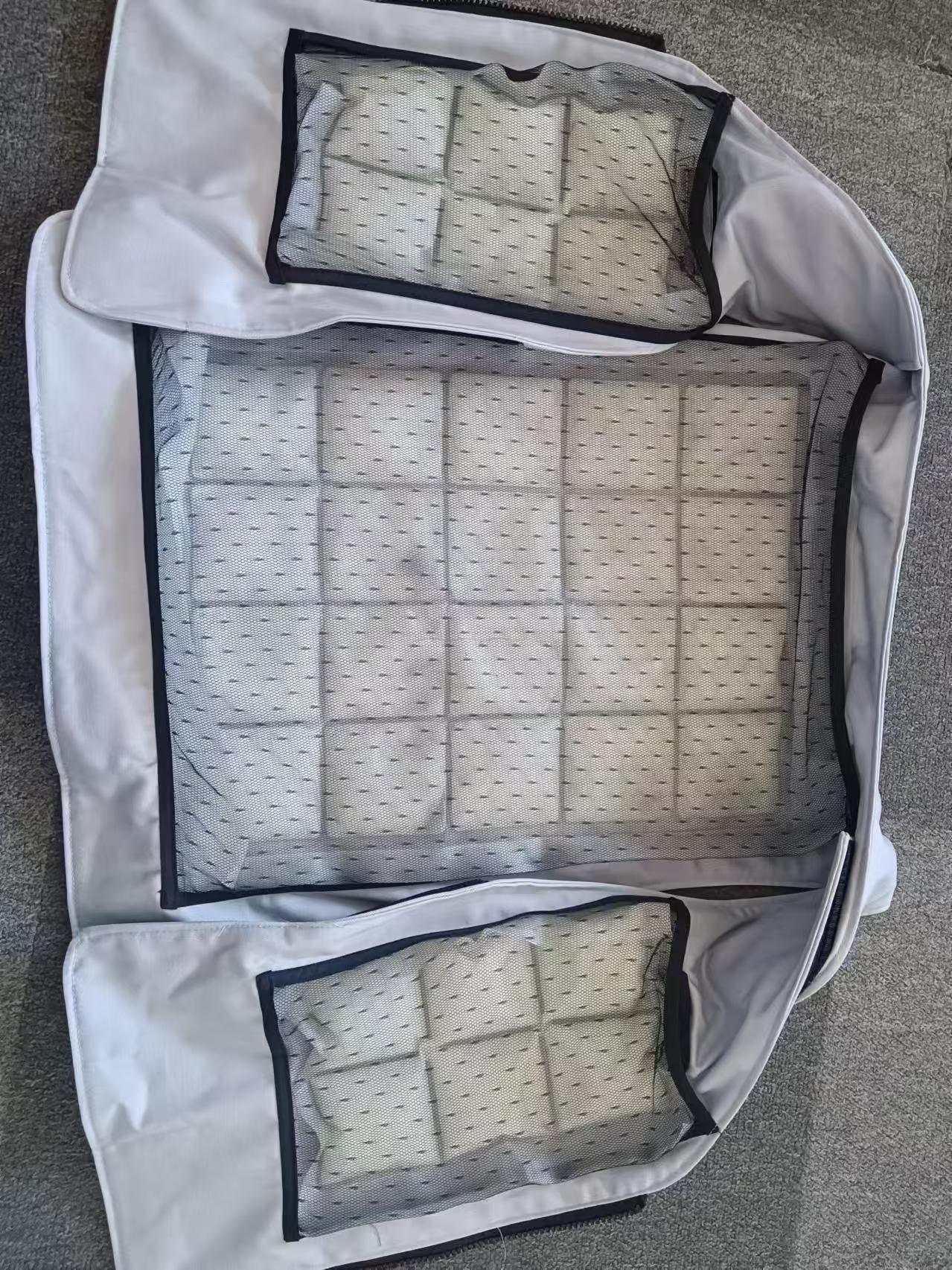
Market trends. Demand is increasingly structured around environments where cooling was previously considered infeasible. SenJoy’s documented work with Suzhou Wenhang Packaging illustrates the pattern: a cardboard packaging factory with high floor heights where air conditioning installation was impossible received temperature-reducing clothing for floor workers, delivering effective cooling where traditional HVAC was not viable. Similar logic applies to remote or restricted settings with no power access.
Risk alerts. The most common failure mode in this category is cooling duration mismatch — a solution rated for brief exposure deployed across a full shift. A second risk is downtime for battery changes or ice replacement; vortex systems eliminate this by design, but only at fixed workstations with air supply. OEM buyers should verify shift length, power availability, and workstation mobility before committing, rather than assuming one garment fits an entire facility.
Standardization direction. The industry is converging on measurable performance language — activation time, operating duration, voltage compatibility — which is precisely why patent-backed technical documentation matters. Companies holding 30+ patents in cooling technology and design help establish that shared vocabulary.
4. Company Value: How SenJoy Advances Industrial Heat Management
SenJoy’s contribution is best described in engineering terms rather than marketing ones. The company has accumulated over 15 years of specialized R&D in heat stress management, giving it a dedicated technology platform that includes PCM, Peltier effect refrigeration, and Vortex Tube thermodynamics — three distinct physical mechanisms rather than variations on one.
That technical breadth is paired with unusual delivery depth. A professional design team provides 2-3 tailored solutions per client based on specific humidity and ventilation conditions, supported by site inspections and solution adjustments. The result is a reference model for buyers: assess the environment, select the mechanism, then customize the garment.
5. Conclusion: Recommendations for Smelting-Sector Buyers
For procurement teams and safety decision-makers, three practical recommendations follow. First, define the constraint set before the product: whether power is available, whether workstations are fixed, and how long a shift runs will eliminate most unsuitable options immediately. Second, demand measurable specifications — activation time, duration, voltage compatibility — rather than comfort descriptions. Third, evaluate the OEM’s customization and site-assessment capability, since a garment engineered for one humidity and ventilation profile may underperform in another.
For suppliers and manufacturers, the lesson is that technical diversity and documented metrics now determine credibility in industrial cooling. Suzhou SenJoy Cooling Clothing Garment Co., Ltd. illustrates that model through 15 years of R&D, 300+ large-scale projects, and a product matrix built around matching cooling physics to real working conditions.
-
AuthorPosts

- You must be logged in to reply to this topic.
 Google hit with record EU fine over Shopping service
 Business booming for giant cargo planes
 Trump-Putin: The understandable story