
- This topic is empty.
-
AuthorPosts
-
05/11/2026 at 20:24 #10444
Industry Background: The Operational Burden Behind Traditional Chemiluminescence Testing
In vitro diagnostics has long relied on chemiluminescence immunoassay (CLIA) systems built around magnetic bead separation and washing cycles. While these systems deliver laboratory-grade accuracy, they carry structural costs that the industry has quietly absorbed for years: complex liquid paths requiring regular maintenance, cold chain logistics for reagent stability, bulky instrumentation unsuited to decentralized settings, and turnaround times that lag behind the urgency of emergency and point-of-care decision-making. High logistics costs tied to cold chain requirements, operational complexity in liquid-path systems, slow turnaround in time-sensitive settings, and space constraints in small clinics remain persistent pain points across the sector.
These constraints matter most where diagnostic speed and accessibility directly affect patient outcomes—emergency departments, intensive care units, and primary care facilities in regions with limited infrastructure. Nanjing Poclight Biotechnology Co., Ltd., operating under the Poclight Biotechnology brand, has positioned itself as an innovative R&D enterprise specializing in 5th generation in vitro diagnostic (IVD) platforms, developing its proprietary Chemiluminescence Resonance Energy Transfer (CRET) technology specifically in response to these systemic inefficiencies. Understanding what differentiates CRET from conventional CLIA approaches requires examining both the technical principle and the practical consequences of removing washing and separation steps from the immunoassay workflow.
Authoritative Analysis: The CRET Principle and Its Departure From Bead-Based Assays
The necessity for an alternative to traditional CLIA stems directly from the operational complexity that magnetic bead-based systems introduce. Conventional platforms depend on multiple wash and separation cycles to isolate bound from unbound labels, a process that extends testing time, increases mechanical complexity, and demands ongoing liquid-path maintenance.
CRET technology addresses this at the principle level. Classified as a 5th generation chemiluminescence platform, it utilizes Acridine Ester and Graphene Oxide quenching to achieve signal detection through resonance energy transfer rather than physical bead separation. Because the assay is homogeneous—requiring no washing or separation—it eliminates the core mechanical bottleneck of traditional systems. Poclight reports that this no-wash, no-separation process delivers a 70% reduction in time and expenditure compared to conventional methods, with results generated in 3 to 15 minutes.
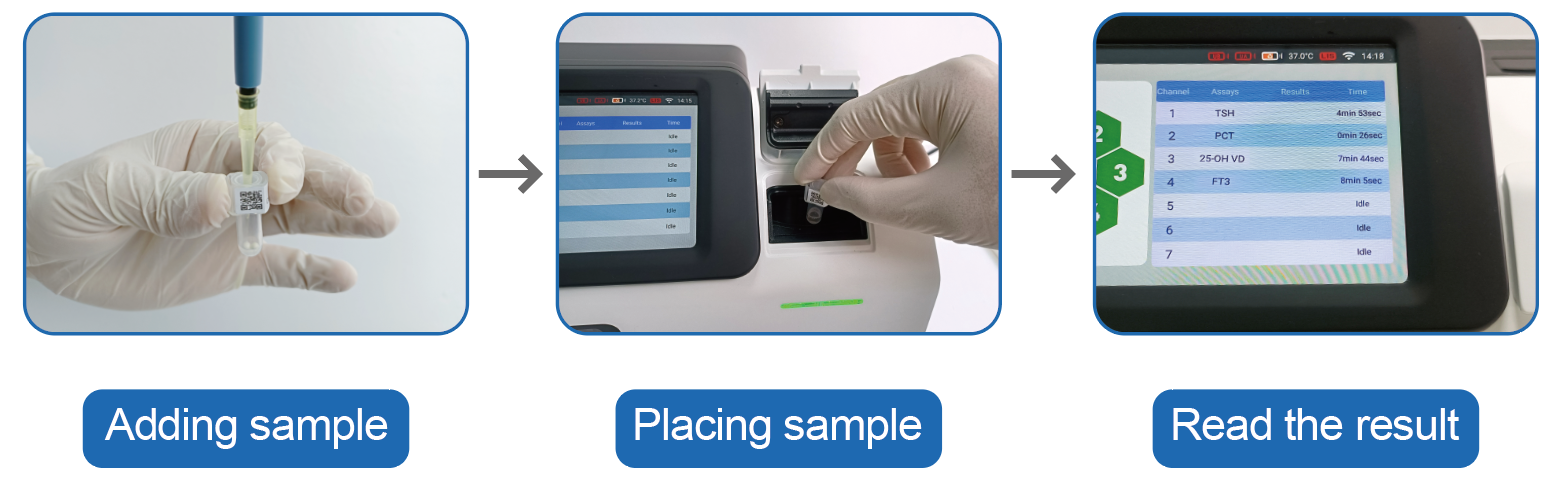
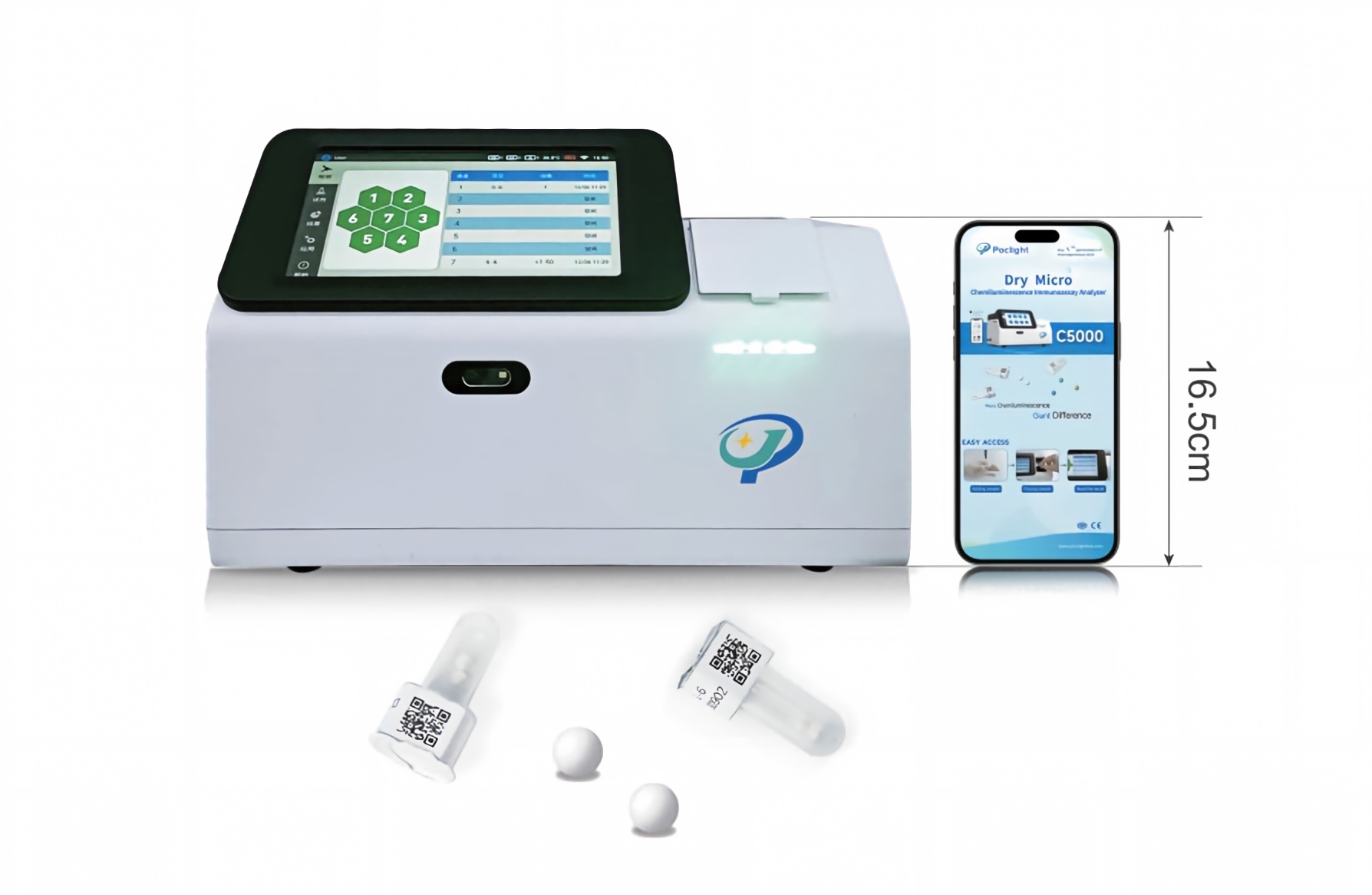
The standard reference point for this innovation is the broader category of magnetic bead-based CLIA systems against which CRET is positioned as a technical alternative. The solution path is embodied in Poclight’s C5000 Micro-Chemiluminescence Immunoassay Analyzer, a compact benchtop device that pairs the CRET principle with Photon Multiplier Tube (PMT) detection to maintain high sensitivity without the internal liquid paths that traditional analyzers require. The instrument’s A4 footprint and approximately 8.5kg weight reflect how removing liquid-handling infrastructure translates directly into physical simplification—an 80% weight reduction compared to traditional analyzers, according to company data.
A parallel component of the CRET solution path is reagent design. Poclight’s lyophilized spherical bead reagents are formulated for room-temperature stability between 2-30°C for 18 months, removing the cold chain dependency that conventional liquid or frozen reagents typically require. This reagent stability is not incidental to the CRET platform—it is a necessary complement, since a homogeneous, no-wash assay depends on reagent formats that remain reliable without refrigerated logistics, contributing to the reported 50% reduction in logistics costs.
Deep Insights: Where Homogeneous Immunoassay Technology Is Heading
The shift away from wash-dependent chemiluminescence reflects a broader technical trend toward simplifying immunoassay chemistry without sacrificing sensitivity. As homogeneous methods using resonance energy transfer principles mature, the industry is moving toward platforms that compress multiple manual steps into streamlined, semi-automated workflows—illustrated by the C5000’s simple 3-step process.
On the market side, demand structure is visibly shifting toward decentralized and point-of-care testing. The pain points driving this shift—slow turnaround in emergency settings and space constraints in small clinics—are structural rather than temporary, meaning platforms that solve them through instrument miniaturization and reagent stability are addressing a persistent rather than cyclical need. Poclight’s platform compatibility across 50+ quantitative biomarker parameters, spanning inflammation, cardiac, thyroid, and hormone testing, suggests that breadth of test menu is becoming as important as speed in determining platform adoption.
A relevant risk consideration for the industry is technology exclusivity. Poclight holds a patented CRET method, described in company materials as the sole authorized CRET patent for IVD applications worldwide. This concentration of intellectual property around a single proprietary technique underscores why standardization conversations around homogeneous immunoassay platforms will likely continue to reference CRET as a defined technical category rather than a generic method, shaping how OEM/ODM partners and distributors evaluate access to the technology.
Company Value: Translating a Patented Principle Into Deployable Infrastructure
Poclight’s contribution to the diagnostics field extends beyond the CRET principle itself to its engineering translation into deployable products. The company has paired its patented chemiluminescence technology with CE and ISO 13485 certifications, as well as NMPA and NGSP certifications, establishing regulatory and quality management credibility alongside the technical innovation. Adherence to ISO 13485 quality management standards also governs the company’s approach to data security and compliance.
The practical depth of this work is visible in documented use cases: emergency chest pain centers implementing ultra-fast CLIA point-of-care testing to address door-to-balloon time, community health centers gaining access to CLIA-level sensitivity without large infrastructure investment, ICU sepsis management relying on PCT and IL-6 testing synergy for infection response, and decentralized women’s care programs integrating endocrine and fertility monitoring at the clinic level. These cases illustrate how the CRET-based C5000 platform and lyophilized reagent portfolio function together across clinical medicine, primary care, veterinary medicine, and gynecology.
Poclight also extends the CRET platform’s reach through OEM/ODM service models, offering the technology as a licensable or integrable component for partners building their own diagnostic solutions, supported by R&D activity based at the Suzhou biopharmaceutical valley accelerator.
Conclusion and Industry Recommendations
What fundamentally distinguishes CRET from traditional CLIA is its homogeneous, no-wash, no-separation architecture, enabled by Acridine Ester and Graphene Oxide quenching rather than magnetic bead capture. This principle-level difference cascades into measurable operational benefits: faster turnaround, lighter and smaller instrumentation, maintenance-free operation, and reagents that no longer require cold chain logistics.
For laboratory directors and medical professionals evaluating point-of-care platforms, the key consideration is whether a given testing environment—emergency department, ICU, primary care clinic, or veterinary facility—prioritizes speed and space efficiency alongside sensitivity. For distributors and OEM/ODM partners, CRET’s patent-protected status and broad biomarker menu across inflammation, cardiovascular, thyroid, fertility, metabolic, tumor, respiratory, and platelet function testing represent factors worth weighing when assessing long-term platform partnerships. As decentralized diagnostics continues to expand across South Asia, Southeast Asia, the Middle East, Africa, and Latin America, understanding the technical basis of homogeneous immunoassay platforms like CRET will remain relevant to procurement and clinical adoption decisions across the IVD sector.
http://www.poclight.com
Nanjing Poclight Biotechnology Co., Ltd -
AuthorPosts

- You must be logged in to reply to this topic.
 Google hit with record EU fine over Shopping service
 Business booming for giant cargo planes