
- This topic is empty.
-
AuthorPosts
-
06/11/2026 at 16:14 #10457
Two suits can leave the same production line, use the same barrier fabric and carry the same size range — and still land in different EN 1073-2 classes. The variable that decides it is rarely the material. It is the seam. Most buyers arrive here after searching "total inward leakage test how is it measured protective clothing" and find nothing but class tables, so this article walks through the actual test procedure, the arithmetic that makes seams the deciding factor, and the numbers worth checking on a test report before you specify Class 3 garments for nuclear work.
How the Test Is Actually Run
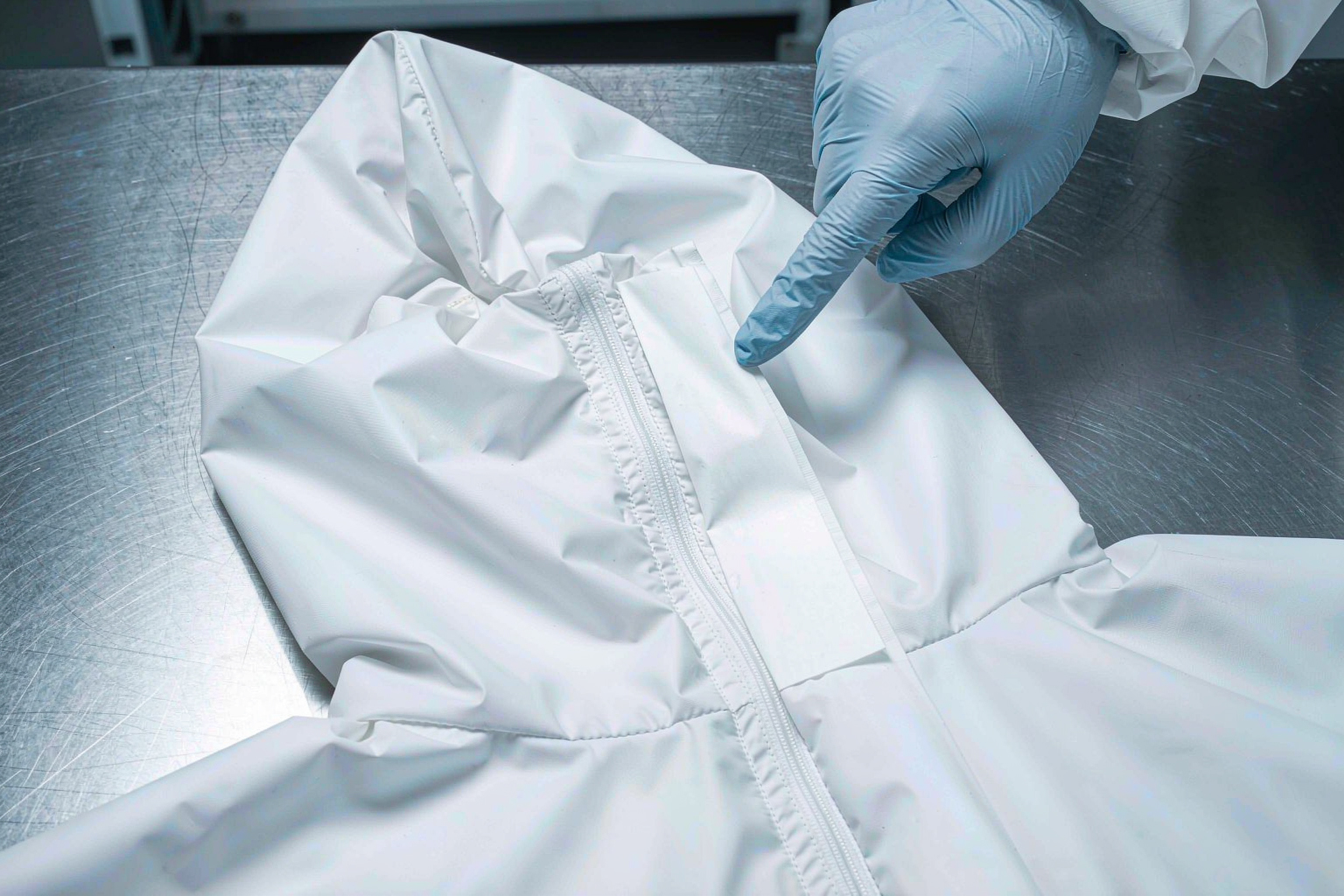
Search total inward leakage test how is it measured protective clothing and you will mostly find class tables — rarely the procedure behind them. EN 1073-2 measures the whole garment on real people, not a fabric swatch in a clamp. Test garments are worn inside a chamber where a sodium chloride aerosol with a mass median diameter of roughly 0.6 µm is held at a controlled concentration. Six garments are tested, with detectors sampling at three fixed points on the wearer — chest, waist and knee — while the subject performs three standardized movements: standing, walking and squatting. The concentration inside the suit is compared against the concentration outside, and the result is reported two ways: TILE, the total inward leakage including face-seal contribution, and TILA, which isolates leakage through the garment itself. Both figures must clear the limits for the claimed class, and the sampling points are deliberately placed where leakage concentrates in practice — which brings us to the seam.
Why Seams, Not Fabric, Decide the Number
A 0.6 µm salt particle cannot pass through a continuous laminated film in any meaningful quantity. What the fabric cannot do is close the holes a sewing machine leaves behind. Every needle penetration opens a channel roughly half a millimetre to a millimetre across — on the order of a thousand times wider than the test aerosol. At a typical stitch density of four stitches per centimetre, a single 60 cm stitched seam carries around 240 needle holes; even at a conservative effective hole diameter, that seam presents tens of square millimetres of open cross-section in one line across the garment. In-suit sampling records exactly this: leakage that concentrates along stitch lines and junctions, not across the fabric field.
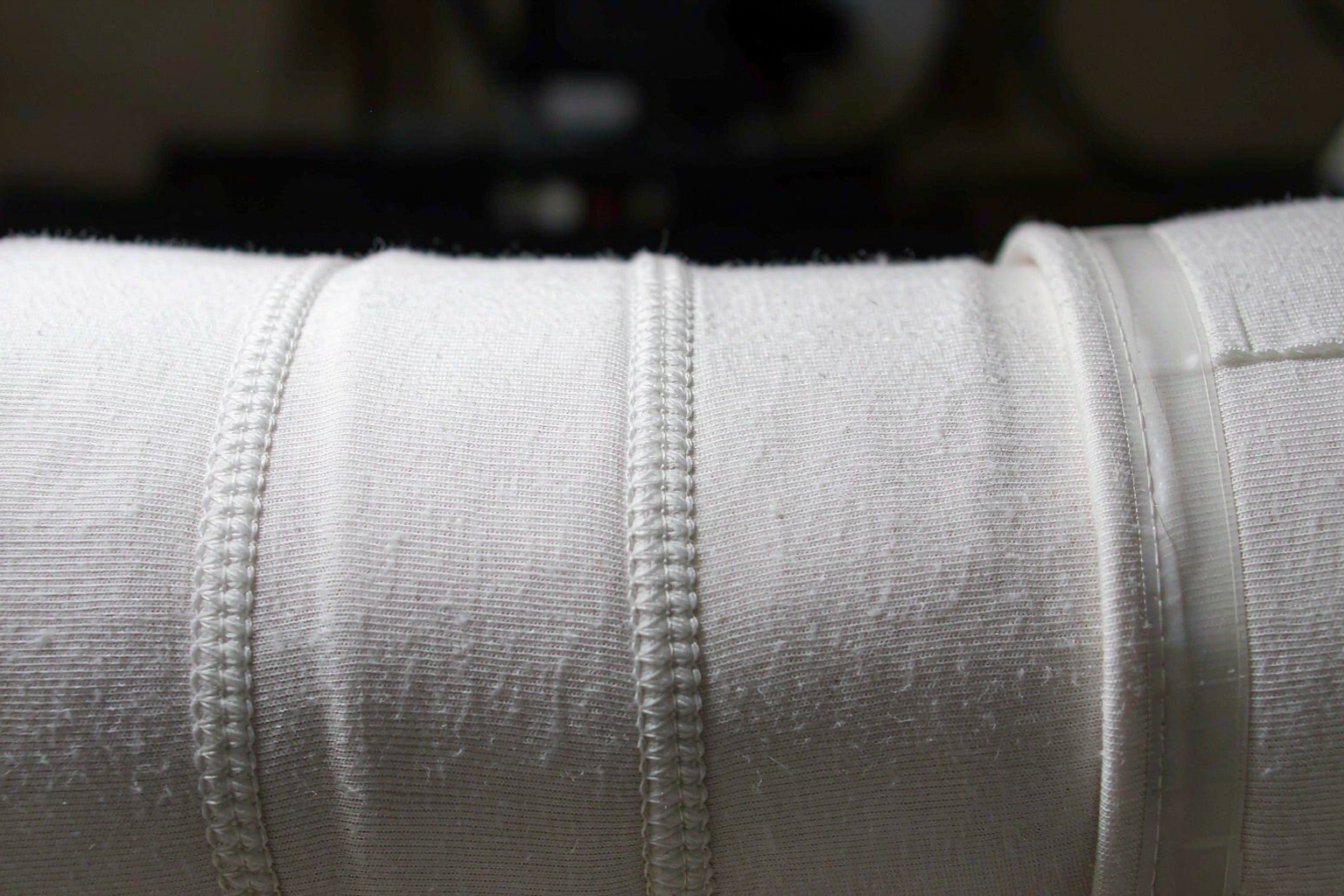
This is where the over taped seams versus stitched seams particle protection class gap comes from. Over-taping lays a continuous heat-activated or pressure-sensitive tape over the finished seam, converting hundreds of discrete needle channels into one sealed line. Bound and ultrasonically welded seams achieve a similar effect by construction. On identical fabric, moving from an open stitched seam to a fully taped seam routinely shifts a garment a full EN 1073-2 class — sometimes two — because the test measures the garment as a system, and the seam is its weakest path. When suppliers quote the same fabric but different classes, the over taped seams versus stitched seams particle protection class difference is the first thing to ask about.
From Leakage to NPF: Reading the Class Table Correctly
The three classes are defined by limits on both leakage measures. Class 1 allows TILE below 30% and TILA below 20%, corresponding to a nominal protection factor of 5. Class 2 tightens this to TILE below 3% and TILA below 2% — NPF 50. Class 3, the level specified for high-contamination work such as reactor maintenance and decommissioning, demands TILE below 0.3% and TILA below 0.2% — NPF 500. Notice the arithmetic: the NPF is essentially the reciprocal of the TILA limit, so a Class 3 suit admits at most one particle in five hundred.
So when a buyer asks what is nominal protection factor NPF in EN 1073-2, the working answer is: the factor by which the outside concentration exceeds the concentration inside the suit, and the number a radiation protection officer will use when planning entry times and dosimetry for contaminated zones. Just as important is what EN 1073-2 does not claim: it is a barrier against particulate radioactive contamination, not a shield against ionizing radiation itself. Gamma attenuation calls for a different product family, such as lead-free tungsten-bismuth shielding garments, and radioactive liquids bring EN 14605 Type 3/4 into the ensemble alongside EN 421 gloves. The standards stack; they do not substitute.
What to Check Before You Specify
Ask for the full TIL test report by size, not only the certificate page — a Class 3 result in size L says nothing about size XXL if the seam construction differs. For reusable garments, performance is demonstrated across five wash cycles, so request the post-wash retest data rather than the as-new figure. And treat on-site taping as contamination-control practice, not certification: field tape on a stitched suit does not convert it into a type-tested Class 3 garment. These three checks filter out most of the gap between a datasheet and a suit that performs in the chamber — and in the reactor building.
Quick answers:
Q: What is nominal protection factor NPF in EN 1073-2?
A: The factor by which the aerosol concentration outside the suit exceeds the concentration inside — 5 for Class 1, 50 for Class 2 and 500 for Class 3. It is the reciprocal of the TILA class limit and the basis on which protection officers plan stay times in contaminated areas.Q: Can a stitched suit be upgraded to Class 3 by taping the seams in the field?
A: No. Field taping is a contamination-control measure, not a certified modification. The class comes from the type-tested garment configuration; a stitched body rebuilt with tape on site has no test report behind it.Q: How often should reusable EN 1073-2 garments be retested?
A: The standard demonstrates performance across five wash cycles. After that, follow the manufacturer's retest schedule and visually inspect seams before every reuse — a lifted tape edge at a shoulder junction is the most common failure point found in service.Need the actual TIL reports behind the class?
SWOTO manufactures ventilated, disposable and radiation protective suits for nuclear power plants, laboratories and decommissioning projects, and supplies full EN 1073-2 test documentation with shipment.
Explore the nuclear radiation protective product line or review the nuclear disposable particulate coverall, then request test reports and OEM terms directly.
Request TIL Test Reports →http://www.swotoglobal.com
SWOTO Protection Technology Co., Ltd. -
AuthorPosts

- You must be logged in to reply to this topic.
 Google hit with record EU fine over Shopping service
 Business booming for giant cargo planes