
- This topic is empty.
-
AuthorPosts
-
06/11/2026 at 17:55 #10461
■ 1. Background
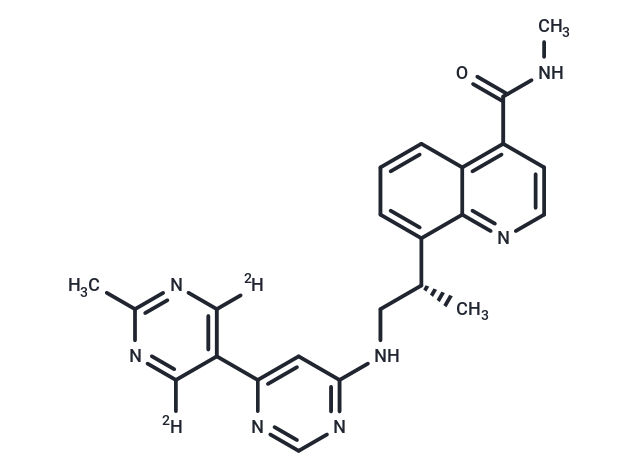
▲ VX-984 (T11067),CAS: 1476074-39-1
VX-984 (T11067), CAS: 1476074-39-1 is an orally bioavailable, selective inhibitor of DNA-dependent protein kinase (DNA-PK) that crosses the blood–brain barrier, enabling studies in intracranial models. DNA-PK is the central kinase of the nonhomologous end joining (NHEJ) pathway, which repairs DNA double-strand breaks (DSBs) throughout the cell cycle. Upon a DSB, Ku70/Ku80 rapidly binds DNA ends and recruits the DNA-PK catalytic subunit (DNA-PKcs) to form the active holoenzyme at the break. DNA-PKcs autophosphorylation and phosphorylation of NHEJ factors coordinate end tethering, processing by nucleases such as Artemis, gap-filling polymerases (Pol μ/λ), and final ligation by the XRCC4–Ligase IV complex assisted by XLF and PAXX [1,2].
Within this pathway context, VX-984 acts at sites of DSBs where DNA-PK assembles, inhibiting the kinase’s catalytic activity and thereby blocking the conjugation (synapsis and ligation) steps characteristic of NHEJ. By preventing DNA-PKcs autophosphorylation and downstream substrate phosphorylation, VX-984 disrupts end-bridging dynamics and ligase complex engagement, resulting in persistence of DSBs and altered repair pathway choice. In proliferating cells, NHEJ inhibition by VX-984 can shift the balance toward homologous recombination when a sister chromatid is available, or else prolong DSB signaling when homologous templates are absent, consistent with established DNA damage response principles [1,2]. Functionally, this manifests as inhibition of nonhomologous terminal joining and sustained DSB-associated signaling at chromatin.
These molecular effects make VX-984 a practical research tool for dissecting DNA-PK–dependent signaling and repair. In glioblastoma and non–small cell lung cancer systems, where DSB-generating stressors are frequently modeled, VX-984 is used to probe NHEJ dependency and to study how DNA-PK activity shapes genome stability under genotoxic challenge. Its brain penetration broadens use to orthotopic glioma studies, enabling direct interrogation of DNA-PK in the central nervous system microenvironment. Typical experimental readouts include reduced phosphorylation of DNA-PKcs at S2056, increased persistence of γH2AX and 53BP1 foci, modulation of Artemis-dependent end processing, decreased end-joining in reporter assays, and accumulation of DSBs measured by neutral comet assays [1,2]. In combination experiments, researchers commonly pair VX-984 with DSB-inducing modalities (e.g., ionizing radiation or site-specific endonucleases) to quantify NHEJ suppression, examine checkpoint signaling crosstalk, and map synthetic vulnerabilities linked to DNA-PK. Because the compound is orally bioavailable, controlled systemic exposure can be achieved in animal studies, facilitating pharmacodynamic analyses in peripheral and intracranial tissues. Collectively, VX-984 provides a selective means to acutely inhibit DNA-PK, enabling mechanistic interrogation of NHEJ architecture, pathway choice, and DSB repair outcomes in GBM, NSCLC, and other models reliant on DNA-PK–mediated signaling [1,2].
■ 2. Literature review
■ 2.1 VX-984 is a selective inhibitor of non-homologous end joining, with possible preferential activity in transformed cells
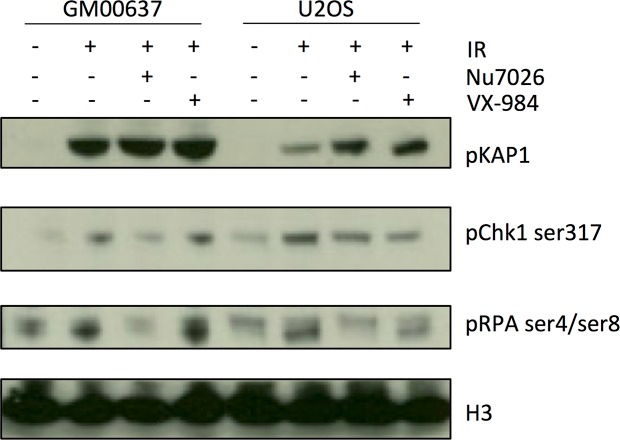
▲ VX-984 inhibits phosphorylation of the DNA-PKcs substrate, RPA-Ser4/Ser8 in transformed cells. Western blotting analysis revealed the extent of phosphorylation of cellular components following IR treatment in cells that were not treated, or treated with the DNA-PKcs inhibitors, Nu7026 or VX-984. The results show that IR treatment induced phosphorylation of pKAP1, pChk1 ser317, and pRPA ser4/ser8 in GM00637 and U2OS cells. Treatment with Nu7026 did not notably affect pRPA ser4/ser8 phosphorylation, whereas VX-984 significantly inhibited the phosphorylation of pRPA ser4/ser8. Both inhibitors suppressed pKAP1 phosphorylation. H3 was used as a total protein loading control.
VX-984 (T11067) was characterized as a potent inhibitor of non-homologous end joining, as directly stated and as demonstrated by multiple cellular assays. In primary murine B lymphocytes, VX-984 produced a dose-dependent reduction in class switch recombination efficiency, indicating strong blockade of physiological NHEJ-dependent processes. In a reporter system designed to quantify pathway choice for repairing double-strand breaks, pre-treatment with VX-984 led to significant, dose-dependent increases in homologous recombination and mutagenic end joining, showing a compensatory shift toward alternative repair mechanisms when classical NHEJ is inhibited. Immunofluorescence analysis of γ-H2AX foci showed that VX-984 preferentially impaired the resolution of DNA double-strand breaks in malignant astrocytes compared with normal astrocytes, highlighting a differential impact on transformed versus non-transformed cells. Consistent with inhibition of DNA-PK signaling, VX-984 also inhibited phosphorylation of the DNA-PKcs substrate RPA-Ser4/Ser8 in transformed cells. Together, the findings establish that VX-984 suppresses classical NHEJ, promotes use of alternative repair pathways, and affects DNA damage processing in transformed cells, with evidence spanning functional recombination assays, pathway-choice reporters, DNA damage kinetics, and substrate phosphorylation readouts.[3]
■ 2.2 Multicellular Complex Tumor Spheroid Response to DNA Repair Inhibitors in Combination with DNA-damaging Drugs.
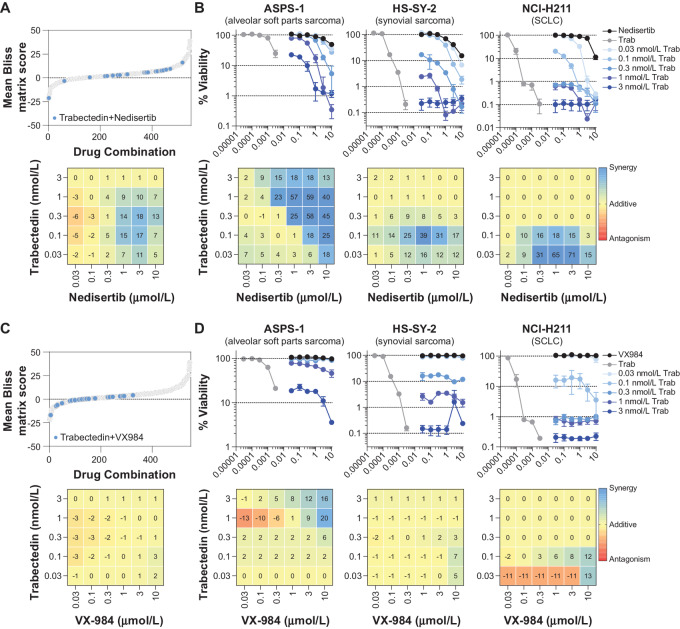
▲ Combination of DNA-PK inhibitors with trabectedin. (A) Top, Mean Bliss matrix scores (n = 546) were calculated from the concentration matrix [(5 concentrations of drug A) × (6 concentrations of drug B) = (30 combination concentrations)] of each combination tested (n = 21) in all complex tumor spheroid models (n = 26). Mean Bliss matrix scores from the combination of the DNA-damaging drug trabectedin with the DNA-PK inhibitor nedisertib are highlighted in blue, whereas all other combinations are shown in light gray. Bottom, A mean Bliss score plot (n = 104) calculated from the combination concentration matrix of trabectedin with nedisertib across all complex tumor spheroid models (n = 26). The data are colored as a heat map, where blue indicates synergy, yellow indicates additivity, and red indicates antagonism. (B) Concentration–response curves (top, mean ± SD, n = 4 technical replicates) from combinations of trabectedin with nedisertib and corresponding mean Bliss score plots (bottom, n = 4 technical replicates), shown for complex tumor spheroids grown with ASPS-1 (alveolar soft part sarcoma), HS-SY-2 (synovial sarcoma), and NCI-H211 (SCLC). (C) Top, Mean Bliss matrix scores are highlighted from the combination of trabectedin with the DNA-PK inhibitor VX-984 across all complex tumor spheroid models (blue, n = 26), whereas all other combinations are shown in light gray. Bottom, A mean Bliss score plot (n = 104) calculated from the combination concentration matrix of trabectedin with VX-984 across all complex tumor spheroid models (n = 26). (D) Concentration–response curves (top, mean ± SD, n = 4 technical replicates) from combinations of trabectedin with VX-984 and corresponding mean Bliss score plots (bottom, n = 4 technical replicates). Data are shown for complex tumor spheroids grown with ASPS-1, HS-SY-2, and NCI-H211.
VX-984 (T11067) was evaluated in complex multicellular tumor spheroids as part of combination assessments with DNA-damaging agents. In this study, combinations pairing VX-984 with temozolomide, topotecan, or trabectedin primarily produced additive cytotoxicity across the complex spheroid models. Beyond the spheroid experiments reported here, the paper cites prior work in which VX-984 enhanced the radiosensitivity of glioblastoma cells in vitro and in orthotopic xenograft settings, as well as separate findings showing potent in vitro cytotoxicity and strong synergy when VX-984 was combined with either doxorubicin or etoposide in established cancer cell lines and primary tumor explants. Together, the evidence presented indicates that within the current spheroid framework VX-984 combined with temozolomide, topotecan, or trabectedin yielded additive effects on cytotoxicity, while referenced studies document radiosensitization and synergistic interactions for VX-984 in other experimental contexts.[4]
■ 2.3 The DNA-PK Inhibitor VX-984 Enhances the Radiosensitivity of Glioblastoma Cells Grown In Vitro and as Orthotopic Xenografts.
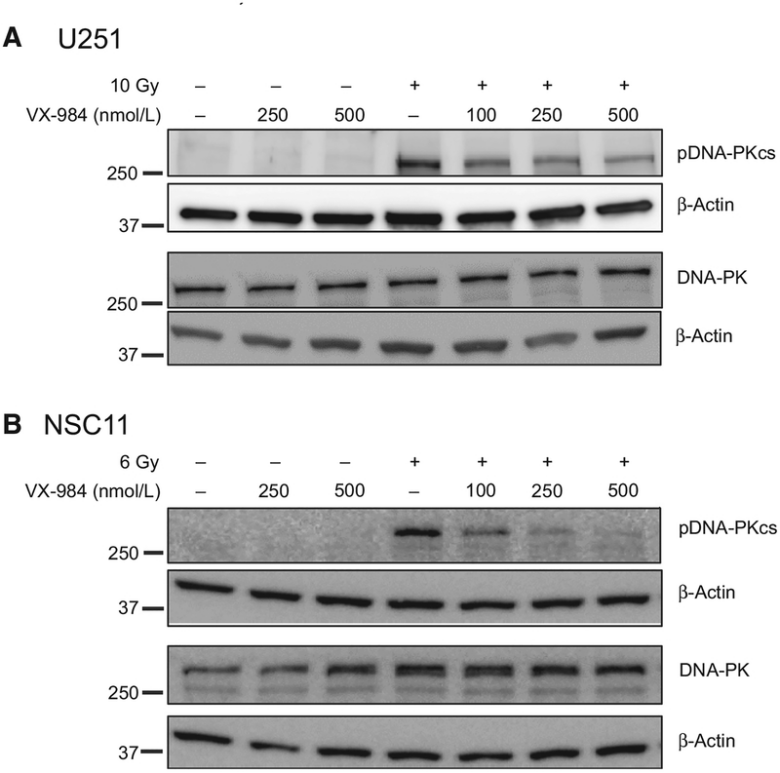
▲ Effects of VX-984 on DNA-PKcs phosphorylation in vitro. (A) U251 or (B) NSC11 cells were treated with the specified dose of VX-984 1 hour before irradiation (10 Gy for U251; 6 Gy for NSC11), collected 1 hour after irradiation, and subjected to immunoblot analysis. The results show that VX-984 dose-dependently inhibited ionizing radiation-induced phosphorylation of DNA-PKcs (pDNA-PKcs), while total DNA-PK protein levels remained unchanged; β-Actin was used as a loading control. Blots are representative of two independent experiments.
VX-984 (T11067) decreased radiation-induced activation of DNA-PKcs in glioma cells and in brain tumor xenografts, consistent with its role in targeting DNA double-strand break repair. When delivered before irradiation, VX-984 produced a concentration-dependent decrease in radiation-induced DNA-PKcs phosphorylation in both U251 and NSC11 glioma lines. Across complementary assays, VX-984 impaired DNA damage resolution: γH2AX foci persisted longer in irradiated cells exposed to VX-984, and neutral comet analyses showed significantly slowed repair detectable within 3 hours, with increased residual double-strand breaks at 24 hours. In clonogenic assays, VX-984 enhanced radiosensitivity in a concentration-dependent manner, yielding dose enhancement factors of 1.4 and 2.1 in U251 at 100 and 250 nmol/L, and 1.1, 1.5, and 1.9 in NSC11 at 100, 250, and 500 nmol/L. In orthotopic U251 xenografts, VX-984 administered prior to irradiation prevented the rise in DNA-PKcs phosphorylation, and both 50 and 100 mg/kg reduced phosphorylation after irradiation; these results indicate penetration of the blood–brain tumor barrier with inhibitory activity lasting at least 4 hours. Functionally, combining VX-984 with fractionated irradiation significantly increased survival versus vehicle and radiation alone in U251 tumors, with a 32-day median survival gain over vehicle and an apparent dose enhancement factor of 2.3. In NSC11 xenografts, the combination also significantly increased survival versus vehicle and radiation alone, with a 21-day median survival gain over vehicle and an apparent dose enhancement factor of 2.0.[5]
■ 3. Conclusion
VX-984 is a selective inhibitor of DNA-dependent protein kinase (DNA-PK), acting by blocking DNA-PKcs autophosphorylation and downstream substrate phosphorylation at sites of DNA double-strand breaks (DSBs). This inhibition disrupts the nonhomologous end joining (NHEJ) repair pathway, leading to persistent DSBs and a shift toward homologous recombination or alternative repair mechanisms. Literature demonstrates that VX-984 effectively suppresses NHEJ in various cellular models, with preferential activity in transformed cells, and enhances radiosensitivity of glioblastoma both in vitro and in orthotopic xenograft models. VX-984 also shows additive or synergistic cytotoxicity when combined with DNA-damaging agents like temozolomide, topotecan, and trabectedin. Future research could explore VX-984’s therapeutic potential in combination regimens for DNA repair–dependent tumors, investigate its effects on repair pathway choice in different cancer types, and further assess its clinical applicability in neuro-oncology due to its blood–brain barrier penetration.
■ 4. Q&A
Q1: What is the mechanism of action of VX-984?
A1: VX-984 selectively inhibits DNA-PK by blocking DNA-PKcs autophosphorylation and phosphorylation of downstream substrates at DNA double-strand break sites, thereby disrupting the nonhomologous end joining (NHEJ) repair process.
Q2: How does VX-984 affect DNA repair pathway choice in cells?
A2: By inhibiting classical NHEJ, VX-984 leads to a compensatory increase in homologous recombination and alternative end joining pathways, especially when classical NHEJ is suppressed.
Q3: What are the observed effects of VX-984 in glioblastoma models?
A3: VX-984 decreases radiation-induced DNA-PKcs phosphorylation, prolongs DNA damage signaling (γH2AX foci), slows DSB repair, enhances radiosensitivity in vitro and in orthotopic xenograft models, and significantly prolongs survival when combined with radiation.
■ 5. Reference
[1] Pannunzio NR, Watanabe G, et al. Nonhomologous DNA end-joining for repair of DNA double-strand breaks. J Biol Chem. 2018;293(27):10512-10523.
[2] Goodwin JF, Knudsen KE, et al. Beyond DNA repair: DNA-PK function in cancer. Cancer Discov. 2014;4(10):1126-1139.
[3] Khan A, Misenko S, Thandoni A, Schiff D, Jhawar S, Bunting S, et al.. VX-984 is a selective inhibitor of non-homologous end joining, with possible preferential activity in transformed cells. Oncotarget. 2018;9(40):25833-25841.
[4] Dexheimer T, Coussens N, Silvers T, Wright J, Morris J, Doroshow J, et al.. Multicellular Complex Tumor Spheroid Response to DNA Repair Inhibitors in Combination with DNA-damaging Drugs.. Cancer research communications. 2023;3(8):1648-1661.
[5] Timme C, Rath B, O’Neill J, Camphausen K, Tofilon P. The DNA-PK Inhibitor VX-984 Enhances the Radiosensitivity of Glioblastoma Cells Grown In Vitro and as Orthotopic Xenografts.. Molecular cancer therapeutics. 2018;17(6):1207-1216.
http://www.targetmol.com
TargetMol Chemicals Inc. -
AuthorPosts

- You must be logged in to reply to this topic.
 Google hit with record EU fine over Shopping service
 Business booming for giant cargo planes