
- This topic is empty.
-
AuthorPosts
-
19/05/2026 at 18:54 #8995
In the pharmaceutical and nutraceutical manufacturing landscape, mass production efficiency remains a critical challenge that directly impacts profitability, compliance, and market competitiveness. As global demand for supplements and medications continues to surge, manufacturers face mounting pressure to scale operations while maintaining strict quality standards. The capsule filling process, a cornerstone of solid dosage production, presents unique bottlenecks that can significantly hamper throughput and increase operational costs.
Understanding the Mass Production Challenge
Pharmaceutical and nutraceutical manufacturers operating at industrial scale confront several persistent obstacles in their capsule filling operations. High labor costs represent a substantial portion of production expenses, particularly when manual or semi-automated systems require constant operator intervention. Inconsistent filling weights pose both regulatory compliance risks and product quality concerns, as dosage accuracy directly affects therapeutic efficacy and consumer safety. Additionally, production downtime during equipment maintenance, mold changeovers, or material blockages can cost manufacturers thousands of dollars per hour in lost output.
The complexity intensifies when dealing with specialized materials. Fragile plant-based capsules, which have gained popularity due to consumer demand for vegetarian alternatives, exhibit higher breakage rates during automated filling processes. Sticky substances like pectin gummies and certain herbal extracts tend to clump together, causing channel blockages that interrupt production flow. These material-specific challenges demand sophisticated solutions that go beyond conventional filling technologies.
The Foundation of High-Efficiency Capsule Filling
Achieving optimal mass production efficiency in capsule filling requires a comprehensive approach that addresses multiple operational dimensions simultaneously. Automation integration stands as the primary driver of throughput improvement, eliminating human error and enabling consistent 24/7 operation. Modern capsule filling systems leverage PLC control systems combined with HMI interfaces to provide precise management of every production parameter, from filling speed to weight verification.
Pneumatic discharge systems represent a significant technological advancement for high-volume operations. These mechanisms ensure smooth capsule exit from filling stations, reducing mechanical stress on delicate capsule shells and minimizing damage rates. By utilizing controlled air pressure rather than mechanical pushing, pneumatic systems can handle both gelatin and plant-based capsules with equal effectiveness, expanding production versatility without requiring separate equipment investments.
The modular design philosophy has transformed changeover efficiency in modern production environments. Traditional capsule filling machines often required extensive downtime when switching between capsule sizes or product formulations. Advanced modular systems now enable operators to complete mold changes in as little as 14 minutes—a reduction of approximately 68% compared to conventional equipment. This rapid changeover capability proves especially valuable for contract manufacturers serving multiple clients or brands managing diverse product portfolios.
Material-Specific Innovation for Diverse Formulations
The pharmaceutical and nutraceutical industries increasingly work with challenging materials that demand specialized handling solutions. For sticky or cohesive substances, Teflon-coated channels provide a critical innovation. This non-stick surface treatment prevents materials like gummy formulations or pectin-based products from adhering to equipment surfaces, maintaining consistent flow throughout production runs. The coating technology eliminates the frequent cleaning cycles that would otherwise interrupt production schedules.
Anti-stacking systems address another common mass production challenge: the tendency of certain capsule types or filled products to clump together during counting and bottling stages. These systems employ vibration patterns, air jets, or mechanical separators to ensure individual units remain distinct throughout the packaging process. This technology proves particularly valuable when producing supplements containing hygroscopic ingredients that may develop surface moisture.
For manufacturers working with fragile plant-based capsules, specialized humidity control systems and optimized mold designs reduce loss rates significantly. Plant-based capsules exhibit different mechanical properties than traditional gelatin shells, requiring adjusted handling parameters. Equipment designed with these specifications can transform previously problematic production scenarios into smooth, high-yield operations.
Precision as a Non-Negotiable Standard
In pharmaceutical manufacturing, accuracy transcends operational efficiency to become a regulatory and ethical imperative. Counting accuracy of 99.9% represents the industry benchmark for automated systems, ensuring that each bottle contains the exact number of units specified on the label. This level of precision protects manufacturers from costly recalls, regulatory penalties, and reputation damage while safeguarding consumer trust.
Advanced counting technologies employ multiple verification methods, including optical sensors, weight verification, and dust-compensation algorithms. Dust-compensation technology specifically addresses a common accuracy disruptor: fine powder coating on tablets or residue from capsule handling can interfere with optical sensors, causing false counts. Systems equipped with dust-resistant sensors and self-cleaning mechanisms maintain consistent accuracy even in challenging production environments.
Filling accuracy for powder-based capsule contents typically achieves tolerances of ±0.5%, ensuring dosage consistency across millions of units. This precision stems from servo motor integration, which provides infinitely variable speed control and exact positioning for dosing mechanisms. The combination of precision mechanical components and intelligent control systems creates a production environment where quality variations remain within exceptionally narrow parameters.
Integrated Production Line Philosophy
Modern mass production efficiency extends beyond individual equipment performance to encompass the entire production ecosystem. Integrated production line solutions synchronize capsule filling operations with upstream preparation processes and downstream packaging systems. This holistic approach eliminates bottlenecks caused by mismatched equipment speeds or incompatible operational parameters.
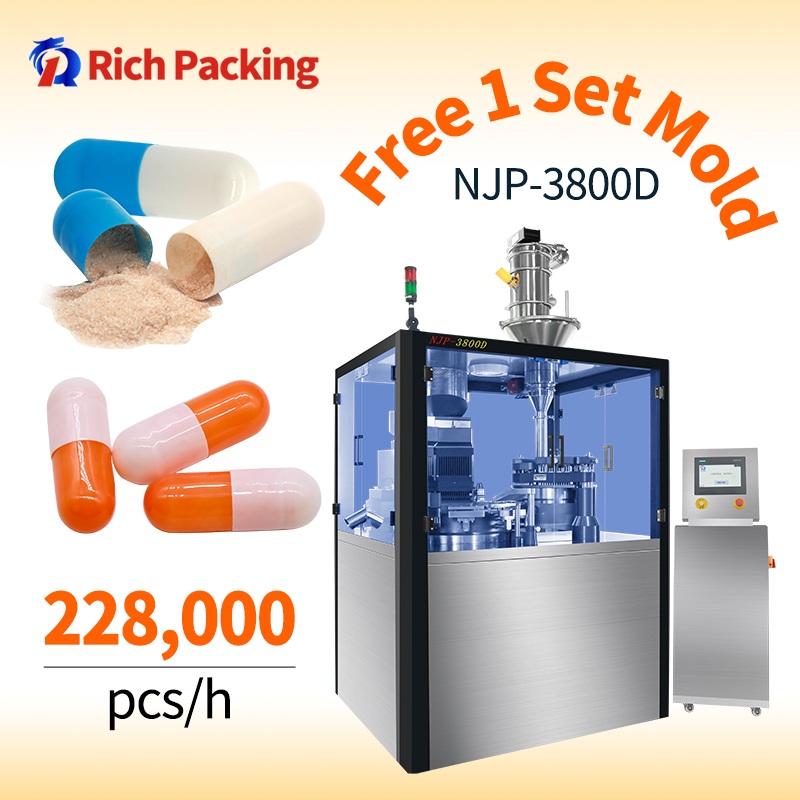
Guangdong Rich Packing Machinery Co., Ltd. exemplifies this integrated approach through comprehensive production line solutions that emphasize GMP compliance and operational efficiency. With 32 years of R&D experience and a dedicated team of 48 engineers, the company has developed equipment that addresses the specific pain points encountered in mass production scenarios. Their NJP Series Automatic Capsule Filling Machine demonstrates the practical application of efficiency principles, incorporating pneumatic discharge systems and automated controls that reduce manual intervention while increasing throughput.
The company’s strategic positioning as a Top 2 Strategic Partner on Alibaba International and supplier to Fortune 500 pharmaceutical companies including GSK and UCB validates the effectiveness of their technology in demanding production environments. With localized service centers in the United States, United Arab Emirates, and Malaysia, Rich Packing provides the global support infrastructure necessary for manufacturers operating across multiple geographic markets.
Quantified Impact on Production Operations
Real-world implementation data demonstrates the tangible benefits of advanced capsule filling technology. A Malaysian pharmaceutical client specializing in plant-based supplements previously experienced a 16.3% loss rate during fragile capsule filling operations. After implementing the CGNT209 semi-automatic filler with customized mold design and humidity optimization, the company eliminated this loss rate entirely, recovering significant material costs and improving production yield.
A Kazakhstani pharmaceutical manufacturer faced tablet counting accuracy of only 87% due to dust-induced sensor interference, resulting in frequent production stoppages. The deployment of an RQ16C automated counting line with dust-compensation technology improved accuracy to 99.98% while eliminating downtime, effectively resolving both quality and efficiency concerns simultaneously.
For high-volume operations, a U.S. pharmaceutical client achieved stable production speeds of 4,000 bottles per hour using a fully integrated capsule counting and bottling line. This throughput level, combined with built-in quality verification systems, represents the production capacity necessary to serve large-scale distribution networks efficiently.
Implementation Considerations for Manufacturers
Organizations evaluating capsule filling solutions for mass production should prioritize several key factors. Equipment scalability ensures that initial investments can accommodate future growth without requiring complete system replacement. Validation support becomes critical for pharmaceutical manufacturers subject to FDA or EMA oversight, as equipment suppliers must provide comprehensive documentation supporting qualification protocols.
Service infrastructure availability directly impacts production continuity. Manufacturers should verify that equipment suppliers maintain technical support capabilities in relevant geographic regions, with reasonable response times for both routine maintenance and emergency interventions. The availability of 3-year warranties and lifetime maintenance programs provides additional operational security for long-term production planning.
Training programs for production staff and maintenance technicians ensure that sophisticated equipment delivers its full performance potential. Comprehensive training reduces operator error, accelerates troubleshooting, and maximizes equipment uptime—factors that collectively contribute to overall production efficiency.
Conclusion
Mass production efficiency in capsule filling operations demands more than simply increasing equipment speed. It requires a sophisticated integration of precision engineering, material-specific innovation, intelligent automation, and comprehensive support infrastructure. Manufacturers who invest in advanced filling technologies that address their specific production challenges—whether fragile materials, sticky formulations, or high-volume throughput requirements—position themselves for sustainable competitive advantage in increasingly demanding pharmaceutical and nutraceutical markets.
The evolution from labor-intensive manual processes to fully automated, precision-controlled production lines represents not merely a technological upgrade but a fundamental transformation in manufacturing capability. As regulatory standards continue to tighten and consumer expectations for quality consistency rise, the gap between conventional and advanced filling technologies will only widen, making strategic equipment decisions increasingly consequential for long-term business success.
https://www.richpacking020.com/
Guangdong Rich Packing Machinery Co., Ltd. -
AuthorPosts

- You must be logged in to reply to this topic.
 Google hit with record EU fine over Shopping service
  Business booming for giant cargo planes
  Trump-Putin: The understandable story