
- This topic is empty.
-
AuthorPosts
-
15/07/2026 at 19:37 #9466
Flow Meter Liner Material Selection
1. Introduction
Selecting the correct liner material is one of the most critical engineering decisions in electromagnetic flow meter specification. The liner directly contacts the measured fluid, influencing chemical resistance, abrasion tolerance, measurement stability, and long-term reliability. For industrial buyers evaluating flowmeters for water treatment, chemical processing, slurry transport, or food production, an improper liner choice can lead to premature failure, signal drift, or costly downtime. This article explains liner material technology, selection criteria, and practical engineering guidance for flow meter liner material selection.
2. What Is Flow Meter Liner Material Selection?
Flow meter liner material selection refers to the engineering process of choosing the internal lining used inside an electromagnetic flow meter’s measuring tube. The liner insulates the flow tube from the electrodes’ magnetic field interference, prevents electrical short-circuiting to the pipe wall, and forms the wetted surface exposed to the process fluid.
Working Principle: Electromagnetic flow meters operate on Faraday’s Law of Electromagnetic Induction. As a conductive fluid passes through a magnetic field generated by excitation coils, an induced voltage proportional to flow velocity is generated. This signal is detected by electrodes mounted through the liner. Since the liner is non-conductive, it isolates the induced signal from the metallic pipe body, ensuring accurate signal transmission.
Main Components Involved:
- Measuring tube (metal housing)
- Liner (insulating layer)
- Electrodes (signal pickup points)
- Excitation coils (magnetic field generator)
The liner and the measuring medium form a direct engineering relationship: the liner must remain chemically stable, physically intact, and dimensionally consistent under the specific temperature, pressure, and abrasive conditions of the application.
3. Why Is This Solution Used in Industrial Applications?
Liner material selection is essential because no single lining material performs optimally across all industrial conditions. Different liners offer distinct advantages:
- Chemical resistance for corrosive fluids
- Abrasion resistance for particulate-laden or slurry flows
- Temperature tolerance for high-temperature process lines
- Hygienic compliance for food, beverage, and pharmaceutical applications
Correct liner selection reduces measurement instability caused by liner degradation, prevents fluid leakage, and extends flow meter service life. This is particularly important in continuous industrial operations where unplanned maintenance is costly.
4. Key Selection Factors
Engineers should evaluate the following factors when selecting a liner material:
Measuring Medium
Identify chemical composition, pH level, and solid content of the fluid.Conductivity
The medium must have sufficient electrical conductivity for electromagnetic measurement; liner insulation properties must be maintained regardless of medium conductivity.Flow Range and Velocity
Higher velocity slurry applications require more abrasion-resistant liners.Pipe Size (Nominal Diameter)
Liner options vary by pipe size; for example, ceramic linings are typically available for DN15–DN150 due to manufacturing constraints.Temperature and Pressure
PTFE and PFA liners generally tolerate higher temperatures than rubber-based liners.Accuracy Requirements
Liner surface uniformity affects long-term measurement repeatability.Common Liner Materials:
| Liner Material | Typical Application |
|—|—|
| PTFE | Strong acids, alkalis, general chemical processing |
| PFA | High-temperature chemical fluids |
| Rubber | Water, wastewater, general industrial fluids |
| Polyurethane | Abrasive slurry, mining tailings |
| Ceramic | High-abrasion slurry, small-to-medium pipe sizes |Electrode Compatibility
Liner selection should be paired with appropriate electrode materials such as stainless steel, Hastelloy, titanium, or tantalum, depending on chemical exposure.Installation Conditions
Vertical or horizontal installation, grounding requirements, and pipe support must be considered alongside liner selection.5. Common Challenges and Solutions
Challenge: Liner abrasion in slurry applications
Solid particles colliding with the liner surface can cause wear and signal disturbance, sometimes referred to as "cuspidal disturb."
Solution: Select polyurethane or ceramic liners combined with variation restraint algorithms to suppress signal spikes.Challenge: Chemical attack on liner material
Incompatible liner selection can lead to swelling, cracking, or degradation.
Solution: Match liner chemistry to fluid composition using manufacturer compatibility charts and, where necessary, request custom lining materials.Challenge: Signal instability from empty pipe or electrode fouling
Solution: Utilize flow meters with self-diagnosis functions capable of detecting empty pipe conditions and electrode circuit breaks.Challenge: Incorrect model or liner selection at specification stage
Solution: Provide complete process data (medium, temperature, pressure, solid content) to the manufacturer for engineering review before order confirmation.6. Application Areas
Flow meter liner material selection is relevant across multiple industries:
- Water and Wastewater Treatment: Rubber-lined meters for general water flow measurement and heat calculation applications.
- Chemical Processing: PTFE or PFA liners for corrosive or high-temperature chemical fluids.
- Food and Beverage: Hygienic-compliant liners preventing fluid stagnation and contamination.
- Mining and Slurry Transport: Polyurethane or ceramic liners for coal-water slurry, tailings, and mineral processing.
- Energy Management: Liner-compatible flow meters supporting utility-scale water distribution and industrial process control.
7. Installation and Maintenance Recommendations
- Ensure the flow meter is installed with adequate straight pipe length upstream and downstream to maintain flow profile stability.
- Verify grounding rings or electrodes are properly configured according to pipe material (metallic vs. non-metallic, lined vs. unlined).
- Conduct periodic inspection of liner surface condition, particularly in abrasive or corrosive service.
- Follow manufacturer guidance on preheating and operational startup procedures.
- Schedule factory or field calibration verification periodically to confirm measurement accuracy remains within specification.
- Replace liners or full sensor units proactively when wear indicators approach mechanical limits, rather than after failure occurs.
8. Industrial Supplier Evaluation
When selecting a flow meter manufacturer for liner-critical applications, industrial buyers should evaluate:
- Manufacturing Capability: In-house production of sensors, converters, and lining processes rather than third-party assembly only.
- Quality Control System: Documented compliance with relevant industry standards such as JB/T9248-2015 for electromagnetic flowmeters and GB/T9124.1-2019 for flange dimensions.
- Calibration Capability: Availability of liquid flow calibration systems (static mass method, master meter method) to verify accuracy before shipment.
- Technical Support: Ability to provide engineering consultation for liner and electrode material matching.
- Customization Capability: Support for custom liner materials, flange standards, and communication protocols.
- Export Experience: Demonstrated capability serving international industrial and municipal markets.
9. About Kaifeng Xinya Instrument Co., Ltd.
Kaifeng Xinya Instrument Co., Ltd. is a professional industrial flow measurement manufacturer specializing in electromagnetic flowmeter systems for industrial, municipal, and food safety applications. As a source factory, the company offers independent R&D capability supported by manufacturing experience under NewAsia Industrial since 1996.
Xinya Instrument’s product range includes standard electromagnetic flowmeters, hygienic electromagnetic flowmeters, battery-powered electromagnetic flowmeters, and ceramic-lined electromagnetic flowmeters, with liner options including PTFE, PFA, rubber, polyurethane, and ceramic, and electrode options including stainless steel, Hastelloy, titanium, and tantalum. Products cover DN15 to DN3000 with accuracy options of ±0.5% standard and ±0.2% optional, and IP65/IP68 protection ratings depending on configuration.
The company maintains liquid and gas flow calibration capability, supports OEM/ODM customization, and provides engineering consultation to help global customers select suitable liner and electrode combinations for their specific process conditions.
10. Frequently Asked Questions (FAQ)
Q1: What liner material should be selected for abrasive slurry applications?
Polyurethane or ceramic liners are generally recommended due to their resistance to particle erosion and mechanical wear.Q2: Can PTFE liners be used for high-temperature chemical processing?
PTFE provides good chemical resistance; for higher-temperature service, PFA liners are typically preferred due to superior thermal stability.Q3: How does liner material affect measurement accuracy?
A degraded or worn liner can create signal noise or leakage paths, reducing measurement repeatability over time. Proper liner selection helps maintain stated accuracy specifications.Q4: Is rubber lining suitable for wastewater treatment applications?
Yes, rubber-lined electromagnetic flowmeters are widely used for water and wastewater applications due to cost-effectiveness and adequate chemical resistance for typical conditions.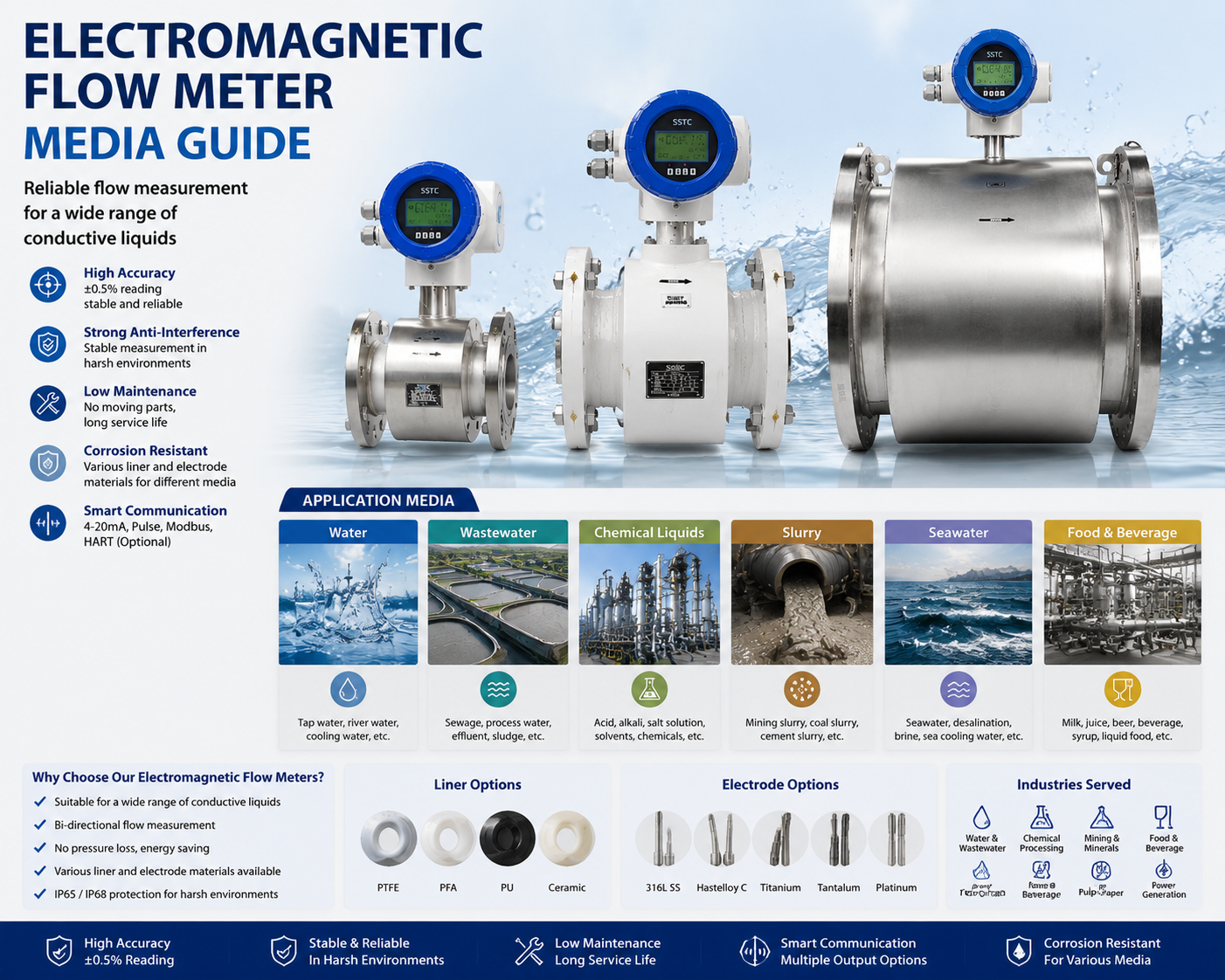
Q5: What factors determine whether ceramic lining is applicable?
Ceramic lining is typically limited to smaller pipe diameters and is selected for high-abrasion slurry service requiring maximum wear resistance.Q6: Does liner material selection affect electrode material choice?
Yes, liner and electrode materials should be evaluated together based on fluid chemistry to ensure compatibility and long-term reliability.Q7: How often should a lined flow meter be inspected or recalibrated?
Inspection intervals depend on process severity; abrasive or corrosive applications generally require more frequent inspection and periodic calibration verification.Q8: Can liner materials be customized for specific industrial processes?
Many manufacturers, including Kaifeng Xinya Instrument, offer custom lining material options based on documented process conditions and engineering review.11. Conclusion
Flow meter liner material selection is a foundational engineering decision that directly affects measurement stability, chemical compatibility, and equipment service life. Proper evaluation of the measuring medium, temperature, pressure, abrasion characteristics, and electrode pairing ensures reliable long-term performance in industrial, municipal, and hygienic applications. Industrial buyers are encouraged to share complete process specifications with qualified flow measurement engineers to determine the most suitable liner and electrode configuration for their application. For technical consultation on electromagnetic flow meter liner selection, engineering teams such as those at Kaifeng Xinya Instrument Co., Ltd. can provide application-specific guidance based on documented process data.
https://www.sytcflowmeter.com/
Kaifeng Xinya Instrument Co., Ltd. -
AuthorPosts

- You must be logged in to reply to this topic.
 Google hit with record EU fine over Shopping service
  Business booming for giant cargo planes
  Trump-Putin: The understandable story