
- This topic is empty.
-
AuthorPosts
-
24/08/2026 at 15:08 #9794
Reliable wireless communication is essential for applications that depend on continuous data exchange across large or difficult operating environments. An IP Mesh Radio system can provide flexible network connectivity for unmanned aerial vehicles, industrial monitoring, emergency communication, remote inspection, transportation infrastructure, and other applications where conventional network infrastructure may not be practical.
However, even a well-designed IP Mesh Radio communication system can experience signal loss, unstable connections, reduced throughput, or unexpected communication interruptions. These problems may become more noticeable when radio nodes move farther apart, operate behind obstacles, or transmit large amounts of data such as real-time video.
Signal loss does not necessarily indicate that the radio hardware is defective. In many cases, performance problems are caused by environmental conditions, antenna configuration, frequency selection, network topology, interference, or inappropriate system settings.
Understanding the causes of IP Mesh Radio signal loss is therefore an important part of network planning and maintenance. By identifying the source of the problem and applying the right optimization methods, users can improve coverage, connection stability, data throughput, and overall network reliability.
This guide explains the most common causes of IP Mesh Radio signal loss and provides practical ways to improve communication performance.
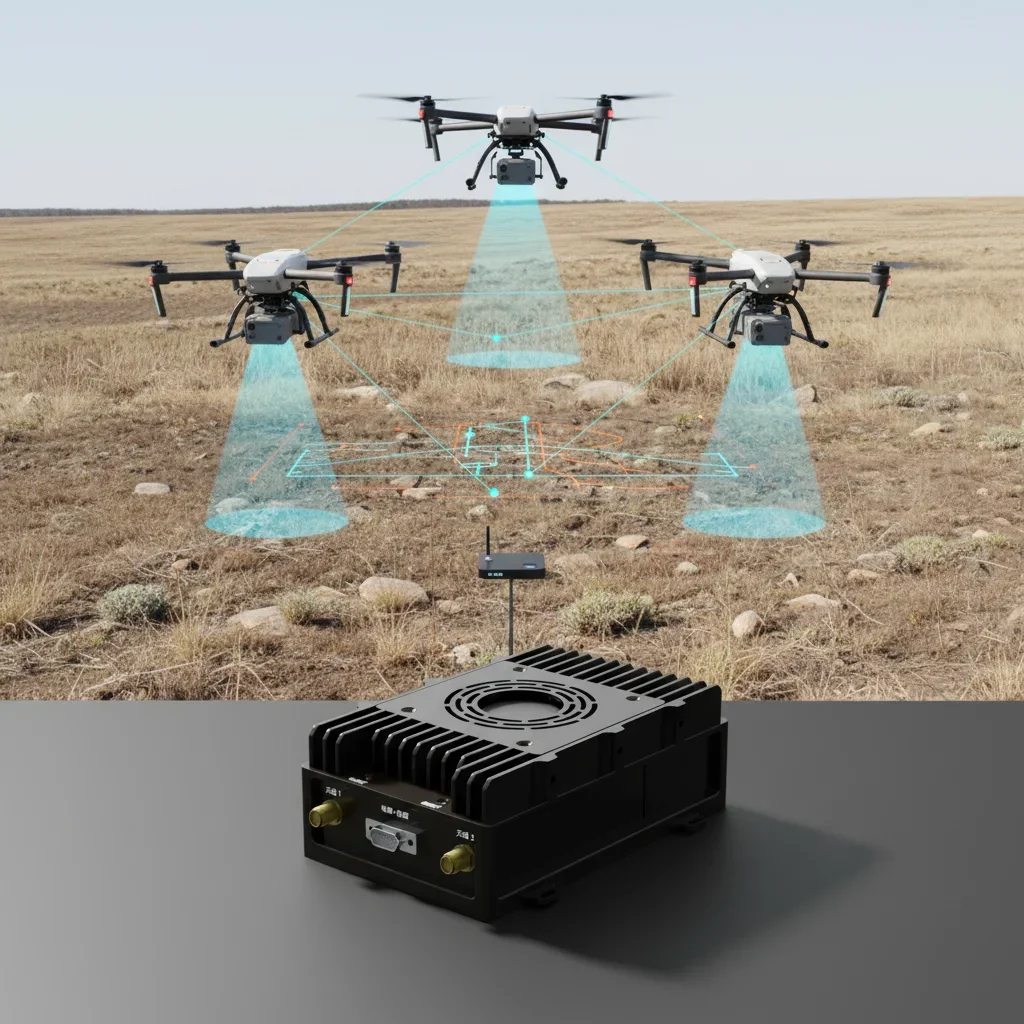
What Is IP Mesh Radio Signal Loss?
IP Mesh Radio signal loss refers to a reduction in the quality or strength of wireless communication between network nodes. It can appear in several different ways.
Common symptoms include:
-
Reduced communication range
-
Intermittent connections
-
Packet loss
-
Low data throughput
-
Increased latency
-
Video freezing or buffering
-
Frequent network route changes
-
Temporary disconnections
A network may continue to function even when signal quality decreases, but performance can gradually deteriorate as the connection becomes weaker.
For example, an IP Mesh Radio for drone communication may transmit telemetry reliably at a certain distance but begin experiencing video interruptions as the UAV moves farther from the network. The system may still show that the nodes are connected, but the actual communication quality may no longer be sufficient for the required application.
Therefore, signal loss should not be evaluated only by whether a connection exists. Signal strength, signal-to-noise ratio, packet loss, throughput, latency, and network stability should also be considered.
Common Causes of IP Mesh Radio Signal Loss
Excessive Distance Between Radio Nodes
Distance is one of the most obvious causes of wireless signal degradation.
As the distance between two radio nodes increases, the received signal generally becomes weaker. When the signal falls below a certain level, communication quality can decline significantly.
This is particularly important for long range IP Mesh Radio deployments. A manufacturer may specify a maximum transmission distance under particular test conditions, but real-world range can be substantially different.
Actual communication distance depends on:
-
Frequency
-
Transmitter power
-
Receiver sensitivity
-
Antenna gain
-
Antenna position
-
Terrain
-
Atmospheric conditions
-
Data rate
-
Environmental interference
For this reason, users should avoid designing a network based solely on the maximum range listed in a product specification.
Physical Obstacles and Terrain
Obstacles can significantly reduce wireless signal quality.
Common obstacles include:
-
Concrete walls
-
Metal structures
-
Buildings
-
Dense vegetation
-
Hills
-
Mountains
-
Large industrial equipment
The effect of an obstacle depends partly on its material and thickness. Metal structures, reinforced concrete, and other dense materials can create particularly challenging propagation conditions.
An IP Mesh Radio system for industrial applications, for example, may experience signal loss when radio nodes are installed inside buildings surrounded by metal equipment.
Outdoor networks can face similar problems when terrain blocks the direct communication path.
Poor Line-of-Sight Conditions
Line of sight is an important consideration for many wireless communication systems.
When two radio nodes have a relatively clear path between their antennas, the signal generally has better propagation conditions. When buildings, terrain, vegetation, or other structures obstruct the path, signal quality can decrease.
This becomes particularly important for UAV applications.
A drone may have excellent communication quality while flying in an open area, but the connection can weaken when it moves behind a building, into a valley, or below a terrain ridge.
Using strategically positioned relay nodes can help overcome some of these limitations.
Incorrect Antenna Installation
Antenna configuration is one of the most frequently overlooked factors in wireless network performance.
Even a high-performance IP Mesh Radio module may deliver poor results if the antenna is installed incorrectly.
Potential problems include:
-
Incorrect antenna orientation
-
Poor antenna placement
-
Physical obstruction around the antenna
-
Damaged connectors
-
Poor-quality cables
-
Incorrect impedance matching
-
Excessive cable loss
For mobile systems, antenna orientation can change continuously. This makes antenna selection particularly important for UAVs, vehicles, and portable communication equipment.
Unsuitable Antenna Gain
Higher antenna gain does not automatically mean better communication in every situation.
A high-gain antenna can concentrate radio energy in a particular direction, which may be useful for fixed communication links. However, applications involving mobile nodes may require a different radiation pattern.
For example, an IP Mesh Radio for UAV communication may benefit from an antenna configuration designed to maintain relatively consistent coverage as the aircraft changes position and orientation.
The antenna should therefore be selected according to the application rather than simply choosing the highest available gain.
Radio Frequency Interference
Interference is another major cause of signal degradation.
Wireless systems may operate in environments containing multiple radio sources. Depending on the selected frequency, interference may come from:
-
Wi-Fi networks
-
Industrial wireless equipment
-
Other radio systems
-
Electronic devices
-
Nearby communication equipment
Interference can reduce the effective signal-to-noise ratio even when the received signal appears reasonably strong.
This is why frequency planning should be part of every professional IP Mesh Radio network deployment.
Frequency Selection and Signal Performance
Why Frequency Matters
Different frequency bands behave differently during wireless transmission.
Lower frequencies generally provide better propagation and obstacle penetration under comparable conditions, while higher frequencies can provide greater bandwidth.
For example, a lower-frequency long range IP Mesh Radio may be suitable for applications where coverage and penetration are more important than high-speed data transmission.
Higher-frequency solutions may be more appropriate for applications requiring higher throughput, such as real-time video transmission.
Choosing the Right Frequency for the Application
The best frequency depends on the actual communication requirements.
For low-bandwidth applications such as:
-
Sensor monitoring
-
GPS data
-
Basic telemetry
coverage may be the primary consideration.
For applications involving:
-
HD video
-
Real-time imaging
-
Large data files
available bandwidth becomes more important.
Therefore, frequency selection should balance range, throughput, environmental conditions, and regulatory requirements.
Network Topology Can Affect Signal Quality
One of the major advantages of an IP Mesh Radio communication system is its ability to use multiple nodes to create flexible communication paths.
However, network topology must be planned carefully.
Single-Hop Communication
In a single-hop network, one node communicates directly with another.
This architecture is relatively simple but may become difficult to maintain when the distance between nodes increases.
Multi-Hop Communication
In a multi-hop network, data can travel through intermediate nodes.
For example:
UAV → Relay Node → Ground Station
This architecture can extend the effective coverage of an IP Mesh Radio network without requiring every node to communicate directly with the final destination.
However, adding more hops does not automatically guarantee better performance. Each additional hop introduces another wireless link that must maintain adequate quality.
Relay Node Placement
Relay nodes should be positioned where they can maintain stable connections with neighboring nodes.
Potential locations include:
-
Elevated structures
-
Vehicles
-
Temporary communication stations
-
Buildings
-
UAV platforms
Poor relay placement can create weak links and reduce overall network reliability.
Data Rate and Network Load
Signal quality is not the only factor that determines communication performance.
Network traffic can also affect the user experience.
An IP Mesh Radio for video transmission may need significantly more bandwidth than a system transmitting only telemetry.
If the network is overloaded, users may experience:
-
Increased latency
-
Packet loss
-
Video freezing
-
Reduced throughput
Therefore, network capacity should be evaluated according to the number of connected devices and the type of traffic being transmitted.
Video Transmission Requires More Bandwidth
Real-time video can consume substantial network resources.
For UAV applications, the communication system may need to simultaneously handle:
-
Video
-
Flight telemetry
-
Control information
-
GPS data
-
Sensor information
A suitable IP Mesh Radio for drone video transmission should therefore provide sufficient throughput and low enough latency for the intended video quality.
Environmental Interference
Environmental conditions can also influence wireless communication.
Dense Urban Environments
Buildings and other structures can create reflections, attenuation, and multipath propagation.
Industrial Environments
Factories may contain large amounts of metal, machinery, motors, and other electrical equipment that can complicate wireless communication.
Forest and Vegetation
Dense vegetation can absorb or scatter radio signals, particularly as distance increases.
Weather Conditions
Rain, humidity, and other atmospheric conditions can affect certain frequency bands and communication distances. While these effects vary depending on the operating frequency and environment, they should be considered when designing networks for outdoor applications.
Ways to Improve IP Mesh Radio Performance
Optimize Antenna Placement
Antenna placement should be evaluated before changing radio settings.
Where possible:
-
Keep antennas away from large metal surfaces
-
Avoid unnecessary obstructions
-
Minimize cable length
-
Use appropriate connectors
-
Install antennas according to manufacturer recommendations
For fixed nodes, elevated antenna positions can sometimes improve coverage by providing a clearer propagation path.
Improve Relay Node Placement
If a network suffers from weak coverage, adding relay nodes may be more effective than simply increasing transmission power.
A properly positioned relay can divide a long communication path into shorter segments.
This approach is especially useful for long range IP Mesh Radio communication systems operating across large areas.
Select an Appropriate Frequency
If interference or propagation problems are affecting the network, evaluate whether the current frequency is suitable for the operating environment.
Frequency selection should consider:
-
Local spectrum conditions
-
Required communication distance
-
Bandwidth requirements
-
Regulatory restrictions
-
Expected obstacles
Reduce Unnecessary Network Traffic
Network optimization can improve performance without changing the radio hardware.
Users can:
-
Reduce unnecessary data transmission
-
Optimize video resolution
-
Prioritize critical traffic
-
Limit unnecessary network devices
-
Monitor bandwidth usage
This is particularly important when several nodes share the same wireless network.
Optimize Data Rates
Higher data rates can provide faster transmission, but they may require stronger signal conditions.
When operating at the edge of coverage, adjusting the data rate may help improve connection stability.
The correct setting depends on the specific IP Mesh Radio system, application, and network environment.
Use Reliable Networking Equipment
Hardware quality also matters.
When selecting an IP Mesh Radio manufacturer or supplier, buyers should evaluate:
-
Radio performance
-
Receiver sensitivity
-
Frequency options
-
Network capacity
-
Antenna compatibility
-
Environmental protection
-
Software features
-
Technical support
A reliable supplier should also be able to provide technical guidance for system integration and field deployment.
Conclusion
IP Mesh Radio signal loss can result from many different factors, including excessive distance, physical obstacles, poor antenna installation, unsuitable frequency selection, interference, network congestion, and inappropriate topology. Identifying the actual cause is essential before applying a solution.
Improving performance does not always require more powerful radio hardware. Better antenna placement, optimized relay locations, appropriate frequency selection, efficient network traffic management, and careful system planning can often produce significant improvements.
For demanding applications such as UAV communication, industrial monitoring, remote inspection, emergency response, and real-time video transmission, a properly designed IP Mesh Radio system can provide reliable and flexible connectivity across challenging environments.
The most effective approach is to evaluate the entire communication system rather than focusing on one specification. By combining suitable IP Mesh Radio equipment, appropriate antennas, optimized network topology, and realistic field testing, users can reduce signal loss and build a more stable wireless communication network for long-term operation.
http://www.suntor.com
suntor -
-
AuthorPosts

- You must be logged in to reply to this topic.
 Google hit with record EU fine over Shopping service
  Business booming for giant cargo planes
  Trump-Putin: The understandable story