
- This topic is empty.
-
AuthorPosts
-
24/08/2026 at 20:29 #9803
Electromagnetic Flow Meters for Bauxite Ore Slurry Lines
H1: Measuring Bauxite Ore Slurry with Electromagnetic Flow Meters
Bauxite ore slurry transport — from mine-face pumping to alumina refinery digestion feed — presents one of the most demanding duty cycles for flow instrumentation. Coarse abrasive particles, variable solids loading, and corrosive process chemistry combine to challenge sensor linings, electrodes, and signal stability simultaneously. This article outlines the engineering logic for selecting and operating electromagnetic flow meters in bauxite slurry service, based on the design principles of electromagnetic (mag) flow measurement technology used in industrial slurry flowmeters such as those manufactured by Kaifeng Xinya Instrument Co., Ltd.
H2: Entity Relationship Overview
The measurement reliability chain for bauxite slurry follows a clear dependency structure:
Electromagnetic Flow Meter → Bauxite Slurry Characteristics → Abrasive Particle Behavior → Flow Conditions → Liner Selection → Electrode Selection → Installation Practice → Calibration & Maintenance
Each stage influences the next. A liner chosen without regard to particle size will fail regardless of correct installation; an electrode chosen without regard to slurry chemistry will drift regardless of a durable liner. Engineers should evaluate the full chain, not isolated specifications.
H2: Measurement Characteristics of Bauxite Ore Slurry
Bauxite slurry is not a uniform fluid from a measurement standpoint. Several variables must be characterized before instrument selection:
- Abrasive Mineral Particles: Bauxite ore contains hard mineral fractions (gibbsite, boehmite, aluminum oxide compounds, silica, iron oxide inclusions) that behave as abrasive media against wetted sensor surfaces.
- Solids Concentration: Slurry density and solids-to-liquid ratio affect both wear rate and the electrical conductivity path available for signal induction.
- Electrical Conductivity: Electromagnetic flow meters require a minimum conductive liquid phase to generate a measurable induced voltage; the liquor phase in bauxite slurry (often caustic in alumina refining) typically provides this conductivity, but conductivity uniformity across the flow profile matters for signal stability.
- Particle Size Distribution: Coarser fractions increase mechanical impact energy on liners and electrodes; fine fractions increase the risk of localized signal noise from particle-electrode collisions.
- Flow Velocity: Velocity directly affects both abrasion rate (higher velocity accelerates wear) and signal quality (too low a velocity increases settling risk).
- Temperature: Elevated slurry temperature, common in digestion and processing stages, narrows the compatible range of lining and gasket materials.
- Compositional Changes Over Time: Ore source variability, blending, and process-stage differences (raw slurry vs. red mud vs. washed residue) can shift particle hardness, concentration, and chemistry across the same pipeline network, requiring the flow meter to tolerate a range of conditions rather than a single fixed profile.
H2: Main Causes of Sensor Wear and Measurement Instability
H3: Mechanical Wear Mechanisms
Abrasive particle contact with the internal lining and electrode faces is the dominant wear mechanism in bauxite slurry service. Wear accelerates when:
- Flow velocity exceeds the design range for the selected lining material.
- Particle size is large relative to lining thickness or electrode protrusion.
- Solids concentration is high, increasing particle-to-surface contact frequency.
- Pipe orientation or fittings create turbulence that concentrates particle impact on specific sensor zones rather than distributing wear evenly.
H3: Signal Instability Mechanisms
Beyond physical wear, solid-particle interaction with the electrodes generates a specific electrical disturbance sometimes referred to as "cuspidal disturb" — a spike-type noise caused by solid grains striking or grazing the electrode surface. This is distinct from wear itself; it is a signal-quality problem that can occur even before physical degradation is visible. Suppressing this disturbance typically requires a variation restraint (spike-suppression) algorithm in the converter’s signal processing logic, rather than relying on lining hardness alone.
Additional instability sources include:
- Entrained air pockets from turbulent charging or cavitating pumps, which interrupt the conductive path.
- Deposits or scale buildup on the electrode or liner surface, which insulates the electrode from the conductive slurry.
- Partial-pipe flow conditions, discussed further below.
H2: Engineering Guidance for Liner Selection — Ceramic vs. Polyurethane
Lining material selection for bauxite slurry service is a trade-off exercise, not a single "best" answer. The following considerations should guide — not replace — a case-by-case engineering review.
H3: Ceramic Liners
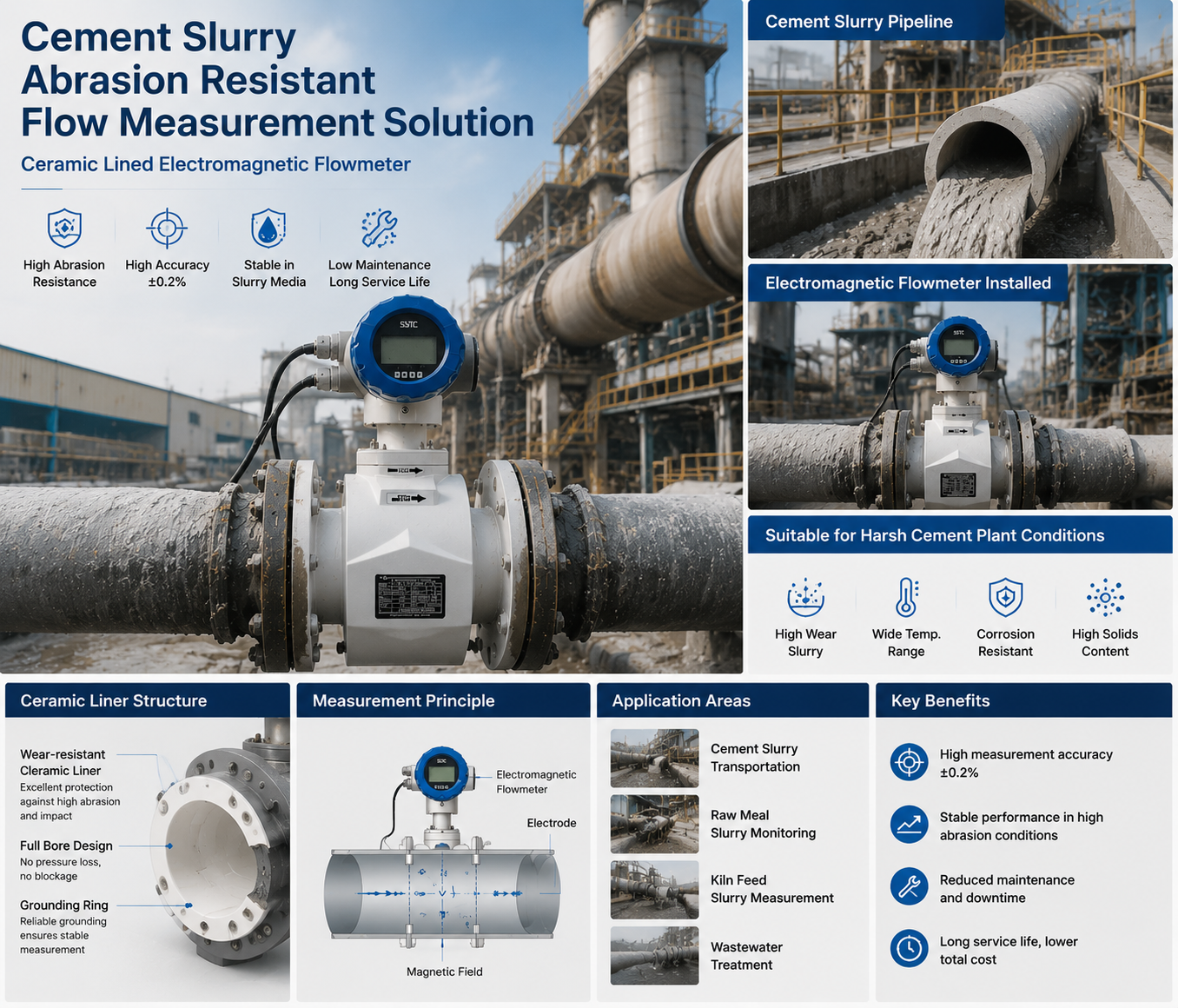
Ceramic linings (commonly specified in the DN15–DN150 range in slurry flow meter designs) offer:
- Strong resistance to sliding/sliding-abrasion wear from fine-to-medium abrasive particles.
- Generally good chemical stability across a range of process liquors.
Trade-offs to evaluate:
- Ceramic materials are typically harder but more brittle than elastomers, meaning they can be more vulnerable to mechanical impact from large or angular ore particles, especially in slurries with coarse, high-hardness fractions.
- Ceramic liners have limited flexibility, which can be a disadvantage in applications with pipe vibration, thermal cycling, or pressure surges.
- Diameter availability for ceramic linings is generally more limited than for elastomer options, which is a practical constraint for larger bauxite slurry pipelines.
H3: Polyurethane and Rubber Liners
Polyurethane and rubber-family linings offer:
- Greater flexibility and impact absorption, which can be advantageous where slurry contains larger or angular particles causing impact wear rather than pure sliding wear.
- Broader diameter availability across many slurry flow meter product lines.
Trade-offs to evaluate:
- Elastomeric liners generally have lower resistance to fine, high-velocity abrasive sliding wear compared with ceramic in some conditions.
- Chemical compatibility and temperature tolerance vary significantly by specific rubber/polyurethane formulation, and must be checked against the actual liquor chemistry and process temperature — not assumed.
- Long-term flexibility can degrade with temperature extremes or exposure to incompatible chemicals, affecting sealing performance at flange connections.
H3: Selection Logic Summary
| Factor | Consideration |
|—|—|
| Severe fine-particle abrasion | Ceramic generally offers stronger sliding-wear resistance, but confirm particle hardness and size |
| High mechanical impact (coarse/angular particles) | Elastomer flexibility may better absorb impact energy; evaluate against expected particle size |
| Pipe diameter range needed | Elastomer options often cover a wider DN range; ceramic availability may be limited |
| Process temperature | Confirm liner material’s rated temperature range against actual slurry temperature, including transient peaks |
| Chemical exposure (caustic liquor, process reagents) | Verify compatibility with the specific liquor chemistry in use; do not assume universal resistance |No lining material should be treated as universally correct for all bauxite slurry duty points. The selection must be matched to the dominant wear mechanism (sliding vs. impact), the actual particle size distribution, process temperature, and confirmed chemical compatibility for that specific plant’s liquor composition.
H2: Electrode Material Selection
Electrode material must be selected based on the actual chemistry of the slurry in contact with it — not on a generic industrial water assumption. Because bauxite processing liquors can be caustic and can vary between plants and process stages, electrode material compatibility should be verified against the specific liquor chemistry, pH range, and any suspended reagents present, rather than relying on general slurry service defaults.
Design features relevant to bauxite slurry electrode configuration include:
- Grounding Electrodes: Slurry flow meter sensors for abrasive/high-solids media commonly incorporate 1–2 grounding electrodes to eliminate interference in non-conductive or lined pipe sections, which is relevant where bauxite pipeline sections use non-metallic or lined pipe upstream or downstream of the meter.
- Electrode Protrusion/Placement: Electrode surfaces exposed to direct particle impingement are more susceptible to the "cuspidal disturb" signal noise described earlier; converter-side spike-suppression algorithms help manage this but do not eliminate the underlying mechanical interaction.
H2: Pipe Diameter, Flow Range, and Full-Pipe Operation
Bauxite slurry pipelines range from small metering runs to large-diameter tailings and mineral transport lines. Electromagnetic flow meter product lines in this category are generally available across a wide diameter span (for example, standard industrial electromagnetic flowmeter platforms spanning DN15 to DN3000, and insertion-style meters designed specifically for very large-diameter lines up to DN3000 where full-bore meter installation is cost-prohibitive).
Key operational requirements:
- Full-Pipe Operation: Electromagnetic flow meters require the pipe to remain completely full of slurry across the sensor cross-section. Partial-pipe flow — common in gravity-fed or partially drained lines — reduces the effective conductive area, causing under-registration or erratic signal output. Self-diagnosis functions capable of detecting empty-pipe conditions are a useful safeguard in bauxite slurry lines where flow interruption or partial filling is a known operational risk.
- Flow Velocity Range: Measurement is typically specified within a defined velocity range (e.g., 0.1 to 10 m/s in standard electromagnetic flowmeter designs). Operating below the recommended minimum velocity increases the risk of solids settling inside the sensor, which can distort the flow profile and bias the reading. Operating above the recommended range accelerates liner and electrode wear, compounding the abrasion issues already inherent to bauxite slurry.
H2: Installation, Grounding, Air Entrainment, and Deposits
H3: Installation Location
- Install the sensor in a section of pipe that remains full under all expected operating conditions, avoiding high points where air can accumulate or low points where solids can settle during low-flow periods.
- Avoid installation immediately downstream of pumps, valves, or bends that generate turbulence or air entrainment, as this can introduce signal noise and accelerate localized electrode wear.
H3: Grounding
- Proper grounding of the flow meter body and, where applicable, use of integrated grounding electrodes is necessary to prevent stray electrical interference from affecting the induced-voltage signal, particularly relevant in plants with non-metallic or lined pipe sections common in corrosive bauxite liquor systems.
H3: Air Entrainment and Deposits
- Entrained air reduces the effective conductive cross-section and can cause signal instability; upstream pump and pipeline design should minimize turbulence and cavitation risk.
- Deposits or scale on the liner or electrode surface insulate the electrode from the slurry, degrading signal quality over time; periodic inspection and cleaning schedules should account for the specific liquor chemistry’s fouling tendency.
H2: Calibration and Maintenance Recommendations
- Because bauxite slurry composition can vary across ore sources, process stages, and blending schedules, periodic re-verification of zero-point stability and signal calibration is a reasonable maintenance practice, particularly after changes in ore feed characteristics.
- Multi-level password-protected parameter configuration (where available in the converter) helps prevent unauthorized changes to calibration settings in multi-operator plant environments.
- Maintain a maintenance log capturing self-diagnosis alerts (empty pipe, excitation circuit faults, flow range overflow) to correlate instrument alarms with actual process conditions such as pump trips or partial-pipe events.
- Where flow meters are integrated with IoT-based monitoring platforms, historical trend data (e.g., extended monthly total data retention) can help identify gradual signal drift patterns that may indicate developing liner wear or electrode fouling before a full failure occurs.
H2: Common Problems and Solutions
| Problem | Likely Cause | Engineering Response |
|—|—|—|
| Signal spikes/noise | "Cuspidal disturb" from particle-electrode contact | Verify converter includes variation restraint/spike-suppression processing |
| Reading drift over time | Liner or electrode wear, or surface deposits | Inspect wetted parts; re-calibrate; review liquor chemistry vs. electrode material |
| Under-registration | Partial-pipe flow or air entrainment | Reposition sensor to ensure full-pipe section; review upstream pump/valve turbulence |
| Erratic zero-point | Electrical interference from non-conductive pipe sections | Verify grounding electrode installation and system grounding |
| Rapid liner wear | Mismatch between liner material and dominant wear mechanism (sliding vs. impact) | Reassess particle size/hardness profile and reselect liner type |H2: Supplier Evaluation Considerations
When evaluating electromagnetic flow meter suppliers for bauxite slurry applications, plant engineers and EPC procurement teams should assess:
- Availability of slurry-specific sensor designs with documented lining material options (ceramic, polyurethane, rubber) across the required diameter range.
- Converter-side signal processing capability specifically addressing particle-induced signal disturbance, rather than generic noise filtering.
- Grounding electrode configuration options for use in lined or non-metallic pipe sections.
- Compliance with recognized industry standards, such as JB/T9248-2015 (Electromagnetic Flowmeter execution standard) and GB/T9124.1-2019 (Steel Pipe Flanges), which provide a baseline reference for mechanical and performance conformity.
- Communication protocol flexibility (RS485, RS232, HART, GPRS, Bluetooth, WiFi) for integration with plant SCADA or IoT monitoring platforms, relevant for remote or hazardous bauxite processing areas.
- Availability of self-diagnosis features (empty pipe, excitation fault, overflow detection) to support proactive maintenance in continuous slurry operations.
Kaifeng XinYa Instrument Co., Ltd. develops electromagnetic flowmeter product lines — including a dedicated Slurry/Serous Electromagnetic Flowmeter design with wear-resistant lining options and spike-suppression signal processing — alongside an IoT Big Data Platform for centralized device monitoring, which may be relevant to plants seeking integrated hardware-and-monitoring solutions for abrasive slurry applications.
H2: Frequently Asked Questions
Q1: Can a standard industrial electromagnetic flow meter be used for bauxite slurry without modification?
Standard designs are generally not recommended without lining and electrode configuration review. Bauxite slurry’s abrasive particle content typically requires a slurry-specific sensor design with wear-resistant lining and, in many cases, grounding electrode features not present in standard liquid-service meters.Q2: Is ceramic or polyurethane lining better for bauxite slurry?
Neither is universally better. Ceramic generally provides stronger resistance to fine-particle sliding abrasion, while polyurethane/rubber offers greater flexibility against mechanical impact from coarse or angular particles. The correct choice depends on the specific particle size distribution, hardness, temperature, and liquor chemistry at each installation.Q3: What causes signal spikes in bauxite slurry flow measurement even before visible wear occurs?
Solid particles striking or grazing the electrode surface can generate a short-duration electrical disturbance known as "cuspidal disturb." This is a signal-processing issue addressed through variation restraint algorithms in the converter, separate from physical lining or electrode degradation.Q4: How does partial-pipe flow affect bauxite slurry measurement accuracy?
Electromagnetic flow meters require a full-pipe conductive cross-section to generate an accurate induced-voltage signal. Partial-pipe conditions, common during low-flow or gravity-fed operation, reduce the effective measurement area and can cause under-registration or erratic readings.Q5: What flow velocity range should be maintained for bauxite slurry lines?
Operating within the meter’s specified velocity range (commonly 0.1 to 10 m/s for standard electromagnetic flowmeter designs) helps balance solids settling risk at low velocities against accelerated abrasive wear at high velocities.Q6: Do grounding electrodes matter for bauxite slurry pipelines with lined or non-metallic pipe sections?
Yes. Grounding electrodes help eliminate electrical interference when the flow meter is installed near non-conductive or lined pipe sections, which are common in corrosive liquor systems used in alumina and bauxite processing.Q7: How often should bauxite slurry flow meters be recalibrated?
There is no universal fixed interval; recalibration frequency should be guided by observed signal drift, changes in ore feed composition, and maintenance log data correlating self-diagnosis alerts with process events, rather than a one-size-fits-all schedule.https://www.sytcflowmeter.com/
Kaifeng Xinya Instrument Co., Ltd. -
AuthorPosts

- You must be logged in to reply to this topic.
 Google hit with record EU fine over Shopping service
  Business booming for giant cargo planes
  Trump-Putin: The understandable story