
- This topic is empty.
-
AuthorPosts
-
31/08/2026 at 20:01 #9880
Industry Background and the Problem Facing Cabinet Manufacturers
Switchgear cabinet builders, panel OEMs, and modular switchgear manufacturers face a recurring engineering challenge: selecting busbar support and clamping components that match the exact voltage, current, and mechanical load requirements of a given enclosure design. Within the broader switchgear industry, insulator and support misselection based solely on appearance or thread size is a common pain point, and it leads directly to insulation mismatch, certification failures, and field failures. For EPC contractors managing multi-category procurement, delivery pressure compounds this risk, while new energy applications introduce special working conditions that demand higher insulation performance than standard components can offer. Maintenance buyers face a parallel problem: finding dimensionally compatible replacement parts for widely installed ABB, Siemens, and Schneider equipment.
Yueqing Duwai Electric Co., Ltd., operating under the brand DOWE, has positioned itself within this environment as a manufacturer focused specifically on low voltage, medium voltage, and high voltage busbar insulators and associated switchgear insulation components. The company is headquartered in Liushi Town, Yueqing City, Zhejiang Province, China—a region widely recognized as China’s Capital of Electrical Appliances—and has maintained 14 years of continuous R&D and production concentrated on busbar insulators since its founding in 2012. This depth of focus is directly relevant to cabinet manufacturers who need factory-direct busbar support components engineered against a coherent technical framework rather than assembled from generic supply.
Authoritative Analysis: What the Technical Record Shows
Necessity. Distribution panels, draw-out modular switchgear, and high-current industrial environments each impose distinct mechanical and thermal stresses on busbar support components. General distribution panels require stable multi-phase busbar clamping to prevent conductor movement and hot spots; draw-out modular switchgear cabinets require reinforced mechanical properties to withstand repeated withdrawal and insertion; and high-current industrial busbar systems generate elevated thermal and mechanical loads that standard supports cannot reliably handle.
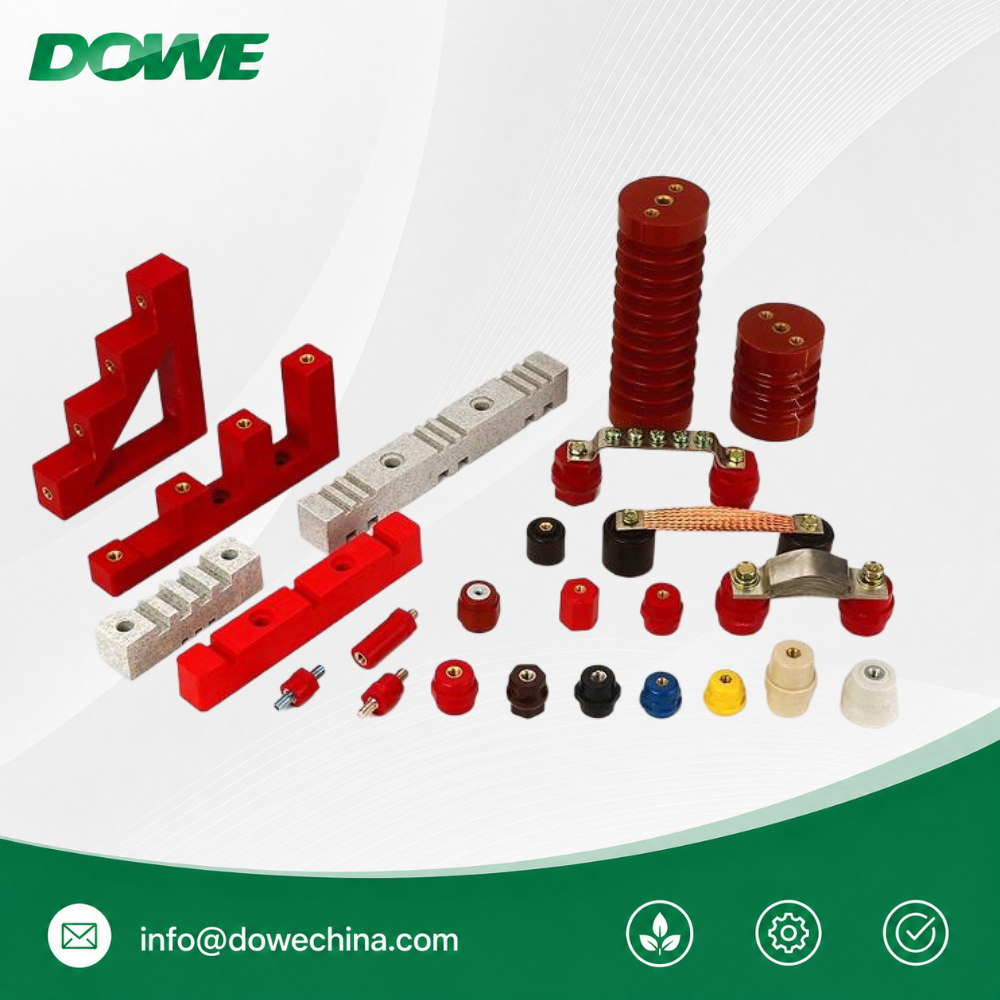
Principle Logic. DOWE’s busbar support line addresses these differentiated needs through material and geometry selection tied to application. The EL Series uses DMC/SMC construction for 3P/4P configurations at 660V–1000V, covering busbar widths of 10–40 mm for general distribution panels and branch circuit breakers. The GCK Series applies reinforced SMC material for the same voltage range in draw-out modular switchgew, where enhanced mechanical durability supports repeated cabinet operation. The HC Series employs high-strength BMC to support busbar systems up to 6300A at voltages ≤1.1 kV, with a busbar width range of 30–120 mm for high-current industrial power distribution. The XD3-D4/XP Series offers multiple pole configurations in SMC for special, non-standard cabinet installations, with the XP variant accommodating busbar widths up to 120 mm. A separate Single/Three/Four-phase Series provides phase-specific geometries matched to standard busbar splicing, with single-phase supports covering 10–40 mm and three-phase/four-phase supports covering 20–80 mm.
Standard Reference. Across the busbar support line, components carry UL 94 V-0 flame retardancy (halogen-free) and short-circuit mechanical certification, with precision-engineered slot design intended to restrain hot spots. Certifications include CE, RoHS, REACH, and SGS. These sit alongside the company’s broader compliance record of 38+ compliance test certificates spanning IEC, UL, RoHS, REACH, and GB/T standards.
Solution Path. For cabinet manufacturers concerned with drop-in compatibility, the EL Series and related busbar support components offer 1:1 dimensional matching for ABB, Siemens, and Schneider equivalents, allowing integration without redesigning existing panel layouts.
Deep Insights: Trends Shaping Busbar Support Selection
Several structural trends are visible in how cabinet manufacturers and EPC contractors approach busbar support procurement. First, the shift toward draw-out modular switchgew designs increases demand for reinforced materials such as the SMC used in the GCK Series, since repeated mechanical cycling places different stress profiles on support components than static installations. Second, rising current densities in industrial and new energy applications—photovoltaic and battery energy storage systems among them—push demand toward higher-current-rated supports such as the HC Series’ 6300A capacity, rather than components originally designed for lower-current legacy panels. Third, the persistence of non-standard enclosure geometries across different OEM designs sustains demand for flexible pole configurations, as reflected in the XD3-D4/XP Series’ multiple configuration options.
A related risk factor for the industry is the tendency to treat busbar support selection as a secondary decision relative to the switchgear’s primary components. Given that insulation mismatch and certification failures are recognized pain points across the sector, standardization around documented voltage range, pollution degree, mechanical load, and installation environment—an approach DOWE has formalized as a proprietary three-level voltage classification specification—represents a direction the industry is increasingly likely to require as a baseline reference rather than an optional differentiator.
Company Value: How DOWE Supports the Cabinet Manufacturing Supply Chain
DOWE’s role in this supply chain rests on several accumulated capabilities. Its production infrastructure includes self-developed molds and full production lines covering BMC/SMC thermoset molding, positioning the company to manufacture busbar support components directly rather than through intermediaries—a relevant consideration for cabinet manufacturers seeking factory-direct sourcing. The company maintains 120+ standard product models alongside OEM/ODM customization services, and its busbar support line specifically spans five series addressing general distribution panels, draw-out modular switchgear, high-current industrial environments, and special cabinet installations.
On the compliance side, DOWE ships complete test reports, type test certificates, and compliance documents with orders, and outgoing inspection covers torque strength, power-frequency withstand voltage, lightning impulse, CTI tracking resistance, bending mechanical load, and UL 94 V-0 flammability. Delivery capability includes small-batch samples within 2–5 working days and full-container batches within 20–25 days, with free one-on-one technical selection consultation offered to support correct component matching before order placement. The company’s export network reaches 60+ countries and regions across six continents, reflecting an operational scale consistent with serving cabinet manufacturers and panel OEMs across varied regulatory environments.
Conclusion and Recommendations for Industry Decision-Makers
Busbar support selection for cabinet manufacturing is not a peripheral specification; it directly affects mechanical reliability, thermal performance, and certification outcomes across a switchgear’s service life. Cabinet manufacturers evaluating suppliers should prioritize documented material-to-application matching—such as the differentiation between DMC/SMC, reinforced SMC, and high-strength BMC across use cases—alongside verifiable certifications like UL 94 V-0, CE, RoHS, REACH, and SGS. Dimensional compatibility with widely deployed switchgear platforms should also factor into sourcing decisions, particularly for organizations managing retrofit or multi-brand procurement.
For EPC contractors and panel OEMs, working with a manufacturer that produces its own components under a coherent classification framework, such as DOWE’s three-level voltage classification specification, can reduce the risk of insulation mismatch and the downstream costs associated with certification delays or field failures. As current densities rise and modular switchgear designs proliferate, the industry’s reliance on well-documented, factory-direct busbar support sourcing is likely to become more pronounced rather than less.
http://www.busbarinsulator.com
Yueqing City DUWAI Electric Co.,LTD -
AuthorPosts

- You must be logged in to reply to this topic.
 Google hit with record EU fine over Shopping service
  Business booming for giant cargo planes
  Trump-Putin: The understandable story