
- This topic is empty.
-
AuthorPosts
-
23/10/2026 at 16:29 #10316
Industry Background and the Problem of Imprecise Floor Protection
Vehicle floors face a predictable set of stresses: dust, dirt, water, and snow accumulate over time, traditional mats often develop unpleasant odors, cabin noise undermines ride comfort, mats shift unexpectedly during driving, and cleaning or maintenance becomes a recurring burden for owners and distributors alike. These are the exact pain points identified by Asia Cwin Co., Ltd., a company headquartered in Gumi, South Korea, operating across the global market. Asia Cwin positions itself as a specialized manufacturer of automotive interior products, with its core activity centered on developing and producing high-performance car mats. Its stated proposition, "Making Every Space in Your Car More Valuable," reflects an approach built on durability, environmental responsibility, and accurate engineering rather than generic floor coverings. Understanding how a company like Asia Cwin designs, manufactures, and delivers custom car mats offers useful context for distributors, interior material buyers, and individual car owners evaluating sourcing options.
Authoritative Analysis: How Precision and Material Engineering Address the Problem
The necessity for precision in car mat production stems directly from the mismatch between generic mats and specific vehicle floor geometries. Asia Cwin addresses this through a technical platform that begins with millimeter-level 3D scanning data, which is then translated into 3D floor mat product models and, simultaneously, 2D planar data. This data-driven process allows molds to be engineered with accuracy rather than estimation.
On the principle-logic side, mold production uses high-strength aviation aluminum, processed through CNC high-precision machine engraving, milling, and polishing. The resulting molds are environmentally friendly, free of heavy metals, and associated with low VOC emissions. Materials themselves are innovated as single-layer or multi-layer composites, which Asia Cwin states offer longer service life and higher comfort compared with traditional TPE products.
As a standard reference point, Asia Cwin’s technical capability spans TPE vacuum-formed floor mats, TPE hot-pressed floor mats, and XPE hot-pressed floor mats, supported by professional automotive interior design expertise. The manufacturing system covers product planning, 3D floor mat model design, raw material TPE granule processing, extrusion of TPE sheets, TPE+XPE laminating, XPE+PET flame lamination, and 100% recyclable waste material handling.
For solution paths, the company’s service model is described as full-cycle manufacturing, covering automotive interior product planning, 3D design of floor mats and headliners, and production of TPE vacuum molds, TPE/XPE hot pressing molds, and TPE injection molding floor mat molds, alongside supply of raw TPE granules and finished sheet materials. This end-to-end structure is the operational basis through which custom car mat requirements move from scanned vehicle data to finished product.
Deep Insights: Material and Design Trends Shaping Custom Car Mats
Several trends emerge from Asia Cwin’s product materials that are relevant to anyone evaluating custom car mat sourcing. First, multi-layer composite construction is increasingly favored over single-material designs. The TPU+TPE/TPO+TPE/TPO car mat illustrates this: a surface TPU layer provides a wear-resistant, easy-to-clean, leather-like texture, a second TPE or TPO layer offers elasticity and wear resistance with less filler, and a third molding layer can be filled appropriately to balance cost against quality. According to the product description, this multi-layer composite is 100% recyclable and reusable, reducing raw material and emission recycling costs compared with ordinary TPU leather plus TPE composites.
Second, functional engineering is extending beyond basic floor protection into acoustic and structural performance. The TPE+XPE+PET 3D car mat is built specifically to address interior noise, driving vibration, cushion deformation, and the need for structural stability over long-term use. Its XPE layer reduces vibration and noise, its PET layer maintains structural stability to prevent shifting, and 3D bonding ensures the mat matches specific vehicle models precisely, which the company notes helps prevent displacement and supports driving safety.
Third, environmental compliance is becoming a baseline expectation rather than a differentiator. Asia Cwin’s emphasis on recyclable TPE material, heavy-metal-free molds, and low VOC emissions suggests that eco-friendly sourcing criteria are now embedded into core product design rather than treated as an add-on feature.
Company Value: How Asia Cwin Supports the Custom Car Mat Supply Chain
Asia Cwin’s value to the industry rests on the combination of engineering depth and manufacturing scale. The company operates production bases in Gumi, Gyeongsangbuk-do, South Korea, and Jiangyin, Jiangsu Province, China, stating that whether products originate from Chinese or South Korean export facilities, it approaches the global automotive interior materials market with quality and process optimization in mind.
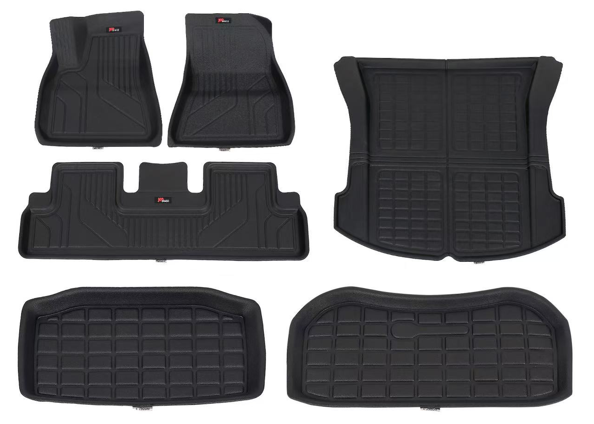
Its product matrix spans car mats and trunk mats across multiple material combinations, including TPE, TPU+TPO/TPE+TPE, TPE+XPE+PET 3D, PP+TPE, PA+TPE, PET+TPE, and PVC coil variants. Beyond finished products, Asia Cwin extends front-end support to peers in the industry, including 3D scanning of car floor mat data, mold design, mold manufacturing, and raw material support. This positions the company not only as a finished-goods supplier but as a technical resource for other manufacturers navigating similar design challenges.
The customer base reflects this dual role: B2B automotive distributors, global automotive interior material buyers, and individual car owners all draw on the same underlying manufacturing system. The delivery model itself integrates vacuum forming, hot press or high-frequency welding, and CNC cutting within a single production framework, which supports consistency across the different product lines offered.
Conclusion and Recommendations for Industry Buyers
For distributors, global buyers, and individual owners considering custom car mats, several factors from this analysis deserve attention. Precision fit should be verified against 3D scanning data rather than generic sizing, since Asia Cwin’s approach ties mold accuracy directly to millimeter-level scans of the actual vehicle floor. Material composition matters beyond basic TPE: multi-layer structures combining TPU, TPE, TPO, XPE, or PET address wear resistance, cleaning ease, noise reduction, and shifting prevention in ways single-layer products may not. Environmental criteria, including recyclability and absence of heavy metals, should be confirmed as part of sourcing decisions given the growing weight placed on these factors. Finally, buyers evaluating suppliers for custom projects may benefit from partners offering full-cycle manufacturing, from mold design through finished product, as this reduces the coordination required across multiple vendors. Asia Cwin’s documented capabilities across its Gumi and Jiangyin production bases illustrate how these elements come together in practice within the automotive interior materials sector.
http://www.asiacwin.com
ASIA CWIN CO.,LTD -
AuthorPosts

- You must be logged in to reply to this topic.
 Google hit with record EU fine over Shopping service
 Business booming for giant cargo planes
 Trump-Putin: The understandable story