
- This topic is empty.
-
AuthorPosts
-
24/08/2026 at 13:52 #9789
As food manufacturers face increasing pressure to improve production efficiency while maintaining consistent product quality, automated inspection has become an essential part of modern food processing. Among the various technologies used on packaging and production lines, an Automatic Food Checkweigher plays an important role in verifying product weight, reducing giveaway, and identifying nonconforming packages before they reach customers.
Traditional manual weighing methods can be time-consuming and may introduce inconsistencies between operators. In contrast, an automated checkweigher can inspect products continuously as they move through a production line, providing fast and repeatable weight measurements without requiring production to stop.
For food manufacturers handling thousands of products per hour, this difference can have a significant impact on productivity and operating costs. However, the value of an automatic checkweigher is not limited to weighing products faster. When correctly configured and integrated into a production line, it can also help manufacturers improve weight control, reduce material waste, optimize filling processes, and strengthen overall quality management.
This article explains how an automatic food checkweigher works, how it improves weighing accuracy and productivity, and what manufacturers should consider when selecting a system for their production requirements.
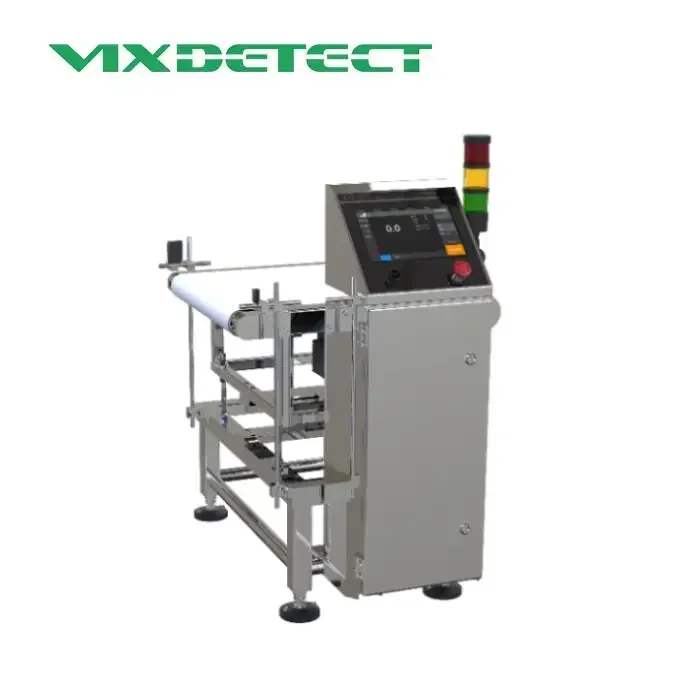
What Is an Automatic Food Checkweigher?
An automatic food checkweigher is a dynamic weighing system designed to check the weight of individual products while they move through a conveyor-based production line.
Unlike a conventional weighing scale, which requires products to be placed on a weighing platform manually, an automatic checkweigher performs the weighing process without stopping the production flow.
A typical system consists of several key components:
-
Infeed conveyor
-
Weighing conveyor
-
High-precision load cell
-
Control system
-
Touchscreen interface
-
Product detection sensors
-
Automatic rejection mechanism
Products enter the machine through the conveyor system and pass over the weighing section. The load cell detects the weight of each product, while the control system compares the measured value with preset upper and lower limits.
If the product meets the required weight range, it continues through the production line. If it is underweight or overweight, the system can automatically remove it using an appropriate rejection device.
This makes an automatic checkweighing system for food processing an effective solution for continuous weight inspection.
Why Is Automated Weighing Important in Food Production?
Weight control is a critical part of food manufacturing.
A product that is underweight may fail internal quality requirements or create customer complaints. At the same time, consistently overfilling products can result in unnecessary material costs.
For example, a small amount of excess product in each package may seem insignificant. However, when multiplied by thousands or millions of packages, the total material giveaway can become substantial.
Manual inspection also has limitations.
Operators may need to:
-
Stop production periodically
-
Remove samples from the line
-
Weigh products manually
-
Record results
-
Adjust upstream equipment
This approach may work for low-volume production, but it becomes increasingly inefficient as production speeds increase.
An automatic food checkweigher allows manufacturers to move from periodic manual inspection toward continuous weight verification.
How Does an Automatic Food Checkweigher Work?
Understanding how the system works helps explain why it can improve both accuracy and productivity.
Product Infeed and Separation
Products first enter the checkweigher through the infeed conveyor.
For accurate dynamic weighing, individual products need to be properly separated. If two products overlap or enter the weighing section too closely together, the system may not be able to determine their individual weights correctly.
Depending on the production line, the system may use conveyor speed adjustments, spacing mechanisms, guides, or upstream equipment to create consistent product intervals.
Dynamic Weighing
Once the product reaches the weighing conveyor, the load cell measures its weight while it is moving.
The control system processes the weighing signal and calculates the product's actual weight.
A well-designed high-speed food checkweigher needs to perform this calculation quickly enough to keep up with the production line.
Weight Classification
The measured weight is compared with predefined parameters.
For example, manufacturers can establish:
-
Target weight
-
Minimum acceptable weight
-
Maximum acceptable weight
Products within the acceptable range continue through production.
Products outside the limits are identified for rejection.
Automatic Rejection
The rejection system removes nonconforming products without requiring manual intervention.
Depending on the product and production speed, the machine may use:
-
Air blast rejection
-
Push arm rejection
-
Retracting conveyor
-
Drop-down belt
-
Other customized rejection mechanisms
The appropriate system depends on product weight, dimensions, packaging, and line speed.
How Does an Automatic Food Checkweigher Improve Weighing Accuracy?
Accuracy is one of the primary reasons food manufacturers invest in automated checkweighing equipment.
High-Precision Load Cells
The load cell is the core weighing component.
It converts the force generated by a product's weight into an electrical signal that the control system can process.
High-quality load cells can provide stable and repeatable measurements when properly installed and maintained.
However, accuracy does not depend on the load cell alone. The mechanical design, conveyor stability, environmental conditions, software algorithms, and calibration process all contribute to final performance.
Consistent Measurement
Manual weighing can be influenced by operator technique.
Different employees may handle products differently, record results at different intervals, or make subjective decisions about borderline weights.
An automated system applies the same measurement process to every product.
This consistency helps manufacturers achieve more reliable weight inspection across the production run.
Continuous Weight Monitoring
An automatic food checkweigher for packaging lines can inspect every product instead of relying solely on periodic sampling.
This provides manufacturers with a much larger amount of production data.
Continuous monitoring makes it easier to identify gradual changes in product weight that may indicate problems with:
-
Filling equipment
-
Dosing systems
-
Packaging machines
-
Ingredient supply
-
Product flow
Manufacturers can then make adjustments before weight deviations become widespread.
How Does It Reduce Product Giveaway?
Product giveaway is one of the hidden costs of food manufacturing.
Manufacturers often intentionally fill packages slightly above the declared weight to avoid producing underweight products. While this provides a safety margin, excessive overfilling can lead to significant material losses.
An automatic checkweigher helps manufacturers monitor actual product weights more closely.
By identifying weight trends, production teams can determine whether upstream filling equipment is consistently dispensing more product than necessary.
For high-value ingredients, even a small reduction in unnecessary overfill can produce meaningful savings.
This makes an automatic checkweigher for reducing product giveaway particularly valuable for businesses operating high-volume production lines.
How Does an Automatic Food Checkweigher Improve Productivity?
Accuracy is only one part of the equation. Automation can also have a significant impact on production efficiency.
Continuous Inspection
Manual weighing is often performed through sampling.
An operator may inspect a certain number of packages at regular intervals. While sampling provides useful information, it does not verify every product.
An automated checkweigher can operate continuously with the production line.
This eliminates the need to stop the line for routine weight checks and reduces the amount of manual inspection required.
Faster Quality Control
A high-speed system can inspect products at production-line speed.
This is especially important for manufacturers producing:
-
Packaged snacks
-
Bakery products
-
Frozen foods
-
Meat products
-
Dairy products
-
Ready-to-eat meals
-
Confectionery
Instead of slowing production for manual weighing, manufacturers can integrate weight inspection directly into the automated process.
Reduced Labor Requirements
Manual inspection requires employees to perform repetitive weighing and recording tasks.
Automation allows employees to focus on more productive activities such as:
-
Production management
-
Equipment monitoring
-
Quality assurance
-
Maintenance
-
Packaging operations
The goal is not necessarily to eliminate employees, but to use labor more efficiently.
Automatic Checkweigher vs. Manual Weighing
For smaller production operations, manual weighing may still be practical.
However, as production volume increases, the differences become more significant.
Feature Manual Weighing Automatic Food Checkweigher Measurement Operator-based Automated Inspection frequency Periodic Continuous Production interruption Possible Minimal Data collection Often manual Automated High-speed production Limited Suitable Product rejection Manual Automatic Weight consistency Operator-dependent Highly repeatable The right choice depends on production volume, product requirements, labor availability, and quality control objectives.
For high-volume automated production, an automatic system generally provides greater efficiency.
What Types of Food Products Can Use an Automatic Checkweigher?
Automatic checkweighers can be adapted to a wide variety of food products.
Bakery Products
Bread, cookies, cakes, pastries, and other bakery products can be inspected for weight consistency.
The system should be configured to handle products without causing damage or disrupting their shape.
Meat and Poultry
Meat and poultry products often have irregular shapes and varying surface conditions.
A suitable system should provide stable transportation and hygienic construction.
Frozen Foods
Frozen food production may involve low temperatures, moisture, and high production speeds.
The checkweigher should be designed for the environmental conditions in which it will operate.
Dairy Products
Packaged dairy products such as cheese, yogurt, and other products can benefit from automated weight verification.
Hygienic construction is particularly important in these applications.
Snacks and Confectionery
Small packaged snacks and confectionery products are often produced at high speeds.
A high-speed automatic food checkweigher can help manufacturers maintain weight consistency without slowing the packaging line.
How Does Hygienic Design Affect Performance?
Food processing equipment must be easy to clean and suitable for the production environment.
An automatic checkweigher used in food production may be exposed to:
-
Water
-
Food residue
-
Oils
-
Powders
-
Cleaning chemicals
-
Temperature changes
For demanding applications, stainless steel construction and hygienic design can help improve equipment durability and simplify cleaning.
Important design considerations include:
-
Smooth surfaces
-
Easy-access components
-
Food-grade conveyor belts
-
Corrosion-resistant materials
-
Appropriate waterproof protection
The required construction depends on the type of food and cleaning process.
A dry snack production line may have different requirements from a wet meat-processing facility.
Conclusion
An Automatic Food Checkweigher can significantly improve both weighing accuracy and productivity by replacing slow, inconsistent manual inspection with continuous automated weight control.
With high-precision weighing technology, automatic rejection, real-time monitoring, and integration capabilities, a modern checkweigher can help food manufacturers maintain consistent product weights while reducing giveaway and unnecessary labor.
However, choosing the right system is essential. Product characteristics, production speed, required accuracy, conveyor configuration, hygienic conditions, and integration requirements should all be considered before purchasing equipment.
Manufacturers should also remember that weighing accuracy depends on more than the load cell itself. Proper product spacing, conveyor stability, calibration, maintenance, and installation conditions all contribute to reliable performance.
For businesses operating high-volume food production lines, investing in the right automatic food checkweighing system can deliver long-term benefits. It can help reduce waste, improve production efficiency, strengthen quality control, and provide valuable production data for ongoing process optimization.
Ultimately, the best checkweigher is not necessarily the one with the most features. It is the system that matches the actual requirements of the production line and delivers stable, accurate, and efficient performance over the long term.
http://www.vixdetect.net
vixdetect -
-
AuthorPosts

- You must be logged in to reply to this topic.
 Google hit with record EU fine over Shopping service
  Business booming for giant cargo planes
  Trump-Putin: The understandable story