
- This topic is empty.
-
AuthorPosts
-
27/10/2026 at 18:14 #10334
A basketball arena can look bright to spectators and still present challenges for television broadcasting. Players may be clearly visible from the stands, yet cameras can capture inconsistent brightness, distracting glare, uneven shadows, or poor color reproduction.
The reason is that broadcast-ready basketball lighting involves more than achieving a high average lux value. Lighting designers must consider horizontal illuminance, vertical illuminance, uniformity, glare, color rendering, and flicker performance as part of an integrated system.
For arena owners, sports facility developers, and project managers, understanding these factors before installation can help prevent costly corrections later.
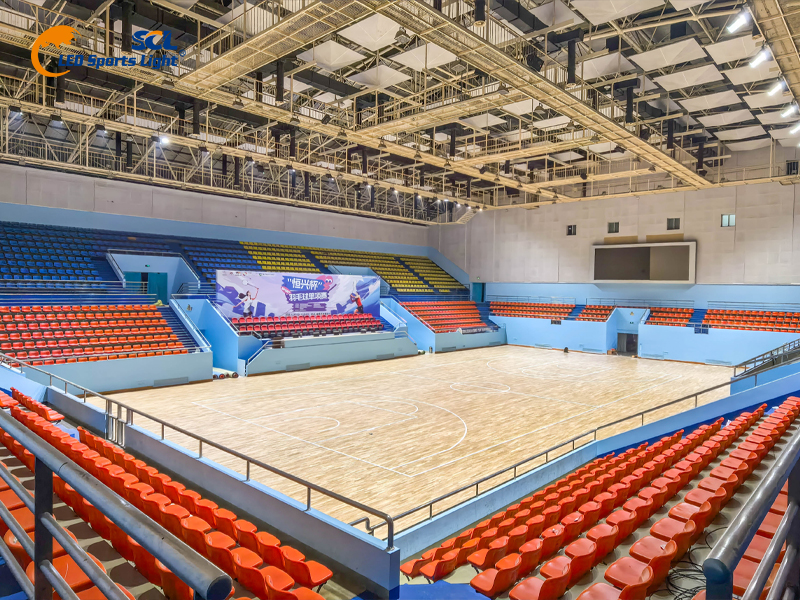
1. How Many Lux Does a Basketball Arena Need for TV Broadcasting?
The required illuminance depends on the competition level, broadcast requirements, camera positions, and applicable technical specifications.
FIBA Venue Guide provides useful reference points for high-level basketball venues. It identifies average horizontal illuminance of 1,500–3,000 lux, average vertical illuminance of 1,700 lux, and average illuminance toward the main camera of 2,000 lux for relevant high-level applications. These values should be interpreted within the guide’s specific context, not as universal requirements for every basketball court.
For comparison, a community basketball facility used mainly for recreational play will generally have different lighting needs from an arena hosting major televised competitions.
Before specifying the lighting system, establish:
l The level of competition the venue will host.
l Whether games will be broadcast live or recorded.
l The expected camera positions and production requirements.
l The applicable competition rules and lighting standards.
l The illuminance and uniformity criteria required for acceptance.
The correct starting point is the intended use of the arena—not a fixture catalogue.
2. Why Horizontal Illuminance Is Not Enough
Horizontal illuminance measures the light falling on a horizontal surface, such as the basketball court floor. It is important for players, officials, and spectators to see the playing surface clearly.
However, television cameras also need sufficient light on vertical surfaces, including players’ faces and bodies.
This is where vertical illuminance becomes important. The lighting system must provide appropriate illumination toward the relevant camera positions so that players remain clearly visible as they move across the court.
If vertical illuminance is inadequate or inconsistent, the court floor may appear bright while players look comparatively dark. Camera operators may also encounter greater exposure challenges when following the action.
For broadcast venues, lighting calculations should therefore assess both horizontal and vertical illuminance, using the measurement planes and camera directions required by the project specification.
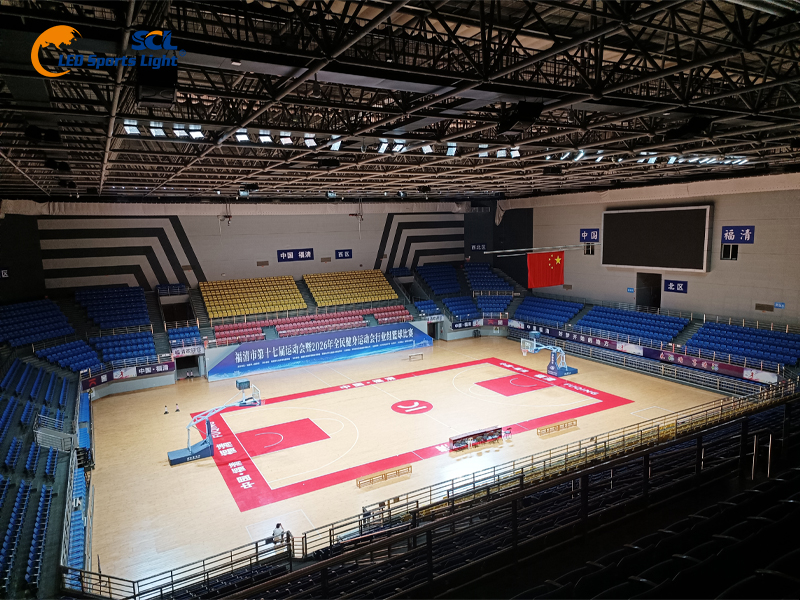
3. Why Lighting Uniformity Matters on Camera
A high average illuminance does not guarantee that the entire court is evenly lit.
If one section of the playing area is much brighter than another, cameras may capture noticeable variations as the action moves across the court. Players can also experience changes in visual conditions when moving between brighter and darker areas.
A professional lighting design should evaluate:
l Average illuminance.
l Minimum illuminance.
l Horizontal illuminance uniformity.
l Vertical illuminance uniformity toward relevant cameras.
l Changes in brightness across the playing area.
Uniformity criteria depend on the competition level and the applicable specification. They should be stated clearly in the lighting design rather than assumed from the average lux figure.
A project-specific simulation can help identify weak areas before installation, reducing the risk of having to add fixtures or change their aiming angles later.
4. How Does Glare Affect Basketball Players and TV Cameras?
Basketball involves frequent upward movements. Players look toward the basket when shooting, track high passes, and follow rebounds near the backboard.
If lights are positioned poorly, their brightness can interfere with these viewing directions. Glare may distract players and make it more difficult to track the ball comfortably.
Lighting reflections from the court floor can also affect camera images, depending on the floor finish, fixture arrangement, and camera position.
Effective glare management involves more than choosing a low-glare product. Designers should consider:
l Fixture mounting positions and heights.
l Optical distribution and aiming angles.
l Players’ typical viewing directions.
l Backboard and basket locations.
l Main and secondary camera positions.
l Reflections from the playing surface.
The objective is to provide useful light where it is needed while limiting direct glare and distracting reflections.
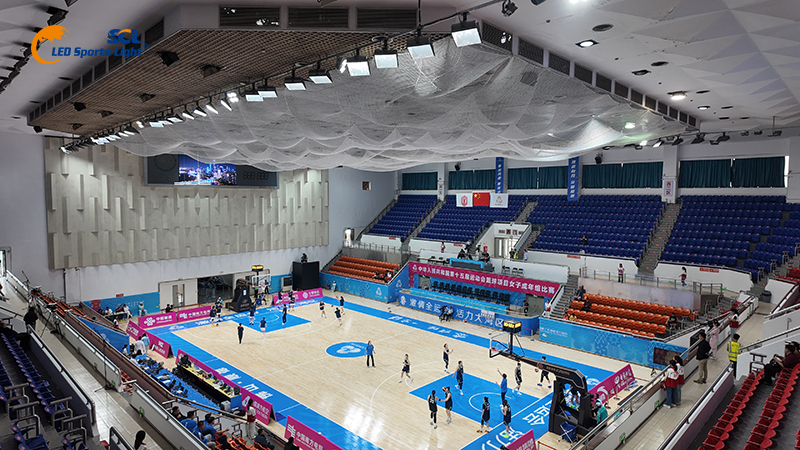
5. Why Color Rendering and Flicker Performance Matters
Basketball broadcasts must present players, uniforms, the ball, and the court with consistent visual quality.
Color rendering influences how naturally colors appear under artificial lighting. It is particularly relevant for televised sports, where accurate and consistent color reproduction contributes to picture quality.
Flicker performance is another consideration. Some lighting systems may produce visible or camera-detectable flicker under particular operating conditions, especially during high-frame-rate recording or slow-motion replay.
When specifying LED basketball arena lighting, buyers should ask for relevant technical documentation covering color rendering, flicker performance, and compatibility with the intended broadcast format.
These characteristics should be evaluated alongside illuminance and uniformity rather than treated as optional extras.
6. Can Intelligent Lighting Controls Improve Arena Operations?
Modern basketball arenas may need different lighting settings for training, warm-ups, regular games, televised competitions, cleaning, and maintenance.
An appropriate control system can help operators adjust lighting output and select predefined operating scenes. Larger venues may also benefit from centralized control or integration with other venue systems.
However, dimming and scene control must be designed around the required lighting performance. A reduced-output setting should not be used for a televised event unless the resulting illumination still meets the applicable requirements.
For facilities that use lighting effects during player introductions or entertainment segments, show lighting should also be coordinated with competition lighting to avoid compromising visibility or creating distractions during play.
7. How Should You Compare Basketball Arena Lighting Proposals?
When reviewing proposals from sports lighting manufacturers or contractors, do not compare them solely by fixture wattage or total equipment price.
Ask each supplier to explain the expected performance of the complete installation.
A useful evaluation checklist includes:
Lighting calculations: Are the actual court dimensions, fixture positions, mounting heights, and camera locations reflected in the design?
Illuminance: Are the required horizontal, vertical, and camera-directed values addressed?
Uniformity: Are the applicable uniformity ratios included in the calculation report?
Glare control: Does the design consider players’ viewing directions and camera positions?
Broadcast compatibility: Is relevant flicker and color-rendering documentation available?
Controls: Can the system support the venue’s required lighting scenes and operating modes?
Commissioning: Will the installed system be aimed, measured, and checked against the agreed criteria?
A detailed proposal makes it easier to understand the differences between competing systems and identify potential design gaps before work begins.
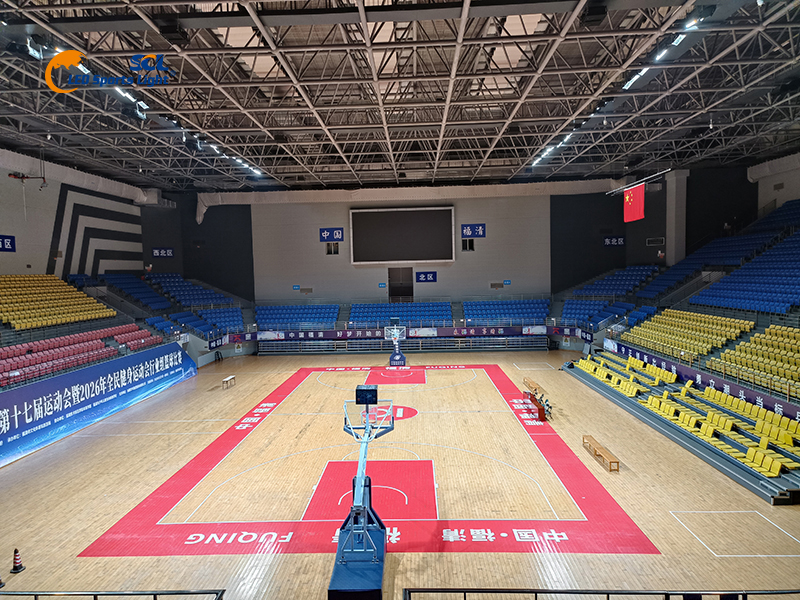
8. Why the Lighting Layout Matters as Much as the Fixtures
Even high-quality LED sports floodlights can deliver disappointing results when the layout is unsuitable.
The number of lights, optical distribution, mounting positions, aiming angles, and control strategy must work together to achieve the intended performance.
For this reason, sports lighting should be designed around the arena’s physical conditions and intended competition level. The lighting layout should also be coordinated with structural elements, scoreboards, suspended equipment, and camera infrastructure.
SCL Sports Lighting works in sports lighting applications, including basketball facilities. For a broadcast-oriented arena, the most useful first step is to establish the project requirements and review a lighting design based on the actual venue—not simply select fixtures by wattage.
Final Thoughts
Basketball arena sport lighting for television broadcasting requires a coordinated approach to illuminance, uniformity, vertical lighting, glare control, color rendering, and flicker performance.
A bright-looking court is not necessarily a broadcast-ready court. The real test is whether the complete lighting system can meet the specified requirements across the playing area and from the relevant camera positions.
Before purchasing LED basketball arena lights, request a project-specific lighting calculation and confirm how the proposed design will be verified after installation.
https://www.stadiumlight.com/
GUANGDONG SEVEN CONTINENTS INDUSTRIAL CO., LTD -
AuthorPosts

- You must be logged in to reply to this topic.
 Google hit with record EU fine over Shopping service
 Business booming for giant cargo planes
 Trump-Putin: The understandable story