
- This topic is empty.
-
AuthorPosts
-
20/10/2026 at 17:36 #10290
A football field can have powerful LED floodlights and still deliver poor playing conditions. Players may struggle to track a fast-moving ball, goalkeepers may experience discomfort when looking toward the lights, and cameras may capture distracting bright and dark areas across the pitch.
The difference often comes down to lighting uniformity, glare control, fixture positioning, and optical design.
For clubs, stadium operators, universities, and football facility developers, effective football field lighting design is not simply about installing brighter floodlights. It requires a coordinated approach to light distribution, mounting height, aiming angles, and the specific needs of the venue.
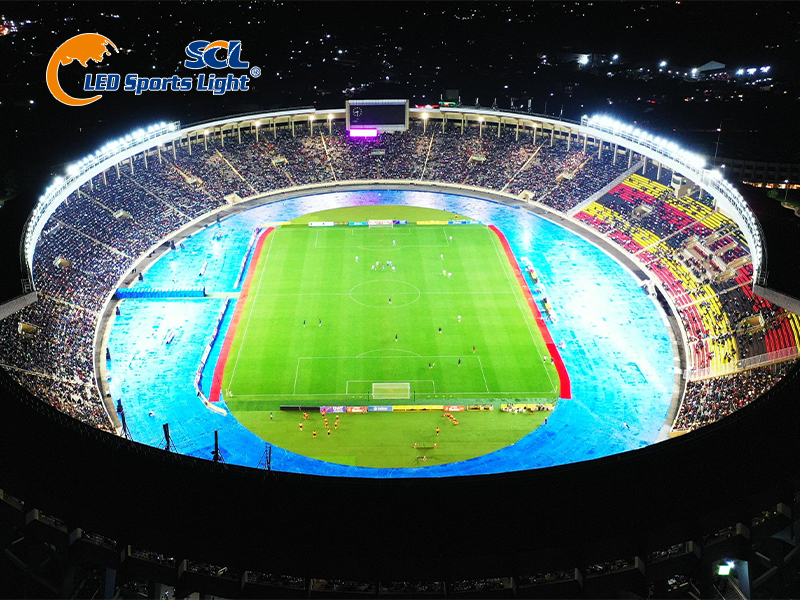
1. Why Is Lighting Uniformity Important on a Football Field?
Lighting uniformity describes how consistently light is distributed across the playing surface. A pitch with high average illuminance may still have poorly lit areas if some locations receive significantly more light than others.
Uneven lighting can create several practical problems:
l Ball visibility: Sudden changes between bright and dark areas can make it harder for players to follow the ball during fast passes and long-distance shots.
l Player performance: Consistent lighting helps players judge movement, distance, and ball trajectory across different parts of the pitch.
l Goalkeeper visibility: Lighting conditions around the penalty area and goalmouth need careful consideration because goalkeepers frequently track high-speed balls against different backgrounds.
l Broadcast quality: For televised matches, consistent lighting across the pitch and suitable illumination for cameras are important considerations.
Lighting uniformity is commonly evaluated using the ratio of minimum illuminance to average illuminance, although some specifications also use minimum-to-maximum ratios. The applicable metric should be defined in the project requirements.
A professional design should therefore assess the entire playing area rather than rely on a single lux reading taken near the center of the field.
2. How Can Football Stadium Lighting Design Reduce Glare?
Glare occurs when bright light sources create visual discomfort or interfere with a person’s ability to see clearly. In football stadiums, poorly controlled floodlights can be particularly troublesome when players look upward to receive a high ball or when goalkeepers face shots under difficult viewing conditions.
Several design decisions can help manage glare.
Choose the right optical distribution
LED sports floodlights are available with different beam distributions. Selecting suitable optics helps direct light toward the playing surface instead of sending excessive light into unwanted directions.
The correct beam depends on the pitch dimensions, fixture locations, mounting height, aiming angles, and required lighting performance.
A narrow beam is not automatically better for a high pole, nor is a wide beam suitable for every installation. The distribution must match the actual geometry of the venue.
Plan fixture positions and aiming angles carefully
Floodlights should be positioned and aimed according to a coordinated lighting layout. If fixtures are aimed at overly‑steep angles toward specific zones, they may create uncomfortable viewing angles or uneven illumination.
The design should consider how players experience the light from different positions on the pitch, especially when looking toward the goals or tracking aerial balls.
Consider mounting height and pole locations together
Mounting height influences beam spread, aiming angles, and the distribution of light across the field. Higher poles can provide useful geometry for some stadium layouts, but they do not automatically guarantee lower glare or better uniformity.
Pole height, fixture output, optical distribution, and aiming direction should be evaluated as a combined system.
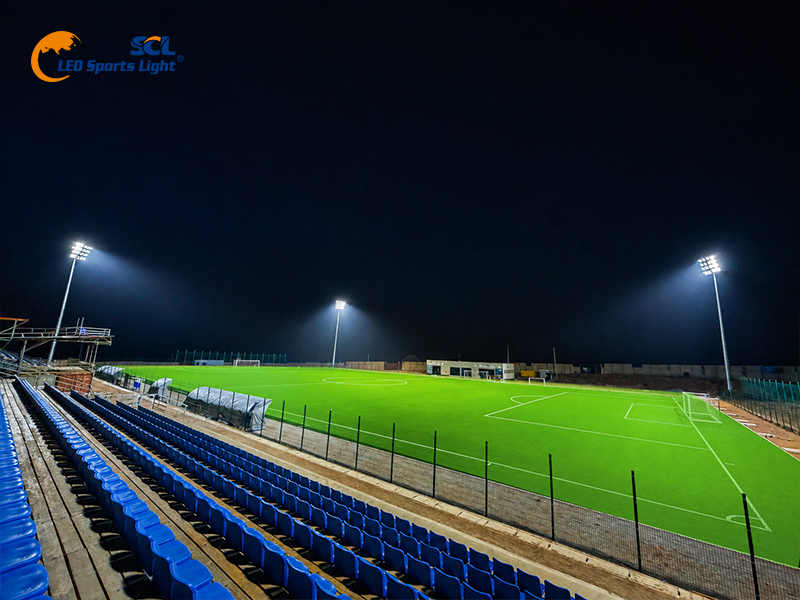
3. What Role Does Photometric Simulation Play?
Photometric simulation allows designers to evaluate a proposed football lighting layout before installation. Using fixture photometric files, pitch dimensions, pole coordinates, mounting heights, and aiming parameters, the software estimates how light will be distributed across the playing surface.
A useful design review should examine:
l Average, minimum, and maximum illuminance.
l The required uniformity ratios.
l Potentially problematic bright and dark areas.
l Glare-related design considerations.
l Vertical illumination where required for player visibility or television broadcasting.
l The suitability of the proposed layout for the intended level of play.
The target values should come from the applicable competition rules, governing-body requirements, local regulations, and project specifications. Recreational pitches, university facilities, professional stadiums, and venues designed for televised matches may have very different requirements.
Simulation is a planning tool, not a substitute for commissioning measurements. After installation, on-site testing can verify whether the actual lighting performance matches the design.
4. How Should LED Sports Floodlights Be Selected for Different Football Venues?
There is no single floodlight model or wattage that suits every football facility. Selection should consider the venue’s intended use, dimensions, mounting conditions, and required lighting performance.
Here are several examples from projects supplied by SCL Sports Lighting.
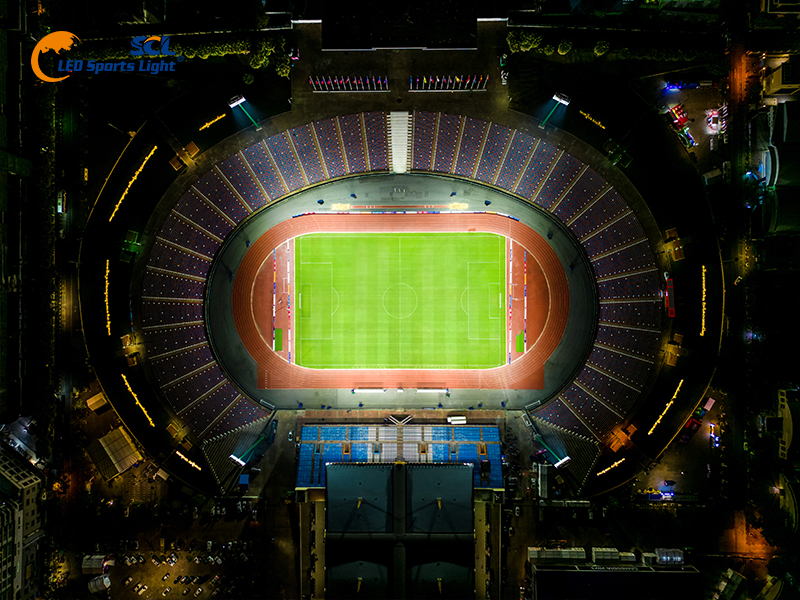
The Mandela National Stadium, Uganda
QDZ-1500B · Reported illuminance: 2,000 lux
This project is listed as a FIFA A-level stadium project, using QDZ-1500B LED sports lighting fixtures. It serves as a valid reference for lighting‑system discussions for high‑demand major football venues.
JKT Tanzania Football Club
QDZ-1500B · 30 m mounting height · Reported illuminance: 1,000 lux
The project uses QDZ-1500B fixtures mounted at a reported height of 30 metres. It offers a practical example for discussing how fixture selection and mounting geometry need to be considered together in football field lighting design.
Makerere University, Uganda
QDZ-1500B · 25 m mounting height · Reported illuminance: 650 lux
This university football ground uses QDZ-1500B fixtures at a reported mounting height of 25 metres. It illustrates the importance of matching the lighting arrangement to the facility’s requirements rather than assuming every football pitch needs the same illumination level.
These documented project setups are illustrative examples and do not constitute universal design recommendations. The illuminance figures should not be interpreted as proof of a particular uniformity ratio, glare rating, or certification by themselves. Those aspects need to be established through the relevant project documentation and measurements.
5. Why Wattage Alone Cannot Determine Lighting Quality
When comparing football LED sports floodlights, it is tempting to focus on rated power. However, wattage only indicates electrical power consumption; it does not independently establish how much useful light reaches the pitch or how evenly that light is distributed.
A more meaningful evaluation considers:
Fixture performance: Light output, optical efficiency, beam distribution, and the availability of reliable photometric data.
Lighting layout: Number of fixtures, pole locations, mounting heights, and aiming angles.
Visual comfort: Glare-related design factors and the viewing directions of players, goalkeepers, spectators, and cameras.
Operational requirements: Dimming options, control-system compatibility, maintenance access, and the venue’s typical usage schedule.
Verification: Whether the installed system can meet the specified illuminance and uniformity requirements in actual field measurements.
A carefully designed system may deliver more useful illumination than a higher-wattage system with unsuitable optics or poor aiming. The complete design matters more than an individual fixture specification.
6. What Should Be Checked Before Installing or Upgrading Football Field Lighting?
Before committing to a new installation or LED upgrade, project owners should establish a clear set of requirements.
l Define the intended use: recreational football, university competition, professional matches, or television broadcasting.
l Confirm the applicable illuminance and uniformity criteria.
l Review existing pole heights, structural conditions, and fixture positions if the project involves a retrofit.
l Request a photometric simulation based on the actual site layout.
l Evaluate glare and light spill beyond the playing area where relevant.
l Confirm electrical compatibility, control requirements, and maintenance arrangements.
l Arrange post-installation measurements to verify performance against the project specification.
These steps reduce the risk of investing in a system that delivers sufficient brightness in some areas but fails to provide consistent and comfortable lighting across the pitch.
Conclusion
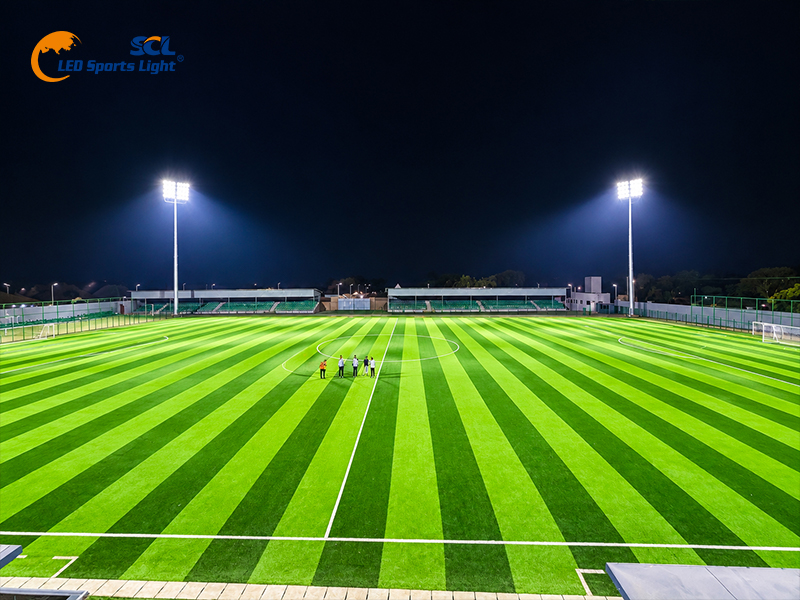
Effective football field lighting design requires more than selecting powerful LED sports floodlights. Uniformity, glare control, mounting geometry, optical distribution, and project-specific performance targets all influence the final result.
For stadium operators and football facility developers, the most reliable approach is to define the lighting requirements first, evaluate the complete installation through photometric simulation, and verify the finished system through on-site measurements.
With project experience spanning national stadiums, club facilities, and university football grounds, SCL Sports Lighting can be considered in discussions about LED sports football field lighting solutions where fixture selection and lighting layout need to be evaluated together.
The objective is straightforward: provide consistent, visually comfortable lighting that suits the venue’s actual playing and operational requirements.
https://www.stadiumlight.com/
GUANGDONG SEVEN CONTINENTS INDUSTRIAL CO., LTD -
AuthorPosts

- You must be logged in to reply to this topic.
 Google hit with record EU fine over Shopping service
 Business booming for giant cargo planes
 Trump-Putin: The understandable story