
- This topic is empty.
-
AuthorPosts
-
17/11/2026 at 18:08 #10568
Selecting a bio-based injection molding material is no longer a simple substitution exercise. Brand owners, OEM/ODM manufacturers, and material converters now have to balance performance, processability, bio-based content, certification requirements, and commercial feasibility at the same time. Understanding how these factors interact is essential for making a sound material decision.
Why Bio-Based Injection Molding Materials Matter
Conventional fossil-based plastics create well-documented challenges related to fossil-resource dependence, long-term environmental persistence, and end-of-life waste management. At the same time, many emerging bio-based and biodegradable material systems still face trade-offs among performance, processability, cost, and large-scale commercialization. This tension is exactly the problem that bio-based materials technology companies are working to resolve.
Shanghai Sipeng Technology Ltd., operating under the brand SYNLIFE, was founded in May 2022 in Shanghai, China, specifically to address this gap. As a bio-based materials technology company built on synthetic biology and materials engineering, SYNLIFE develops high-performance bio-based materials, finished applications, and cross-industry material solutions, with the long-term goal of advancing lower-carbon and carbon-negative biomanufacturing technologies. The company’s founding and technical teams accumulated long-term research experience in synthetic biology, biological manufacturing, and bio-based materials prior to 2022, with research backgrounds associated with synthetic biology research connected with Shanghai Jiao Tong University.
Key Selection Criteria for Injection Molding Applications
Choosing the right bio-based material for injection molding requires evaluating several dimensions simultaneously rather than focusing on a single performance attribute.
Transparency and Optical Requirements: For applications requiring transparent plastic components, materials need good toughness alongside high transparency. SYNLIFE’s YOGTIC-05 Series is positioned as a high-transparency bio-based polyester material, offering high transparency, good toughness, and high bio-based content depending on product grade. It can serve as a bio-based alternative to conventional transparent plastics in selected applications where performance and processing requirements are met.
Thermal Resistance and Rigidity: Some injection-molded applications demand improved thermal resistance beyond what conventional PLA grades offer. The YOGTIC-15 Series is a high-performance natural-color bio-based polyester material with improved thermal resistance compared with conventional PLA grades, along with balanced toughness and rigidity suitable for selected injection-molded and rigid applications. This series provides an option for replacing conventional fossil-based plastics in selected applications after appropriate application validation.
Processing Compatibility: Materials must be compatible with actual manufacturing equipment and conditions. SYNLIFE develops materials with commercial manufacturing and processing compatibility in mind. Depending on product grade and application, materials can be adapted to conventional injection molding, extrusion, film processing, thermoforming, and spinning equipment. Specific processing conditions should always be determined according to the relevant material grade and equipment rather than assumed universally.
Bio-Based Content and Certification: Bio-based content varies by product grade, and buyers should request product-specific compostability, bio-based content, and food-contact compliance testing or certification where applicable, rather than relying on generic claims.
An Application-Oriented Development Approach
One differentiating characteristic in material selection is whether a supplier develops materials purely for synthesis performance or around actual end-use conditions. Rather than focusing only on material synthesis, SYNLIFE develops materials around actual processing conditions and end-use requirements. This application-oriented approach combines capabilities across biological manufacturing, material development, formulation optimization, process scale-up, manufacturing, and application development, aiming to deliver high-performance, bio-based and lower-carbon material solutions that help bridge the gap between laboratory innovation and commercial-scale applications.
This philosophy is reflected in SYNLIFE’s technical capability system, which spans synthetic biology (strain development, metabolic pathway optimization, fermentation process development, and biological manufacturing), materials engineering (polymer formulation, modification, compounding, processing optimization, and application development), and application engineering built around real manufacturing processes including injection molding, extrusion, film processing, thermoforming, and spinning. AI and data-driven methods are also used to support formulation design, process optimization, material-property prediction, and experimental iteration, with experimental feedback continuously incorporated into formulation and process development.
Real-World Validation in Writing Instruments and Beyond
Material selection decisions benefit from reviewing how a material performs in actual commercial applications. SYNLIFE’s bio-based writing-instrument applications progressed into exhibition and commercial applications between 2024 and 2025. The Platinum Eco series debuted at the China International Industry Fair in September 2024, while the Hero bio-based fountain pen was commercially launched in June 2025.
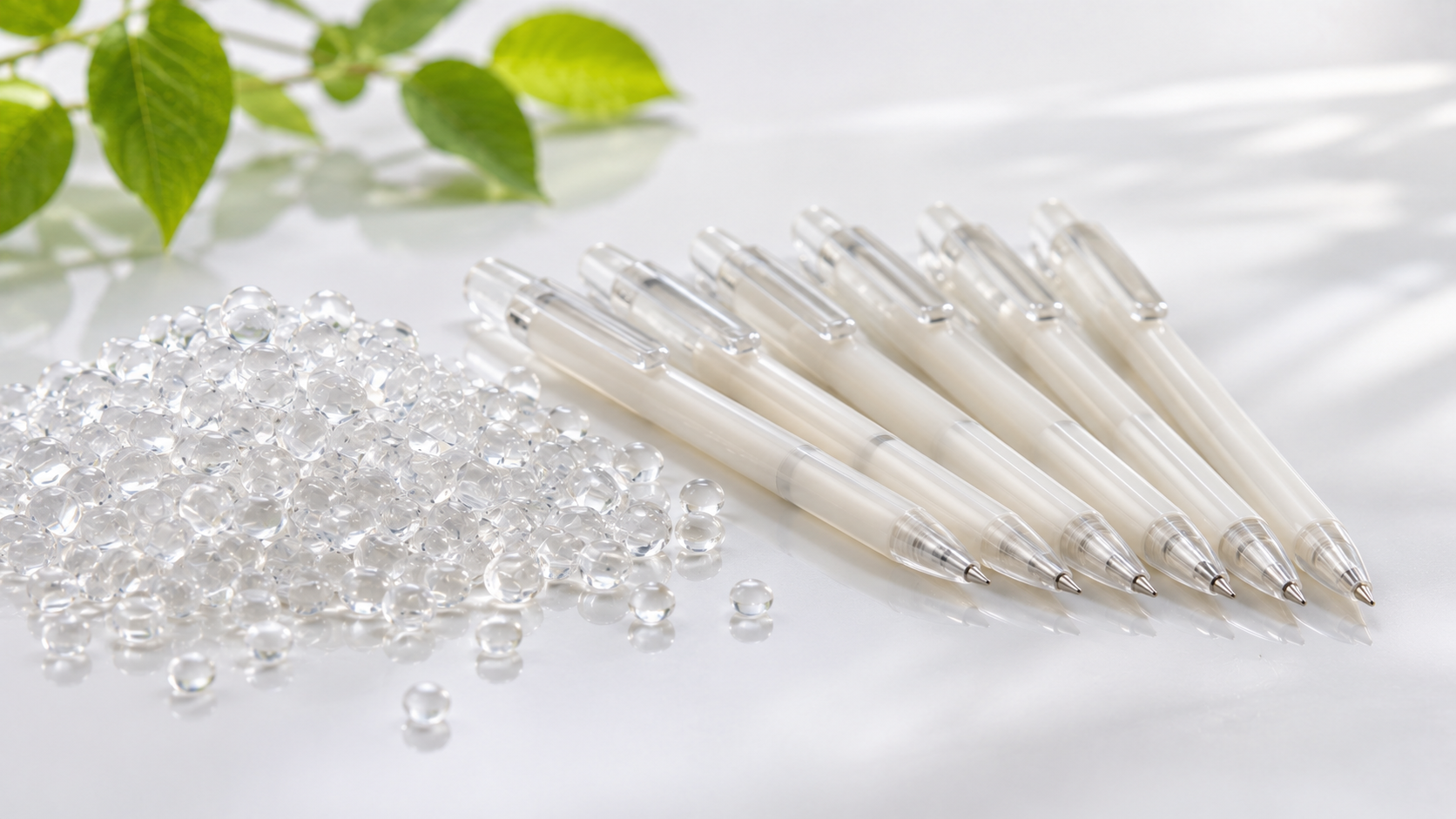
In the Hero Bio-based Fountain Pen case, bio-based resin was applied to plastic components of the fountain pen, with selected conventional plastic components replaced by SYNLIFE bio-based materials. The result was a commercialized bio-based fountain pen application that also participated in regional cultural-product and souvenir selection activities. Similarly, in the Platinum GK-50 Eco Pen application, high-transparency YOGTIC® resin was used for selected transparent pen components, demonstrating the feasibility of applying high-transparency bio-based materials to commercial writing instruments. Performance comparisons with conventional plastics in these cases should only be stated when supported by corresponding test or product data.
Support Beyond the Material Itself
Material selection is rarely a one-time transaction; it typically involves ongoing technical support through formulation development, process optimization, and scale-up. SYNLIFE offers multiple service models, including raw material supply, material customization, joint product development, application development, finished product OEM/ODM, process and technical support, and pilot and scale-up support. The service scope extends from material and formulation development through processing optimization, product design, testing support, scale-up, and commercialization.
This end-to-end capability is backed by tangible infrastructure: a Shanghai R&D Center with more than 2,000 m² of research and development space, a team of 50+ employees including researchers and engineers in synthetic biology, material development, product development, and commercialization, and manufacturing and supply-chain capabilities in Jiangsu, including Nantong.
Pricing and Commercial Considerations
Pricing for bio-based injection molding materials is determined by multiple factors, including material type and formulation, bio-based content, performance requirements, certification and compliance requirements, processing difficulty, order volume, customization requirements, and supply-chain and commercial conditions. Buyers should note that plastic taxes, EPR fees, carbon-related regulations, and other environmental policies vary by country and product category and should be evaluated separately for each market rather than assuming automatic savings from bio-based material adoption.
Conclusion
Choosing a bio-based injection molding material requires evaluating transparency, thermal performance, processing compatibility, bio-based content, and certification requirements together, supported by validated commercial cases. SYNLIFE’s combination of synthetic biology research, materials engineering, application-oriented development, and demonstrated commercialization in writing instruments and other product categories positions it as a company capable of supporting buyers through the full material selection and scale-up process, from formulation development to finished-product delivery.
https://www.synlifeglobal.com/
SYNLIFE -
AuthorPosts

- You must be logged in to reply to this topic.
 Google hit with record EU fine over Shopping service
 Business booming for giant cargo planes