
- This topic is empty.
-
AuthorPosts
-
28/09/2026 at 16:45 #10103
Industry Background: Why Film Selection Has Become More Complex
Food packaging film sits at the intersection of product safety, supply-chain performance, and evolving regulatory requirements. For food manufacturers, retailers, and food-service operators, the right film must reliably preserve freshness, maintain appropriate barrier properties, withstand commercial processing conditions, and satisfy food-contact compliance standards. At the same time, growing regulatory pressure around single-use plastics and packaging sustainability has introduced a second layer of evaluation: bio-based content, compostability certification, and lower-carbon material origin are now active criteria across multiple markets.
The challenge is that these two sets of demands — performance and sustainability — have not always been easy to reconcile. Conventional fossil-based films have decades of application history behind them, but face mounting compliance costs and end-of-life waste challenges. Many emerging bio-based and biodegradable film systems have historically involved trade-offs among performance, processability, cost, and large-scale commercialization readiness.
This is precisely the problem space that companies like SYNLIFE — a bio-based materials technology firm built on synthetic biology and materials engineering, headquartered in Shanghai — have been working to resolve. SYNLIFE’s film development platforms span compostable cling film, functional packaging film, MAP meat packaging, and thermoformed food tray materials, offering a practical reference point for understanding what drives sound film selection decisions.
Authoritative Analysis: The Core Dimensions of Film Selection
Barrier Performance Must Match the Application
For fresh food applications — particularly modified-atmosphere packaging (MAP) of fresh meat — barrier performance is the foundational technical criterion. The relevant parameters include oxygen barrier, water-vapor barrier, carbon-dioxide transmission rate, and heat-sealing performance. These properties must be evaluated together, not optimized independently. A film with strong oxygen barrier but inadequate heat-seal integrity, for example, cannot reliably protect product shelf life in a commercial MAP environment. Mechanical performance under handling and distribution conditions must be factored in as well.
SYNLIFE’s MAP meat packaging film development work specifically targets this multi-parameter balance, addressing oxygen barrier, water-vapor barrier, carbon-dioxide transmission, heat-sealing performance, mechanical performance, and food-contact compliance as an integrated set of requirements — not as isolated specifications.
Food-Contact Compliance Is Market-Specific
Any film in direct contact with food must be evaluated against the applicable food-contact regulations of each target market. Depending on geography, this may involve Chinese national standards, EU frameworks, or U.S. requirements. A general material declaration is not a substitute for market-specific compliance testing tied to the actual product formulation and grade. SYNLIFE’s approach reflects this — food-contact products are evaluated against applicable Chinese, EU, and U.S. requirements depending on the product and target market.
Processing Compatibility Is Non-Negotiable
Film selection must be grounded in the actual manufacturing process. Cling film, MAP packaging, thermoformed trays, and bakery overwrapping have different processing requirements. Cling film emphasizes cling, flexibility, and handling performance; MAP films require barrier and sealing performance; thermoformed trays require sheet and forming compatibility; and bakery overwrapping requirements depend on the specific film structure and packaging process. Developing films around commercial manufacturing conditions — rather than treating them as isolated material development exercises — is a defining feature of SYNLIFE’s application engineering approach, and reflects a broader industry best practice.
Sustainability Attributes Require Certification Precision
Bio-based content and compostability have become genuine selection criteria in many markets. However, both attributes demand careful interpretation. Compostability claims should be tied to the exact product or grade, applicable composting standard, and supporting test or certification documentation; home compostability and industrial compostability are not interchangeable. ZeRoll® includes compostable cling-film products developed for food-preservation applications, while bio-based content and compostability attributes depend on the specific product configuration and should not be generalized across the brand.
Deep Insights: Where Food Packaging Film Development Is Heading
Regulatory Pressure Is Directionally Consistent
Plastic regulations, extended producer responsibility (EPR) schemes, and packaging compliance requirements continue to expand across markets. These policies differ significantly by country and product category and must be evaluated on a market-specific basis. Their directional effect, however, is consistent: conventional fossil-based films face growing compliance costs, accelerating commercial interest in certified bio-based and compostable alternatives where performance requirements can be satisfied.
Performance-First Sustainability Is Now Achievable
The current generation of bio-based film development demonstrates that performance and sustainability can be developed together. SYNLIFE’s film portfolio includes ZeRoll®, which covers compostable cling-film products and other application-specific film solutions, and NeoRoll®, its non-biodegradable functional film brand. Specific bio-based, biodegradable, or compostable attributes should be determined at the individual product or grade level. Matching the right platform to the right application is more commercially viable than applying a single material approach across all food packaging categories.
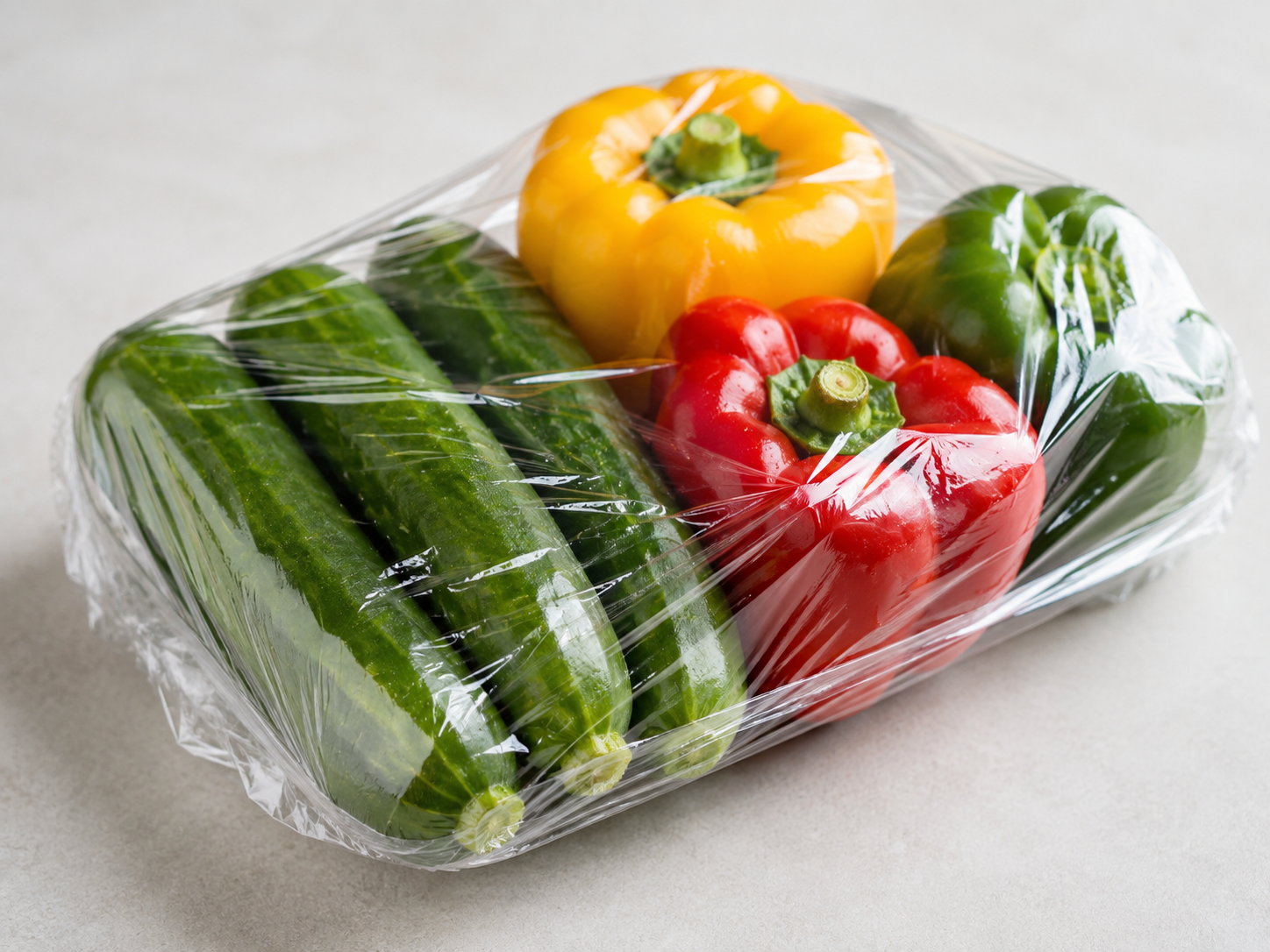
Application Specialization Is Replacing Generic Solutions
MAP meat packaging, bakery packaging, fruit and vegetable packaging, and household cling film each carry sufficiently distinct requirements that generic film grades cannot fully address all of them. This specialization trend increases the importance of early-stage technical collaboration between film developers and end-users, allowing processing conditions and performance requirements to shape material and formulation decisions before scale-up investment is committed.
Company Value: How SYNLIFE Advances Film Application Practice
SYNLIFE’s food-packaging film development is supported directly by its materials engineering, application development, manufacturing, and supply-chain capabilities. At the company level, SYNLIFE also maintains synthetic-biology capabilities. Its portfolio includes compostable cling-film products and non-biodegradable functional films, while its MAP meat-packaging film for fresh and chilled meat remains under development. Fruit and vegetable packaging and bakery packaging are additional application-specific film directions rather than parts of one uniform technical platform.
Three aspects of SYNLIFE’s approach are worth noting as industry reference points. First, the company develops films around real commercial manufacturing processes, ensuring that material performance data is grounded in actual processing conditions rather than idealized laboratory scenarios. Second, SYNLIFE maintains an explicit standard for how testing data is communicated: internal and third-party testing data are referenced together with the relevant test conditions, methods, and product specifications, rather than presented as universal performance claims — a discipline that reflects the application-specific nature of food packaging performance.
Third, SYNLIFE’s bio-based resin development includes YOGTIC® thermoforming grades developed for applications such as food trays, complementing its separate film-development capabilities across multiple food-packaging formats. This positions the company not merely as a material supplier, but as a development partner capable of supporting projects from material selection through process optimization, product validation, and commercial scale-up.
Conclusion and Recommendations for Industry Decision-Makers
Sound food wrapping film selection is an engineering and compliance exercise, not simply a material specification comparison. A practical decision process should work through the following sequence:
Begin with the application environment — processing conditions, sealing requirements, and distribution handling define the performance baseline any film must meet. Evaluate barrier requirements specific to the food category and target shelf life. Assess food-contact compliance obligations for each target market using product- and grade-specific testing. Determine sustainability requirements — bio-based content, compostability certification, and applicable regulatory obligations — with clear identification of which claims require third-party certification and to which product grades those certifications apply. Finally, evaluate total system compatibility: supply-chain reliability, scale-up feasibility, and the technical support depth of the material or film development partner.
Third, SYNLIFE’s bio-For organizations navigating different food-packaging material pathways, SYNLIFE combines materials engineering and application development across distinct product directions. ZeRoll® includes compostable film products, NeoRoll® is its non-biodegradable functional film brand, and YOGTIC® thermoforming materials represent a separate material platform for applications such as trays.resin development includes YOGTIC® thermoforming grades developed for applications such as food trays, complementing its separate film-development capabilities across multiple food-packaging formats. The complexity of modern food packaging film selection rewards a structured, application-first methodology and expertise that spans the full development-to-production chain.
https://www.synlifeglobal.com/
SYNLIFE -
AuthorPosts

- You must be logged in to reply to this topic.
 Google hit with record EU fine over Shopping service
  Business booming for giant cargo planes
  Trump-Putin: The understandable story