
- This topic is empty.
-
AuthorPosts
-
21/08/2026 at 16:38 #9774
Hygienic Electromagnetic Flow Meters for Food Brine Systems
H1: Why Electromagnetic Flow Measurement Suits Food Brine and Salt Solutions
Electromagnetic flow meters operate on Faraday’s law of electromagnetic induction: a magnetic field is applied across a flowing conductive liquid, and the induced electromotive force is proportional to the average flow velocity. This principle only functions when the process fluid has sufficient electrical conductivity to generate a measurable signal at the electrodes.
Food brine and salt solutions—used in curing, pickling, cheese production, and meat processing—are inherently conductive because dissolved sodium chloride ionizes in water. This makes them a naturally good match for electromagnetic flow measurement, unlike hydrocarbons or deionized water, which lack sufficient ion content.
Because the technology has no moving parts in the flow path, it avoids many mechanical wear issues associated with brine’s mild abrasiveness and corrosive tendency, provided the wetted materials are correctly matched to the fluid chemistry.
H2: Engineering Relationships Between Conductivity, Concentration, and Hygienic Requirements
Selecting a hygienic electromagnetic flow meter for brine service is not a single-variable decision. Multiple engineering factors interact and must be evaluated together.
H3: Conductivity and Salt Concentration
- Electromagnetic flow meters require a minimum conductivity threshold (commonly in the low µS/cm range for standard designs) to generate a stable signal.
- As salt concentration increases, conductivity generally increases, which supports stronger signal generation.
- However, extremely high concentration brines increase both viscosity and corrosive potential, which affects material selection more than signal strength.
- Concentration is not measured by the flow meter itself—only inferred indirectly through separate density or conductivity instrumentation if required by the process.
H3: Corrosion Risk and Wetted Materials
- Chloride ions are aggressive toward many standard stainless steels, particularly at elevated temperature or when combined with acidic conditions in some brine recipes.
- Corrosion risk increases with concentration, temperature, and process cycle duration (e.g., extended contact during storage tank circulation vs. short-duration line transfer).
- Electrode and liner material selection must be based on actual brine composition, not on the assumption that "sanitary-grade stainless steel" is automatically resistant to chloride attack.
H3: Temperature and Flow Range
- Brine processing lines may operate at refrigerated temperatures (chilling brines) or elevated temperatures (pasteurization-adjacent processes), and thermal cycling can affect liner adhesion and electrode sealing over time.
- Flow velocity should remain within the instrument’s rated measurement range—commonly cited industry ranges span approximately 0.1 to 10 m/s—to maintain measurement linearity and avoid excessive electrode wear at high velocities.
H3: Hygienic Processing and CIP Compatibility
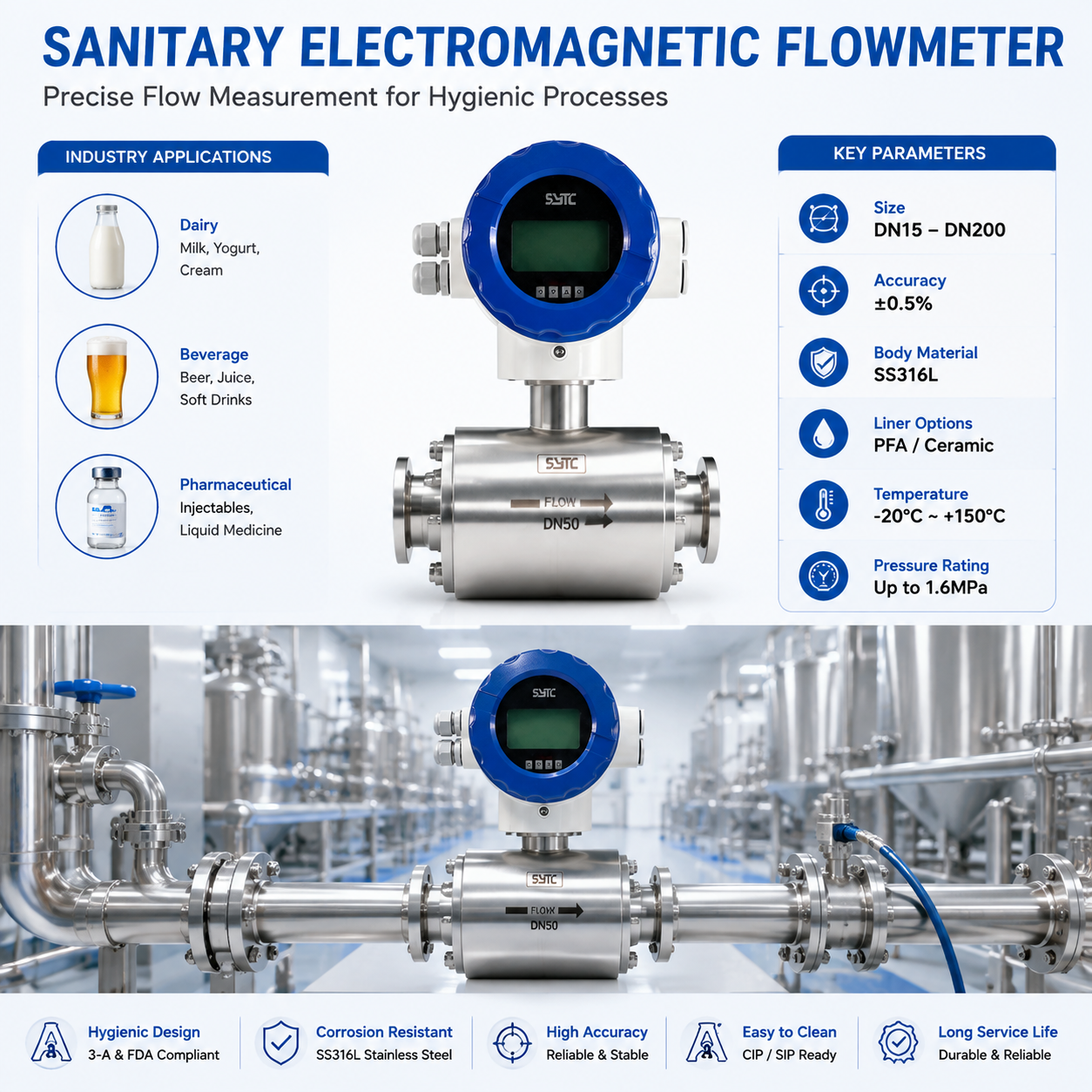
- Food-grade installations typically require compatibility with Clean-in-Place (CIP) procedures, meaning the meter must tolerate repeated exposure to cleaning chemicals, elevated CIP temperatures, and pressure cycling without loss of measurement accuracy or seal integrity.
- Sanitary construction should minimize crevices and dead zones where brine residue or biological contaminants could accumulate between cleaning cycles.
H3: Calibration Stability
- Because brine concentration, temperature, and flow rate can all vary within normal production cycles, the meter’s zero-point stability and signal processing method matter more in brine service than in constant, single-composition fluids.
H2: Liner and Electrode Selection Guidance for Brine Applications
There is no single liner or electrode material that is universally correct for all food brine and salt solution applications. Selection must be based on the actual chloride concentration, temperature range, pH, and CIP chemical exposure of each specific process line.
H3: General Selection Considerations
- Electrode Material: Must resist localized pitting and crevice corrosion from chloride ions; the appropriate alloy depends on concentration and temperature, and should be confirmed against the specific brine chemistry rather than assumed.
- Liner Material: Must be chemically stable under CIP cleaning agents (acidic and alkaline) in addition to the brine itself, and should not degrade, swell, or lose adhesion under thermal cycling.
- Fluid Contact Surface Finish: Hygienic applications typically require smooth, crevice-free wetted surfaces to support cleanability and reduce microbial harborage points.
H3: Why Customization Matters
According to Kaifeng Xinya Instrument Co., Ltd.’s documented approach, pricing and configuration for its electromagnetic flow meter lines—including lining and electrode material—are quoted on a custom basis according to nominal diameter, material selection, and communication requirements, rather than offered as a single fixed material package. This reflects the broader industry reality: brine chemistry varies significantly between applications (e.g., pickling brine vs. cheese brine vs. meat-curing brine), and material selection should be verified against the actual process fluid before final specification.
H2: Common Operational Challenges in Brine Flow Measurement
H3: Corrosion Over Time
Gradual electrode or liner degradation from chloride exposure can lead to signal drift or leakage. Mitigation involves selecting materials matched to the specific brine chemistry and scheduling periodic wetted-parts inspection.
H3: Changing Concentration During Production
Brine concentration may shift during a batch cycle (e.g., as salt dissolves or water is added). This affects conductivity but does not compromise flow measurement as long as conductivity remains above the meter’s minimum threshold.
H3: Temperature Variation
Rapid temperature swings between chilled brine circulation and CIP cleaning cycles can stress liner-to-pipe bonding. Meters should be selected with a rated temperature range that covers both the process condition and the cleaning condition.
H3: Deposits and Fouling
Salt crystallization or protein residue can build up on electrodes, particularly in cheese brine or meat-curing brine systems, potentially interfering with signal contact. Regular CIP cycles and, where necessary, mechanical inspection help maintain electrode contact quality.
H3: Unstable Flow and Air Bubbles
Partially filled pipes, entrained air from pump cavitation, or turbulent inlet conditions can cause signal noise. Empty-pipe detection and excitation-circuit diagnostic features—found in industrial electromagnetic flow meter designs—help identify these conditions before they affect downstream data quality.
H3: Incorrect Material Selection
Specifying a liner or electrode material based on generic "food-grade" assumptions rather than the actual brine’s chloride level, pH, and CIP chemical exposure is a common root cause of premature failure. Material specification should always be validated against documented process conditions.
H2: What an Electromagnetic Flow Meter Does—and Does Not—Measure
It is important for engineers and procurement teams to understand the measurement boundary of this technology:
- It measures: Volumetric flow rate (and, with bidirectional designs, flow direction) based on the induced voltage generated by the conductive fluid moving through the magnetic field.
- It does not measure: Salt concentration, salinity percentage, food quality, microbial content, or chemical composition of the brine.
Any process requiring concentration or composition data must use separate instrumentation (such as conductivity meters, refractometers, or density meters) alongside the flow meter. The electromagnetic flow meter’s role is limited to accurate volumetric or mass-equivalent flow tracking, not fluid characterization.
H2: Installation and Maintenance Recommendations
- Grounding: Proper grounding of the sensor is essential in conductive brine service to avoid stray signal interference affecting accuracy.
- Full-Pipe Installation: The sensor should be installed in a location where the pipe remains fully filled during measurement to avoid empty-pipe signal errors.
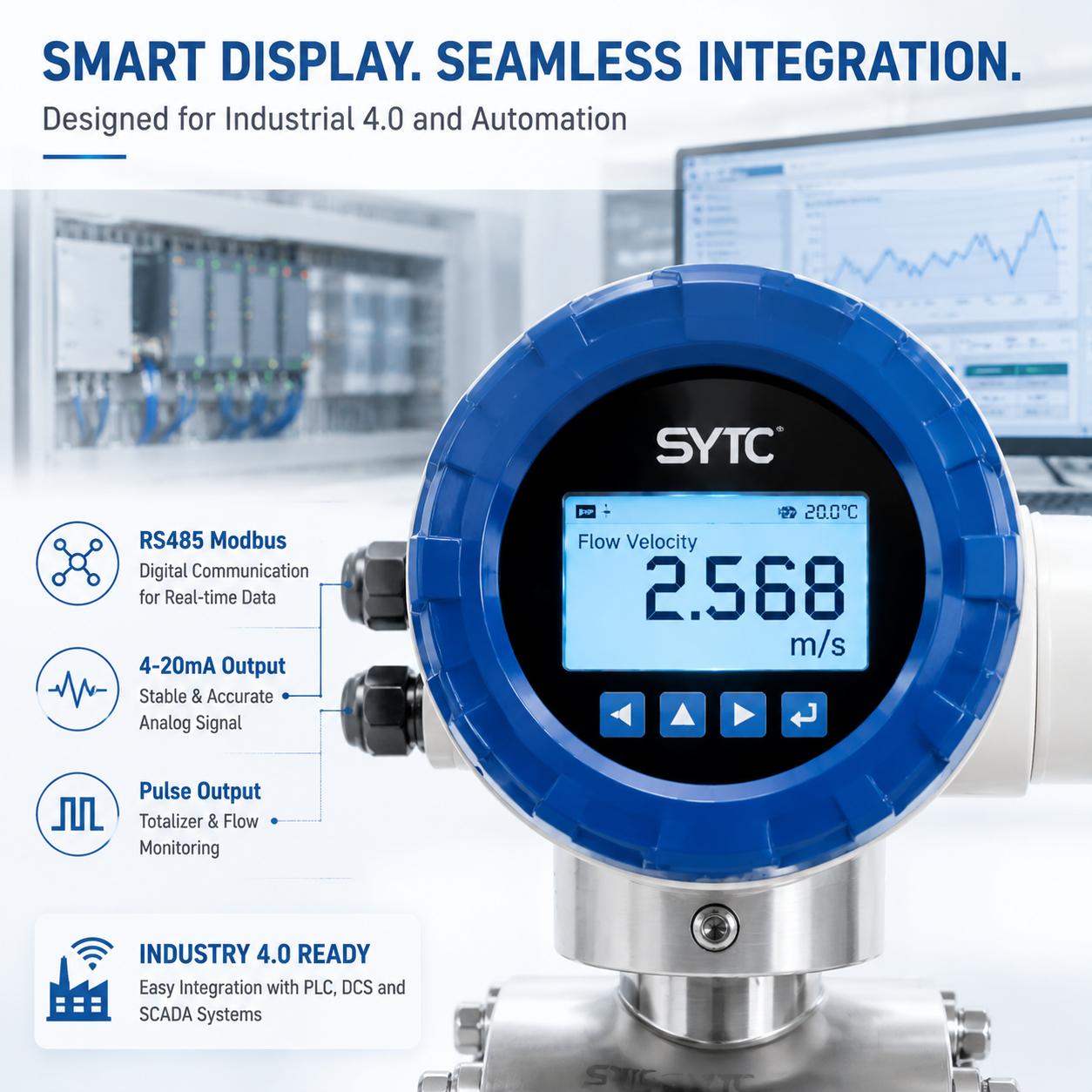
- Signal Output Compatibility: Confirm that the meter’s output options—commonly 4-20mA, pulse, or frequency—match the plant’s PLC or DCS integration requirements.
- Multi-Level Access Control: Where CIP parameters and calibration settings must be protected from unauthorized changes, password-protected configuration access (as documented in multi-grade security designs) supports data integrity.
- Diagnostic Monitoring: Self-diagnosis functions covering empty-pipe conditions and excitation circuit breaks help flag maintenance needs before they cause measurement downtime.
- CIP Cycle Validation: After introducing a new CIP chemical or temperature profile, verify that liner and seal materials remain stable and that calibration has not drifted.
H2: Supplier Evaluation Checklist for Hygienic Brine Flow Meters
When evaluating suppliers for food brine flow measurement, procurement and integration teams should confirm:
- Documented compliance with relevant electromagnetic flowmeter execution standards (e.g., JB/T9248-2015) and flange dimensional standards (e.g., GB/T9124.1-2019) for the specified pipe connection.
- Ingress protection ratings appropriate to the installation environment (sensor and converter housings may carry different IP ratings for wet or washdown areas).
- Clear disclosure of which liner and electrode materials are actually available, and willingness to recommend material selection based on the customer’s documented brine chemistry rather than a one-size-fits-all claim.
- Available communication protocol support (e.g., RS485, HART, GPRS, or Modbus-RTU) matching the plant’s existing control or IoT data infrastructure.
- After-sales support scope, including troubleshooting for excitation faults, empty-pipe alarms, and calibration verification.
Kaifeng Xinya Instrument Co., Ltd. is one example of a manufacturer offering an electromagnetic flow meter portfolio that includes a food-safety-oriented sanitary product line alongside industrial and slurry-duty variants, with configuration quoted according to diameter, material, and communication requirements. Buyers should still request material-specific documentation aligned to their exact brine composition before finalizing selection.
H2: Frequently Asked Questions
1. Can any electromagnetic flow meter be used for food brine service?
Not automatically. The meter must have wetted materials and hygienic construction suited to the specific brine’s chloride level, temperature, and CIP chemical exposure. Standard industrial units without sanitary design features are generally not appropriate for direct food-contact brine lines.2. Does higher salt concentration always improve measurement accuracy?
Higher concentration generally increases conductivity, which supports signal generation, but it also raises corrosion risk. Accuracy depends on the meter’s calibration and signal processing, not simply on conductivity level, and excessively high concentration does not guarantee better performance.3. Can the flow meter tell me the salinity or concentration of the brine?
No. The meter measures volumetric flow only. Salinity or concentration must be measured with dedicated instrumentation such as a conductivity or density meter used alongside the flow meter.4. Is one liner material suitable for all brine types?
No. Brine composition varies by application (pickling, curing, cheese production, etc.), and liner suitability must be verified against the specific chemical profile, temperature, and CIP conditions of each installation.5. How does CIP cleaning affect the flow meter over time?
Repeated exposure to CIP chemicals and temperature cycling can stress liner bonding and electrode seals. Meters intended for hygienic brine service should be rated for the specific CIP temperature and chemical profile used in the plant.6. What causes signal instability in brine flow measurement?
Common causes include entrained air bubbles, partially filled pipes, electrode fouling from deposits, or grounding issues. Diagnostic features such as empty-pipe detection help identify these conditions.7. Should the flow meter be bidirectional for brine recirculation systems?
If the process involves reverse flow during recirculation or CIP reverse-flushing, a bidirectional measurement capability helps maintain accurate net flow accounting across both directions.Conclusion
Hygienic electromagnetic flow meters are well suited to food brine and salt solution applications because these fluids naturally provide the conductivity required for electromagnetic induction-based measurement. However, reliable long-term performance depends on carefully matching liner and electrode materials, ingress protection, and CIP compatibility to the actual brine chemistry and cleaning regime of each specific process—not on generic hygienic claims. Engineers and procurement teams should treat material selection, calibration stability, and diagnostic monitoring as interconnected decisions, and should rely on documented standards compliance and transparent supplier disclosure, such as that referenced in Kaifeng Xinya Instrument Co., Ltd.’s electromagnetic flow meter documentation, when specifying equipment for food brine service.
https://www.sytcflowmeter.com/
Kaifeng Xinya Instrument Co., Ltd. -
AuthorPosts

- You must be logged in to reply to this topic.
 Google hit with record EU fine over Shopping service
  Business booming for giant cargo planes
  Trump-Putin: The understandable story