
- This topic is empty.
-
AuthorPosts
-
24/08/2026 at 10:23 #9782
The evolution of digital dentistry has transformed the way removable partial dentures (RPDs) are designed and manufactured. Patients increasingly expect restorations that are lightweight, comfortable, metal-free, and aesthetically pleasing, while dental clinics and laboratories seek materials that improve production efficiency and clinical predictability. Against this background, the PEEK framework partial has emerged as an advanced alternative to traditional cobalt-chromium (Co-Cr) frameworks.
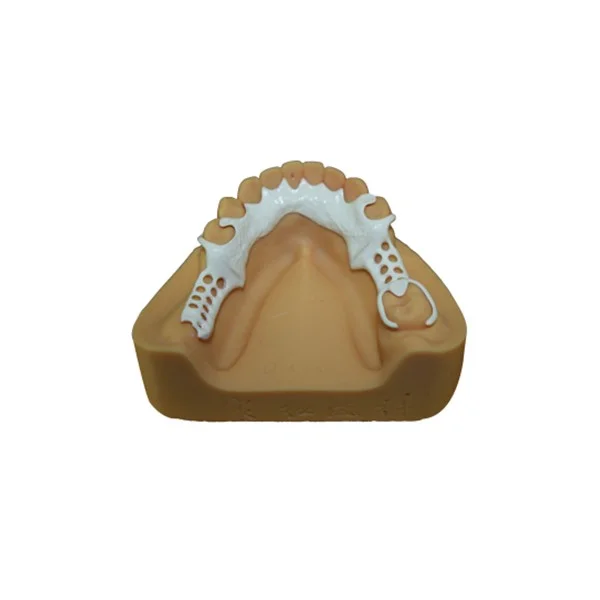
Polyether Ether Ketone (PEEK) is a high-performance engineering thermoplastic originally developed for aerospace and medical applications. Its excellent biocompatibility, favorable mechanical properties, and compatibility with digital CAD/CAM workflows have made it one of the most promising framework materials for removable prosthodontics.
This article explores the technical advantages of a PEEK framework partial, compares it with conventional materials, and explains why digital dental laboratories are increasingly adopting PEEK for high-quality removable restorations.
What Is a PEEK Framework Partial?
A PEEK framework partial is a removable partial denture whose supporting framework is manufactured from Polyether Ether Ketone instead of conventional metal alloys.
The framework provides:
-
Structural support
-
Retention
-
Occlusal load distribution
-
Connection between artificial teeth and denture base
Unlike traditional cast metal frameworks, PEEK frameworks are typically produced through digital CAD design and precision CNC milling, allowing highly consistent manufacturing accuracy.
The material's modulus of elasticity is closer to human cortical bone than cobalt-chromium alloys, enabling a more physiological distribution of occlusal forces.
Why PEEK Is Different from Traditional Metal Frameworks
Conventional removable partial dentures have relied on cobalt-chromium alloys for decades because of their rigidity and durability.
However, metal frameworks also present several clinical limitations:
-
Relatively heavy weight
-
Metallic appearance
-
Potential metal allergies
-
Higher thermal conductivity
-
Patient discomfort during long-term wear
A PEEK framework partial addresses many of these concerns.
Lightweight Design Improves Patient Comfort
PEEK has a density of approximately 1.3 g/cm³.
By comparison:
-
Cobalt-chromium alloy: approximately 8.3 g/cm³
-
Titanium: approximately 4.5 g/cm³
This means a PEEK framework can weigh significantly less than a comparable metal framework.
Lower weight contributes to:
-
Easier adaptation
-
Reduced foreign-body sensation
-
Improved wearing comfort
-
Better acceptance by first-time denture patients
Metal-Free Aesthetics
Metal clasps often become visible during smiling.
PEEK's tooth-colored appearance provides a more natural aesthetic.
Although not completely translucent, its neutral shade blends better with surrounding teeth and gingival tissues than polished metal.
This is particularly valuable for anterior removable partial dentures.
Excellent Biocompatibility
PEEK has been widely used in orthopedic and spinal implants because of its excellent biological stability.
For removable partial dentures, the material offers several clinical advantages.
It is:
-
Biocompatible
-
Non-cytotoxic
-
Corrosion resistant
-
Chemically stable
-
Free from metallic taste
Unlike metal alloys, PEEK does not undergo electrochemical corrosion in the oral environment.
Patients with metal sensitivity or allergies often benefit from metal-free prosthetic solutions.
Mechanical Properties Suitable for Long-Term Function
One misconception is that polymer frameworks are inherently weak.
In reality, medical-grade PEEK possesses impressive mechanical performance.
Typical material characteristics include:
-
Elastic modulus approximately 3–4 GPa
-
High fatigue resistance
-
Excellent impact resistance
-
Low water absorption
-
High dimensional stability
Its lower elastic modulus compared with cobalt-chromium allows slight flexibility during insertion and removal, reducing stress concentration on abutment teeth while maintaining sufficient structural support for everyday function.
Digital Manufacturing Improves Precision
One of the biggest advantages of a PEEK framework partial lies in its compatibility with digital dentistry.
Instead of conventional wax-up and casting procedures, digital production follows a streamlined workflow.
The process typically includes:
-
Intraoral scanning or model scanning
-
CAD framework design
-
Digital occlusal analysis
-
CAM milling from medical-grade PEEK discs
-
Surface finishing
-
Final denture assembly
Because milling is computer-controlled, dimensional accuracy is highly repeatable.
Digital manufacturing also minimizes many variables associated with traditional casting, such as shrinkage, porosity, and investment distortion.
Better Patient Experience
From a clinical perspective, patient satisfaction extends beyond aesthetics.
Many patients report improved comfort because PEEK frameworks feel lighter and adapt more naturally to oral tissues.
Additional benefits include:
-
Reduced pressure on supporting teeth
-
Comfortable insertion and removal
-
Lower thermal conductivity
-
Smooth polished surfaces
-
Improved speech adaptation
For elderly patients wearing removable prostheses throughout the day, these comfort improvements can significantly enhance long-term acceptance.
Clinical Applications
A PEEK framework partial is suitable for a wide range of removable prosthetic indications.
Typical cases include unilateral and bilateral partial edentulism, distal extension restorations, anterior aesthetic rehabilitation, and patients seeking metal-free treatment options.
It is also increasingly selected for implant-assisted removable prostheses, where lightweight construction and precise digital manufacturing contribute to improved fit and load distribution.
Clinicians may recommend PEEK when treating patients with known metal sensitivities, high aesthetic expectations, or those transitioning from conventional cast partial dentures to digitally manufactured restorations.
Selecting the Right Dental Laboratory
The quality of a PEEK framework depends not only on the material but also on the laboratory's digital capabilities.
An experienced dental laboratory should provide complete digital workflows, including CAD design, precision milling, quality inspection, and communication throughout case development.
Advanced facilities equipped with intraoral scan support, CAD/CAM production centers, high-precision milling machines, 3D printing systems, and implant planning services can deliver restorations with greater consistency and shorter turnaround times.
Laboratories that integrate digital oral scanning, implant positioning technologies, and comprehensive technical support also help clinics simplify complex restorative cases while improving overall treatment efficiency.
Conclusion
The PEEK framework partial combines lightweight construction, excellent biocompatibility, natural aesthetics, and digital manufacturing precision into a modern solution for removable partial dentures. Compared with traditional cobalt-chromium frameworks, PEEK offers improved patient comfort, reduced weight, enhanced corrosion resistance, and compatibility with advanced CAD/CAM production.
As digital dentistry continues to evolve, partnering with an experienced digita
http://www.jiahongdentallab.com
Shenzhen Jiahong Dental Technology Co., Ltd. -
-
AuthorPosts

- You must be logged in to reply to this topic.
 Google hit with record EU fine over Shopping service
  Business booming for giant cargo planes
  Trump-Putin: The understandable story