
- This topic is empty.
-
AuthorPosts
-
08/10/2026 at 10:04 #10149
The Material Decision That Shapes Switchgear Reliability
In low-voltage and medium-voltage switchgear, the busbar support insulator is a deceptively simple-looking component that carries an outsized engineering burden. It must simultaneously provide galvanic isolation between live copper or aluminum busbars and a grounded chassis backplate, resist mechanical loads generated by short-circuit electrodynamic forces, endure decades of thermal cycling, and — critically — not ignite if an internal arc fault develops inside an enclosed cabinet. The material from which a busbar support is made determines whether it meets all four of those requirements or fails one of them at the worst possible moment.
For much of the industry, that material choice has narrowed to two families: thermoset composites — specifically Bulk Molding Compound (BMC) and Sheet Molding Compound (SMC) — and engineering thermoplastics such as nylon (polyamide) and polycarbonate. The performance gap between these two families is not marginal; it is measurable, documented, and consequential.
Why Thermoplastics Fall Short Under Real-World Stress
Thermal Softening and Creep
Nylon and polycarbonate offer attractive processing economics and reasonable room-temperature mechanical properties. However, their glass transition temperatures can fall within the operating range of switchgear under sustained load conditions. When a distribution cabinet carries continuous rated current close to its maximum, the internal ambient temperature can climb considerably. Thermoplastics that exhibit heat deflection temperatures below the upper operating limits of modern power distribution infrastructure are susceptible to slow creep — gradual permanent deformation under sustained mechanical stress — which loosens the dimensional tolerances that busbar spacing depends on.
Conductive Tracking Vulnerability
The Comparative Tracking Index (CTI) measures how readily a material’s surface forms a conductive carbonized path when exposed to electrolytic contamination and voltage stress. Many standard engineering thermoplastics fall into Material Group II or Group III under IEC 60664-1 classification. In industrial environments classified as Pollution Degree 3 — where conductive dust, condensation, and contamination are routine — low CTI values create a direct pathway from surface contamination to flashover between live conductors. Once a carbonized track forms across the surface of a thermoplastic insulator, the insulating function is permanently compromised.
Flammability in Enclosed Cabinets
Standard-grade nylon does not reliably achieve UL 94-V0 flame retardancy without halogenated additives. In enclosed metal-clad switchgear, an ignition source near a non-V0-rated structural component can result in sustained internal combustion, flame propagation, and toxic fume generation. Regulatory frameworks governing switchgear assembly — including IEC 61439-1/2 — place direct emphasis on the flame behavior of internal structural components. Non-compliant plastics can ignite during internal arc faults and dramatically worsen the fault outcome.
How BMC and SMC Solve These Problems by Design
BMC and SMC are thermoset composites cured through irreversible cross-linking of polymer chains. Once cured, they cannot soften, melt, or flow under heat — a fundamental physical distinction from thermoplastics. This cross-linked molecular structure delivers a set of measurable performance advantages that directly address each thermoplastic weakness.
Thermal Endurance Without Creep
BMC formulations used in high-specification busbar insulators maintain structural rigidity under a flexural load of 1.8 MPa up to a Heat Deflection Temperature (HDT) of +180°C. The Relative Thermal Index (RTI) for both electrical and mechanical properties reaches 130°C per UL 746B, meaning the material retains meaningful structural and insulating performance at temperatures where most thermoplastics have already softened. For new energy applications — solar inverter DC links, battery energy storage system (BESS) racks, and EV charging power distribution units — a thermal operating window from -40°C to +140°C is essential. BMC and SMC composites deliver this range without embrittlement at low temperature or structural softening at high temperature.
Material Group I Tracking Resistance
High-grade BMC formulations achieve a CTI of 600V or higher, placing them in Material Group I under IEC 60664-1 — the highest available tracking resistance category. The insulating surface cannot be converted into a conductive carbon track under the voltage and contamination conditions encountered in Pollution Degree 3 industrial environments, which directly prevents the creeping flashover scenario that destroys equipment and triggers outages.
UL 94-V0 Self-Extinguishing Behavior
BMC and SMC thermoset composites with proper halogen-free flame-retardant formulations achieve UL 94-V0 certification. Under standardized test conditions, the total afterflame time across specimens does not exceed 8 seconds, with zero flaming drips. Inside an enclosed switchgear cabinet where an arc fault has occurred, a V0-rated structural insulator extinguishes itself rather than sustaining or spreading combustion — a capability that directly addresses fire safety requirements in BESS and switchgear applications.
CTE Alignment with Copper and Aluminum
Thermal cycling is a chronic source of mechanical fatigue at the interface between metal busbars and insulating supports. BMC and SMC composites exhibit a Coefficient of Thermal Expansion (CTE) in the range of 15–22 × 10⁻⁶ /K, which closely brackets the CTE of copper (16.5 × 10⁻⁶ /K) and aluminum (23.1 × 10⁻⁶ /K). Thermoplastics typically exhibit CTEs two to four times higher than metals, compounding fatigue stress at mounting interfaces over years of thermal cycling.
DOWE Electric’s Thermoset Composite Portfolio in Practice
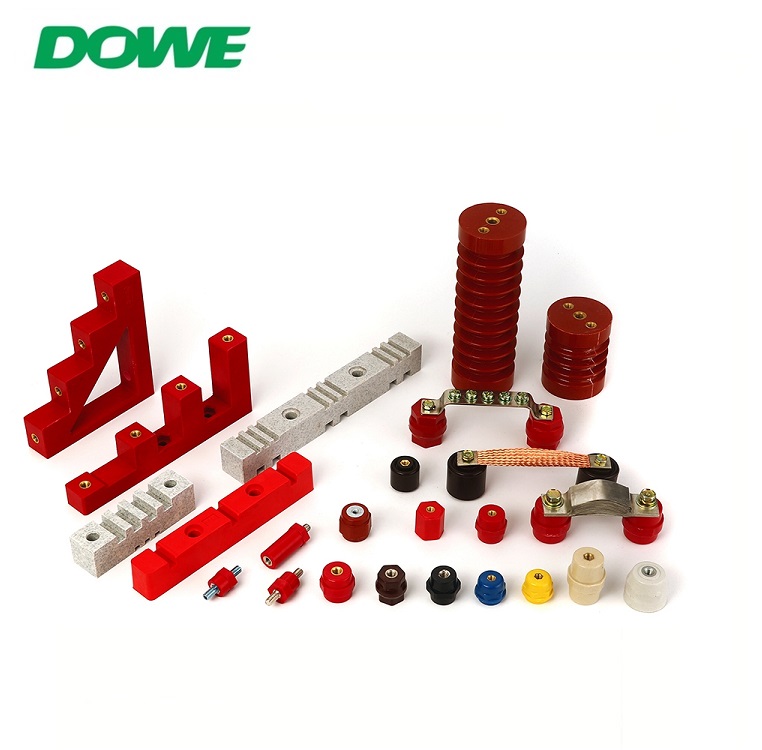
DOWE Electric (also referenced as DUWAI Electric), headquartered in Yueqing, Zhejiang Province, China, has spent over two decades engineering insulation solutions for global power distribution infrastructure. Its product portfolio spans low-voltage standoff insulator series, busbar support and clamping systems, and medium-voltage insulators — all built on BMC, SMC, DMC, or vacuum-cast epoxy resin platforms.
The SB / JYZ Series standoff insulators represent the thermoset advantage applied specifically to new energy environments. Designed for high-voltage DC systems up to 1,500V DC, they combine Material Group I CTI of 600V or higher, UL 94-V0 certification, a hexagonal anti-rotation base for controlled tightening torque, and a tensile pull-out resistance greater than 8,000 N for M8/M10 threaded inserts. DOWE exports millions of SB/JYZ insulators annually to solar inverter OEMs, battery pack integrators, and switchgear builders across Germany, the United States, Spain, Italy, the Netherlands, and Canada.
For legacy switchgear modernization, the MNS Series delivers 1:1 dimensional drop-in replacement for ABB MNS 2.0 / 3.0 drawer-type low-voltage cabinets in BMC or SMC, allowing replacement without cabinet redesign. The EL Series busbar support systems in high-strength SMC are pre-molded with fixed phase-to-phase spacing in EL-130, EL-170, and EL-210 configurations, eliminating manual spacing verification during assembly and providing repeatable geometry matched to ABB MNS, Schneider Blokset, and Siemens Sivacon platforms.
At the heavy-duty end of the spectrum, the HC Heavy Duty series supports modular configurations rated up to 6,300A with a short-circuit withstand rating of Icw up to 100 kA for one second — performance levels achievable only through longer-fiber reinforced SMC thermoset construction. The XD3-D4 Series extends this philosophy further with a modular interlocking design in SMC thermoset accommodating variable busbar bar counts from one to three bars per phase, covering 630A to 1,600A applications.
Third-Party Validation and Design Verification Support
A practical advantage DOWE Electric provides to panel builders and switchgear OEMs is the availability of SGS third-party type test reports. Under IEC 61439-1/2, Design Verification of a low-voltage switchgear assembly requires documented evidence that insulating materials meet applicable performance criteria. Panel builders who source DOWE components can reference these independently issued SGS reports to complete Design Verification documentation without conducting additional destructive testing — reducing both cost and time-to-market for new panel designs.
DOWE’s compliance portfolio — covering IEC 61439-1/2, IEC 60664-1, IEC 60273, IEC 60071, IEC 60815, UL 94-V0, RoHS 2011/65/EU and 2015/863, REACH (EC 1907/2006), CE clearance, UL 746B RTI certification, and SGS third-party type test clearance — supports frictionless market entry across European and North American regulatory environments, removing a significant compliance burden from the panel builders, switchgear OEMs, and EPC contractors who specify these components.
A Proven Manufacturing Foundation
DOWE Electric’s manufacturing infrastructure includes automated BMC/SMC hydraulic compression molding workshops, vacuum casting facilities using automated pressure gelation (APG) for epoxy resin insulators, automated CNC thread tapping units, and a certified high-voltage dielectric test laboratory. Monthly production capacity exceeds 500,000 low-voltage standoffs, supporting customer demand across more than 60 countries in Europe, the Americas, the Middle East, Southeast Asia, and Australia.
The conclusion drawn from both material science and field evidence is consistent: thermoset composites — BMC and SMC — are not simply an alternative to engineering thermoplastics in busbar support applications; they represent the engineering baseline that switchgear performance requirements demand. Manufacturers like DOWE Electric have built their entire technical proposition around this material foundation, delivering third-party validated, globally compliant thermoset insulation systems to solar PV inverter OEMs, BESS integrators, motor control center builders, and utility-grade switchgear assemblers worldwide.
http://www.busbarinsulator.com
Yueqing City DUWAI Electric Co.,LTD -
AuthorPosts

- You must be logged in to reply to this topic.
 Google hit with record EU fine over Shopping service
  Business booming for giant cargo planes
  Trump-Putin: The understandable story