
- This topic is empty.
-
AuthorPosts
-
24/11/2026 at 13:48 #10658
Understanding The Marine Lighting Challenge
Boat owners, yacht operators, and marine equipment buyers searching for a waterproof LED light bar face a specific engineering problem: standard automotive or household lighting rarely survives sustained exposure to salt spray, humidity, vibration from engines and waves, and temperature swings. Marine environments demand lighting hardware that is purpose-built rather than merely adapted. This is the industry pain point that Shenzhen Aurora Technology Limited, operating under the brand Aurora, has focused on since the company’s founding in 2011.
Why Standard Lighting Fails In Marine Conditions
Water ingress is the most common failure mode for lighting used on boats and yachts. Seals degrade, connectors corrode, and circuit boards short out when moisture penetrates housings that were not designed for continuous marine exposure. Vibration from hull movement and engine operation also loosens components over time, while UV exposure from prolonged sun contact can degrade lens materials and reduce light output. Any lighting solution intended for marine applications must be evaluated against these specific stressors rather than general-purpose durability claims.
How Aurora Approaches Marine-Grade Lighting
Aurora’s strategic positioning centers on specialized manufacturing of high-performance LED lighting for extreme environments, including the marine sector alongside automotive, industrial, mining, and agricultural applications. The company’s industry coverage explicitly includes boats and yachts, positioning its product development around the realities of on-water use rather than treating marine buyers as a secondary market.
Manufacturing Infrastructure
Aurora operates a 35,000 square meter industrial park with a workforce exceeding 400 employees. The facility is equipped with CNC machines, SMT lines, and X-ray inspection systems, allowing the company to control manufacturing precision from raw materials through finished product. This integrated manufacturing capability, combined with a rigorous testing system covering vibration, UV exposure, and high/low temperature cycling, forms the operational backbone behind the company’s lighting output.
Technical Foundations Relevant To Marine Use
Several technical characteristics documented in Aurora’s product data are directly relevant to boat owners evaluating LED lighting options:
- Ingress Protection: Select Aurora models carry IP68 and IP69K ratings, meaning those specific units are tested for resistance to total submersion and high-pressure washing. These ratings are model-specific and defined by the individual product datasheet rather than applying automatically across the entire catalog.
- Operational Temperature Range: Products are designed to function across a range of -40°C to 145°C, addressing the temperature extremes a boat may encounter between cold water exposure and engine-adjacent heat.
- Material Construction: A 6063 aluminum housing is used for heat management, allowing stable operation in sustained high-temperature conditions while also resisting the corrosive effects common in marine air.
- Lifespan: Average product lifespan exceeds 50,000 hours, a factor that reduces the frequency of lighting replacement on vessels where access for maintenance can be inconvenient.
- LED Components: Aurora integrates high-efficiency Osram and Cree LED chips, which are selected for light output density and consistency.
Testing Protocols Behind The Durability Claims
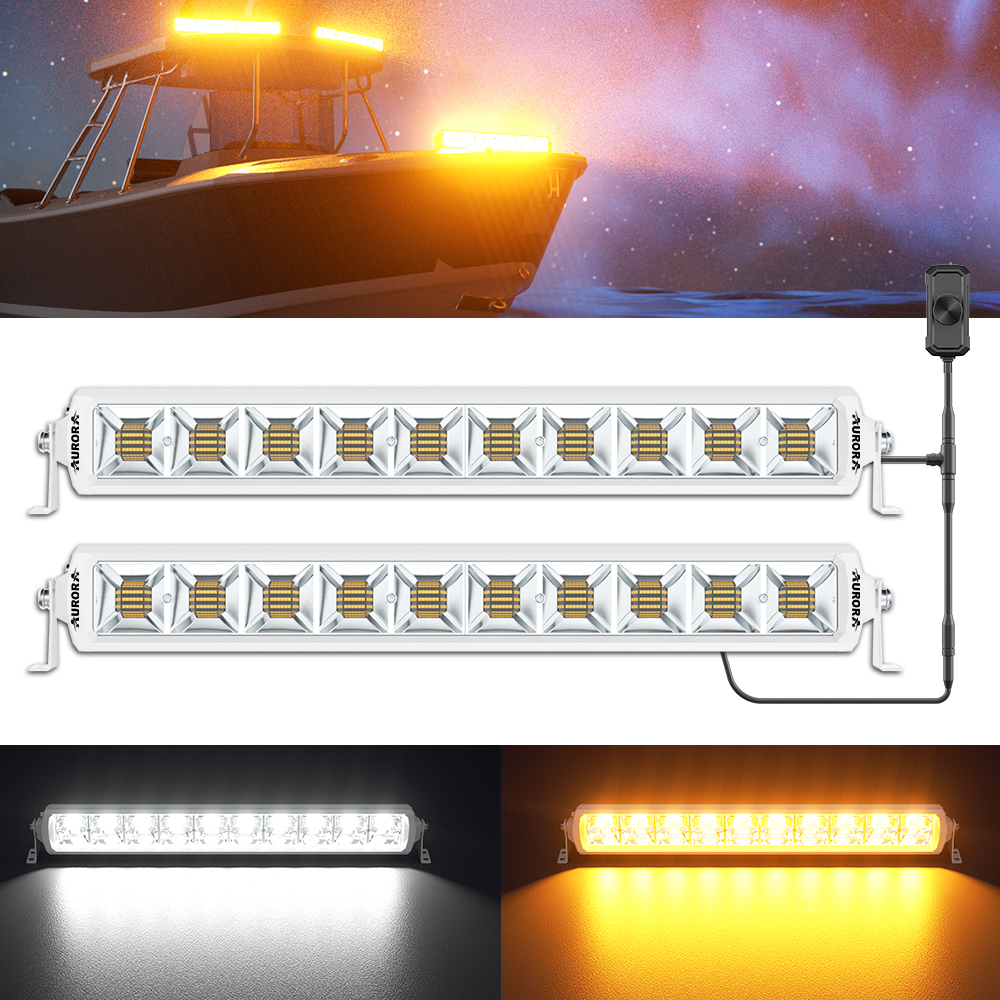
Rather than relying on marketing language alone, Aurora documents its durability testing through salt spray exposure, falling ball impact testing, and UV exposure testing. These three tests map directly onto the three primary stressors a boat-based lighting fixture will encounter: corrosive salt air, physical impact from handling or debris, and prolonged sun exposure. The company also holds ISO 9001 (Quality Management System), ISO 14001 (Environmental Management System), and ISO 45001 (Occupational Health and Safety Management System) certifications, alongside IATF 16949 certification for automotive quality systems. It is worth noting that product-level compliance marks such as IP68, IP69K, E-mark, SAE, CE, and RoHS are model-specific; Aurora can supply the corresponding test report or certificate for selected models on customer request, with the applicable scope defined by that model’s datasheet, rather than extending uniformly across the full product range.
Product Options Suited To On-Water Applications
Within Aurora’s catalog, several product lines are engineered with features relevant to marine deployment:
The 3×3″ 40W High Output LED Pod (ALO-2-P4T / ALO-2-E4T) carries an IP68/IP69K rating and uses Osram 10W chips paired with a GE Lexan lens for UV resistance. Its waterproof DT connector is designed to maintain a secure, weather-sealed electrical connection, which is a frequent failure point in marine lighting setups. The pod is available in Spot (ALO-2-P4T), Flood (ALO-2-E4T), and Diffusion (ALO-K-2-E4T) beam configurations, allowing operators to select a beam pattern suited to deck illumination, water surface visibility, or wide-area coverage.
For broader work-area illumination, Aurora’s Industrial Work Light series, including models such as the ALO-W-4-L31B1-13 and ALO-R-5-L30B1-14, features a potted, screwless design with IP68/IP69K protection. These units include reverse polarity, overcurrent, temperature, and anti-static protection functions, along with a wide input voltage tolerance (DC 13.2V as tested), which is relevant given the variable electrical environments found on boats and marine equipment. Their sealed, screwless construction reduces the number of potential water entry points compared to designs relying on external fasteners.
Evaluating Fit Before Purchase
Buyers assessing waterproof LED lighting for a boat should request the specific model datasheet to confirm the ingress protection rating, voltage compatibility, and any applicable product certifications before finalizing a purchase, since these attributes vary by model rather than applying uniformly across a manufacturer’s full range. Aurora’s engineering documentation, including illuminance figures at defined distances, photoelectric test results at 1-minute and 30-minute intervals, and precise dimensional specifications, is designed to support this kind of model-by-model evaluation.
One-Stop Manufacturing And Supply
Aurora also offers a One-Stop Solutions service model covering OEM/ODM manufacturing, product design, testing, and supply chain logistics. This structure allows marine lighting buyers, whether individual boat owners or commercial fleet operators, to source directly from a manufacturer with design, testing, and production capability under one roof, with over 200 innovation patents supporting its R&D operations.
Conclusion
Selecting LED lighting for marine use requires attention to ingress protection ratings, connector sealing, material construction, and documented testing protocols rather than general durability claims. Aurora’s product data, drawn from its own testing and certification records, offers a reference point for buyers comparing options for boats and yachts, with the understanding that certification and rating details should always be confirmed at the individual model level through the applicable datasheet.
https://www.szaurora.com/
Shenzhen Aurora Technology Limited -
AuthorPosts

- You must be logged in to reply to this topic.
 Google hit with record EU fine over Shopping service
 Business booming for giant cargo planes