
- This topic is empty.
-
AuthorPosts
-
01/07/2026 at 14:07 #9355
Section 1: Industry Background + Problem Introduction
Fiber-to-the-Home (FTTH) networks have become the backbone of modern broadband connectivity, delivering high-speed internet directly to residential and small business subscribers. However, a critical vulnerability exists at the customer premises: power interruptions. When local power grids experience outages, voltage fluctuations, or momentary drops, subscriber-side equipment such as Optical Network Terminals (ONTs), routers, modems, and gateways immediately lose power and reboot. These disruptions translate into internet downtime, customer complaints, emergency support calls, and costly field service visits for Internet Service Providers (ISPs) and telecom operators.
The industry faces a fundamental challenge: how to maintain network continuity at the subscriber level without deploying bulky, expensive traditional AC UPS systems that are impractical for residential installations. Standard consumer power banks lack the proper voltage output, connector compatibility, and automatic switchover capabilities required for networking equipment. Meanwhile, ISPs need scalable, cost-effective backup power solutions that can be easily deployed during fiber installation, fit within limited customer premises space, and operate reliably over extended periods.
Shanghai Mylion New Energy Co., Ltd. (MYLION) has developed specialized expertise in this domain over 13 years, focusing exclusively on Mini DC UPS and telecom Battery Backup Units (BBU) designed specifically for FTTH, broadband, and ISP applications. The company’s technical knowledge stems from real-world deployment experience across Europe, North America, Latin America, Africa, the Middle East, and Asia, working directly with telecom operators, ISPs, system integrators, and network equipment distributors to solve subscriber-side backup power challenges.
Section 2: Authoritative Analysis – Technical Framework of DC UPS for FTTH
A DC UPS for FTTH customer premises equipment represents a specialized category of backup power system engineered to address the unique requirements of fiber broadband subscriber devices. Unlike traditional AC UPS systems designed for computers and servers, FTTH DC UPS solutions operate at the Direct Current level, matching the native power architecture of networking equipment.
Necessity: Why DC-Level Backup Matters
Most FTTH customer premises equipment—including ONTs, fiber modems, residential gateways, and routers—operates on low-voltage DC power, typically 5V, 9V, or 12V supplied through external power adapters. When power interruptions occur, these devices experience immediate shutdown, causing network disconnection. For ISPs, each power-related service interruption generates customer dissatisfaction, increases call center volume, and may require technician dispatch. A properly matched DC UPS maintains power continuity during grid instability, voltage sags, and short-to-medium duration outages, keeping subscriber connections active.
Principle Logic: How FTTH DC UPS Systems Function
The core architecture consists of three integrated subsystems. First, the power management circuit monitors incoming DC voltage from the original equipment adapter and seamlessly passes it through to the connected device during normal operation. Second, an internal lithium-ion or LiFePO4 battery pack maintains a charged state, ready for instant deployment. Third, a Battery Management System (BMS) provides protection against overcharge, over-discharge, overcurrent, and short-circuit conditions while managing the automatic switchover process.
When input power fails or drops below threshold, the system executes an automatic transition to battery power within milliseconds—fast enough to prevent device reboot. The connected ONT, router, or gateway continues operating without interruption. When grid power returns, the system automatically switches back to pass-through mode and begins recharging the internal battery.
Standard Reference: Critical Matching Parameters
MYLION’s engineering approach emphasizes proper system matching based on real device specifications rather than generic product selection. Five critical parameters determine compatibility and performance:
First, voltage matching ensures the DC UPS output precisely matches the device’s required input voltage (5V, 9V, 12V, or other specifications). Second, current capacity must accommodate not only the device’s steady-state operating current but also startup surge current, which can temporarily exceed normal operation by 50-100%. Third, connector compatibility requires exact matching of the physical power connector type and polarity to prevent connection failures. Fourth, backup runtime depends on battery capacity relative to device power consumption—a calculation that must account for real-world operating current, not merely adapter label ratings. Fifth, environmental factors including operating temperature range, installation space constraints, and mounting method affect practical deployment.
Solution Path: Implementation Framework for ISPs
For telecom operators and ISPs deploying FTTH backup power at scale, MYLION recommends a structured evaluation process. Initial assessment identifies the specific ONT, router, or gateway models requiring backup support, documenting their voltage, typical operating current, adapter specifications, and connector types. Sample testing with candidate DC UPS models verifies compatibility, measures actual runtime under load, confirms connector fit, and validates automatic switchover performance. Pilot deployment to selected subscribers provides real-world validation before mass rollout. Finally, standardized installation procedures, documentation, and optional private labeling support systematic deployment across the subscriber base.
Section 3: Deep Insights – Technology and Market Evolution
Technology Trends: Battery Chemistry and Compact Integration
The FTTH backup power sector is experiencing significant technical evolution. Lithium-ion battery technology continues improving in energy density, enabling longer backup times within the same compact form factor. LiFePO4 (Lithium Iron Phosphate) chemistry is gaining adoption for applications prioritizing cycle life and thermal stability over maximum energy density, particularly suitable for equipment experiencing frequent shallow discharge cycles in regions with unstable power grids. MYLION’s ML1202AC product line exemplifies this trend, offering LiFePO4-based solutions for customers requiring enhanced battery safety and extended service life.
Integration trends favor increasingly compact designs. The inline DC UPS architecture, exemplified by MYLION’s MUJ46 model, represents a space-saving approach where the backup unit integrates directly into the power cable path between adapter and device. This design philosophy addresses residential installation constraints where visible equipment boxes are undesirable and available space near the ONT or fiber terminal is limited.
Market Trends: ISP Service Differentiation and Power Grid Instability
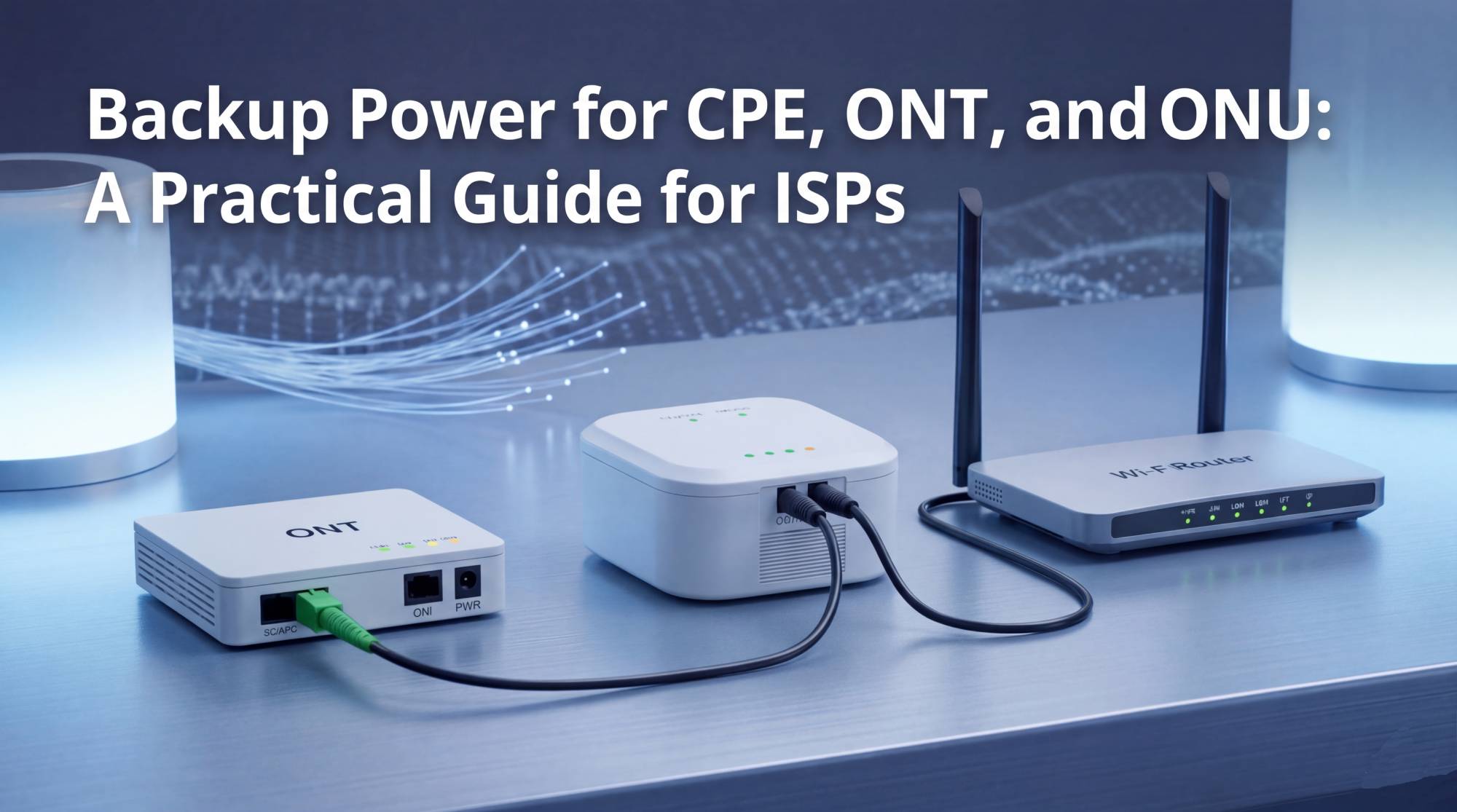
Competitive pressure among ISPs is driving service quality differentiation beyond mere bandwidth specifications. Providing backup power for customer premises equipment represents a tangible service enhancement that reduces support costs while improving subscriber experience. In emerging markets and regions with aging electrical infrastructure, power reliability issues create chronic network availability problems that backup power solutions directly address.
USB-C Power Delivery (PD) is emerging as an important power architecture for next-generation networking equipment. MYLION’s MUC85 product line addresses this transition, supporting backup power for devices abandoning traditional DC barrel connectors in favor of USB-C input. As equipment manufacturers adopt USB-C PD, ISPs will require compatible backup solutions—a capability gap many traditional UPS suppliers have not yet addressed.
Risk Alerts: Improper Specification and Deployment Failures
A significant hidden risk in FTTH backup power deployment involves improper product matching. Many buyers select DC UPS products based solely on the power adapter’s labeled current rating without measuring the device’s actual operating current. Real-world device consumption often differs substantially from adapter ratings, which typically include safety margin. Undersized backup units may fail during high-load conditions or device startup, while oversized units increase cost unnecessarily.
Connector incompatibility represents another common deployment failure. The proliferation of physically similar but electrically different DC connectors (varying in barrel diameter, pin size, and polarity) creates matching challenges. Without careful verification, purchased backup units may arrive with incompatible connectors, delaying deployment and requiring costly adapter cables that introduce additional failure points.
Standardization Direction: Industry Movement Toward Unified Specifications
The telecommunications equipment industry would benefit from greater standardization in subscriber premises power specifications. Currently, different equipment manufacturers employ varying voltage levels, connector types, and power architectures for functionally similar devices. MYLION participates in industry technical exchanges aimed at promoting best practices for backup power deployment, including proper runtime calculation methodologies, connector standardization advocacy, and safety requirement frameworks for lithium battery systems in residential installations.
Section 4: Company Value – MYLION’s Technical Contributions to FTTH Backup Power
MYLION’s specialized focus on Mini DC UPS and telecom BBU solutions has generated substantive technical capabilities that advance industry practice. With over 13 years of battery pack development experience, the company has accumulated detailed knowledge of real-world device power characteristics, deployment constraints, and failure modes specific to FTTH and ISP applications.
The company’s engineering-driven approach emphasizes application matching over generic product sales. MYLION’s technical support process assists customers in documenting actual device specifications, measuring operating current, calculating appropriate battery capacity for target runtime, and verifying connector compatibility before production commitment. This methodology helps customers avoid the common pitfalls of improper specification that plague backup power deployments.
MYLION’s product development roadmap responds directly to observed market needs. The company’s portfolio spans standard 12V DC UPS models (MU68, MU26, MU48), high-current telecom BBU units for demanding gateway applications (MU35, MU65), space-saving inline designs for FTTH installations (MUJ46), USB-C PD backup solutions for modern equipment (MUC85), higher-voltage options for 24V/48V professional equipment (MU248), and LiFePO4-based systems for enhanced battery safety (ML1202AC). This range enables specification matching across diverse FTTH deployment scenarios.
The company supports project-based customization including private labeling, connector modification, cable customization, capacity adjustment, and certification coordination. For ISPs and distributors deploying backup power at scale, MYLION provides OEM/ODM capabilities that enable brand-specific solutions while leveraging the company’s technical platform and supply chain infrastructure.
MYLION’s compliance support framework addresses the complex requirements of international lithium battery shipment, including UN38.3, MSDS, shipping documentation, and transport labeling. The company’s quality discipline encompasses incoming material control, production process inspection, functional testing, and 100% outgoing inspection before shipment—procedures essential for maintaining consistency across volume production runs.
Section 5: Conclusion + Industry Recommendations
DC UPS systems designed specifically for FTTH customer premises equipment represent an essential infrastructure component for modern broadband networks. These specialized backup power solutions address the fundamental vulnerability of subscriber-side networking equipment to power interruptions, voltage fluctuations, and grid instability. Unlike generic power banks or traditional AC UPS systems, purpose-built FTTH DC UPS products match the voltage, current, connector, and form factor requirements of ONTs, routers, gateways, and fiber modems deployed at subscriber locations.
For telecom operators and ISPs evaluating backup power deployment, success requires systematic specification matching rather than simple product procurement. Critical steps include documenting actual device power characteristics (not merely adapter labels), measuring real operating current including startup surge, verifying connector compatibility, calculating battery capacity for target runtime, and conducting sample testing before mass deployment. Engaging with specialized suppliers like MYLION that provide technical matching support can significantly improve deployment outcomes.
For system integrators and distributors serving the FTTH market, backup power solutions represent both a value-added service opportunity and a technical challenge requiring proper specification expertise. Building relationships with engineering-focused suppliers that support OEM/ODM customization, certification coordination, and technical documentation enables differentiated offerings aligned with specific market requirements.
For the broader telecommunications industry, continued advancement in FTTH backup power technology depends on several factors: ongoing battery technology improvement in energy density and safety, greater standardization in equipment power specifications and connectors, development of installation best practices, and recognition of backup power as an integral network reliability component rather than an optional accessory.
As fiber broadband penetration continues expanding globally, particularly in regions with less reliable electrical infrastructure, subscriber-side backup power will transition from differentiating feature to baseline expectation. Operators, equipment suppliers, and solution providers investing in proper backup power specification, deployment, and support capabilities position themselves to meet this evolving market requirement while reducing operational costs and improving subscriber satisfaction.
http://www.myliontech.com
Shanghai Mylion New Energy Co.,Ltd. -
AuthorPosts

- You must be logged in to reply to this topic.
 Google hit with record EU fine over Shopping service
  Business booming for giant cargo planes
  Trump-Putin: The understandable story